 Stéphanie Fournier
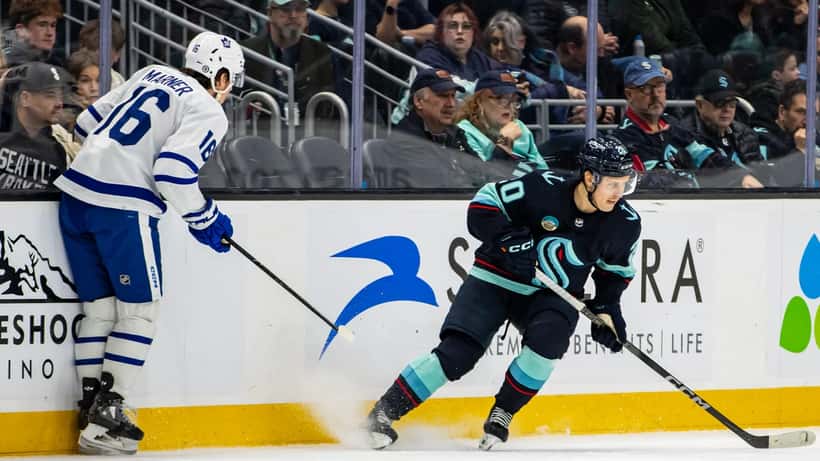
When Mitch Marner signed an eight-year, $96-million deal with the Vegas Golden Knights on June 30, 2025 — just hours before his unrestricted free agency would have kicked in — it looked like a clean break from Toronto. In practice, it was the culmination of a highly choreographed legal maneuver built around a specific provision in the NHL's Collective Bargaining Agreement. Now, as Marner leads all NHL playoff scorers with 18 points in 12 games for a Golden Knights squad advancing through the Western Conference Final, the contract that sent him west is worth examining closely.
The Mechanics of the Sign-and-Trade
A sign-and-trade in the NHL is a transaction that can only occur during a narrow window on the final day of a player's contract, before he becomes an unrestricted free agent at midnight local time on July 1. Under the CBA, the player and his original team negotiate and sign a new contract — and simultaneously agree to trade that contract to a third team.
For Marner, this meant the Toronto Maple Leafs retained his exclusive negotiating rights right up until June 30, 2025. Vegas could not approach him directly. Instead, both sides negotiated a framework in which Marner would sign with Toronto (retaining the 8-year maximum term available only when re-signing with one's own team), and Toronto would then trade that contract to Vegas in exchange for forward Nicolas Roy.
Had Marner waited even hours longer and become a UFA, Vegas could have signed him directly — but only to a maximum of seven years. By using the sign-and-trade structure, Marner secured an eighth year worth approximately $12 million, adding roughly $12 million to the total value of the deal that would not have been available to any other team in a direct signing.
Why the Eight-Year Term Matters
This is not a minor technicality. The eighth year is a significant financial and contractual lever that most players only have access to through the sign-and-trade mechanism. It comes with one critical legal constraint: only the player's current team can offer it. Once a player becomes a UFA and signs with a new club, the maximum term drops to seven years under Article 11 of the CBA.
The practical effect is that teams holding a star player's rights have a structural advantage in negotiations — and players who understand this can use it strategically to maximize their total contract value, even when they intend to change teams. Marner's camp, led by agent Darren Ferris, used this provision precisely as intended.
The total value of the eight-year deal is $96 million, at an average annual value (AAV) of $12 million per year. Over the life of the contract, the eighth year is worth an additional $12 million relative to what a UFA signing with Vegas could have provided.
What the CBA Actually Protects (and Limits)
The NHL CBA, negotiated between the NHL and the NHLPA, governs every aspect of player contracts — from entry-level deals to maximum salary limits, no-movement clauses, performance bonuses, and trade provisions. Understanding what players can and cannot negotiate is essential for any athlete at the professional level.
No-movement clauses (NMCs): A player with 10 or more years of NHL service (and seven with his current team) is eligible for a full no-movement clause, which prevents the team from trading, waiving, or assigning him without his written consent. Marner's contract with Vegas almost certainly includes such protections, though specific terms are not publicly disclosed.
Salary cap implications: Every NHL contract is subject to a salary cap — $88 million for the 2025-26 season. A $12M AAV represents approximately 13.6% of a team's entire cap space, meaning both the player and the team have to carefully structure the deal around the cap. Players earn real salary in each year; the "cap hit" (average annual value) is what counts against the ceiling.
Trade clauses vs. NMCs: Even without a full NMC, players can negotiate modified no-trade clauses (NTCs) that limit which teams can acquire them. A player may list 10, 15, or 20 teams to which he cannot be traded without consent. These clauses are a subject of direct negotiation and require experienced legal counsel to structure properly.
What Professional Athletes Should Know
Marner's deal illustrates a broader truth about professional sports contracts: the legal framework governing them is complex, time-sensitive, and full of provisions that significantly affect the player's financial outcome. The difference between understanding the sign-and-trade window and missing it is, in this case, approximately $12 million.
For any professional athlete — not just NHL players — having qualified legal counsel before major contract negotiations is essential. A sports lawyer can help identify provisions in a collective bargaining agreement that affect contract length, total value, movement rights, and performance incentives. An experienced agent brings market knowledge; a sports lawyer brings the contractual framework.
The stakes are high enough that athletes often assemble a full team: an agent for negotiation, a lawyer for contract review and dispute advice, and a financial advisor to manage the wealth that results. When all three roles are filled by people who communicate with each other, the athlete is far better positioned to maximize the value of their career.
For current and former professional athletes in Canada who have questions about the terms of their contracts, their rights under a collective bargaining agreement, or their options in a potential trade or dispute, a sports lawyer is the starting point. The NHLPA's official CBA resources are also publicly available and provide a foundation for understanding the framework.
See also: our coverage of the Pettersson contract dispute and NHL buyout options, and what the Michael Hage situation revealed about NHL player rights.
Disclaimer: This article is for informational purposes only and does not constitute legal advice. Consult a qualified lawyer for advice specific to your situation.
