 Olivia Dubois
When Buffalo Bills linebacker Michael Hoecht tore his right Achilles tendon in Week 9 of the 2025 NFL season, it wasn't just a sports headline — it was a career-altering moment that millions of recreational athletes across Canada could learn from. Hoecht, who had signed a three-year, $21 million contract with the Bills just months earlier in March 2025, found himself sidelined for the remainder of the season. Activated off injured reserve in February 2026 and now targeting the Bills' September 13 season opener against the Houston Texans, his recovery journey offers a sobering lesson for every weekend warrior who has ever heard — or ignored — that sudden pop in the back of their calf.
The Injury That Changed Everything for Hoecht
Hoecht's Achilles tear occurred during a high-intensity defensive play in the Bills' Week 9 contest against the Kansas City Chiefs. The mechanism — a sudden push-off or lateral cut — is nearly identical to what happens during a recreational hockey game in Mississauga, a Sunday soccer match in Vancouver, or a competitive tennis set at a suburban club in Calgary.
The Achilles tendon is the largest tendon in the human body, connecting the gastrocnemius and soleus calf muscles to the heel bone. Despite its thickness and tensile strength — capable of bearing forces up to ten times body weight — it is paradoxically one of the most vulnerable to complete rupture, particularly in male athletes aged 30 to 50 who engage in explosive stop-and-start sports.
What makes Hoecht's situation instructive for Canadian athletes is not just the injury itself, but the speed and quality of his medical response. NFL players receive immediate sideline evaluation, advanced imaging within hours, and surgical consultation within days. That rapid-response chain is a major reason Hoecht's prognosis is optimistic — and a template that recreational athletes rarely have access to, unless they know to ask.
What the Recovery Timeline Reveals
Hoecht was placed on injured reserve shortly after his injury in November 2025 and was formally activated in February 2026 — approximately three to four months post-surgery. His target for a return to full practice and competition is July 2026 training camp, with his eyes set on the September 13 Bills opener. That puts his full recovery arc at approximately ten months from injury to competitive return.
Even with the best medical team money can buy, ten months is the baseline for a complete Achilles rupture in an elite athlete performing explosive movements at the highest level of professional football. For recreational athletes in their 30s and 40s, that window often stretches to twelve months or beyond — particularly when surgical intervention is delayed.
According to data published by the Canadian Institute for Health Information, musculoskeletal conditions represent one of the most common causes of emergency visits and disability claims among working-age Canadians. Achilles tendon ruptures account for a disproportionate share of sports-related lower limb injuries, with rates climbing significantly among men aged 30 to 49 over the past decade.
The injury typically requires surgical repair followed by an intensive physiotherapy protocol. Conservative (non-surgical) management exists for partial tears or lower-activity patients, but this distinction requires expert assessment — not a Google search or a pharmacist's recommendation.
When You Need More Than a Family Doctor
A family physician can perform an initial bedside screening using the Thompson squeeze test — gently compressing the calf to assess whether the foot responds with plantar flexion. A negative response strongly suggests a complete rupture. What happens next, however, determines everything.
Sports medicine specialists and orthopedic surgeons with lower-limb expertise are the appropriate next step. They bring three capabilities that generalist practitioners cannot easily replicate: precise ultrasound or MRI interpretation of the tear's extent and location; surgical versus conservative management recommendations based on your age, activity level, and injury characteristics; and evidence-based rehabilitation protocols that significantly affect your return-to-sport odds.
In Canada, access to these specialists varies widely by province. Ontario and British Columbia have urgent sports medicine pathways that can deliver specialist consultations within days for clearly time-sensitive injuries. In other provinces, elective referrals can take weeks to months — which is exactly why understanding how to advocate for an expedited referral is as important as knowing when to go.
The critical window is the first 48 to 72 hours. After that, the ruptured tendon ends begin to retract, scar tissue starts forming, and the surgical repair becomes more technically complex. Surgeons who operate within this window achieve cleaner repairs with better tissue-to-tissue apposition — directly improving long-term strength and flexibility outcomes.
Concrete Case: The 41-Year-Old Beer League Hockey Player
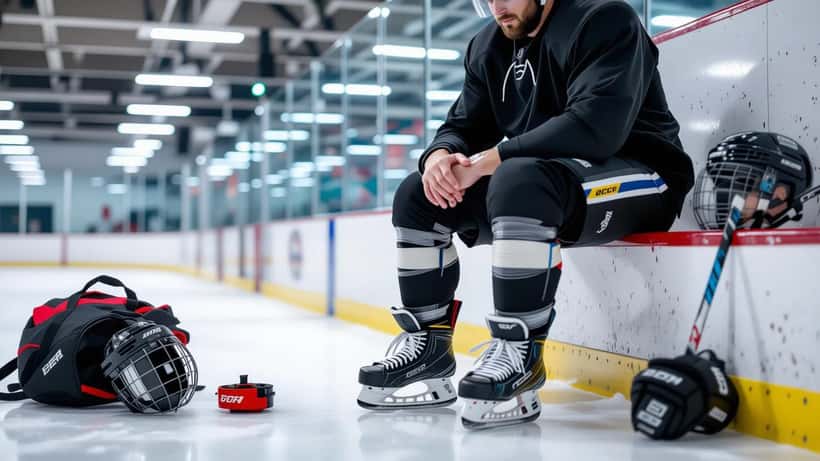
Picture a 41-year-old man who plays twice-weekly beer league hockey in Mississauga. Fit enough, no chronic conditions, no previous Achilles issues. On a Thursday night in October 2026, he makes a hard push-off toward the puck and hears a sharp snap. His leg buckles. A teammate jokes that someone shot him. The rink medic says it's probably a bad sprain. He drives home, ices it, takes two ibuprofen, and decides to wait until Monday to call his doctor.
Here is what the data says about those four days:
If he calls an urgent care clinic Friday morning and is assessed by a sports medicine specialist by Saturday: Ultrasound confirms a complete tear. He is referred to an orthopedic surgeon and is in the operating room within seven to ten days, before significant retraction has occurred. His rehabilitation timeline runs four to six months. According to orthopedic outcomes literature, return-to-sport at prior performance level for recreational athletes in this scenario is approximately 85 to 90%.
If he waits until the following Monday and sees his family doctor, who refers him for an elective orthopedic consult: He receives that consult in three to five weeks. By then, tissue retraction has occurred. Surgery is more complex, potentially requiring a tendon-lengthening procedure or graft. His recovery extends to nine to twelve months. Return-to-sport probability at prior level drops to approximately 65 to 70%. The risk of re-rupture within the first two years post-surgery also increases.
The financial dimension compounds this. Provincial health insurance in Canada covers the surgical consultation and the procedure itself. Physiotherapy — which is essential throughout recovery — is typically out-of-pocket unless covered by employer benefits. In Ontario, physiotherapy sessions average $80 to $130 per session. A standard Achilles recovery protocol involves two to three sessions per week for the first three months, tapering to one session per week thereafter. Total rehabilitation cost for a six-month recovery: approximately $2,500 to $4,500. For a twelve-month recovery, that figure can exceed $7,000.
Understanding these numbers in advance — and reviewing your extended health benefits coverage before you're injured — is the kind of planning a financial or benefits advisor can walk you through. It rarely happens, but it should.
What to Do If It Happens to You
Michael Hoecht's path back to the NFL demonstrates what is possible with immediate, expert-led care. It also highlights what recreational athletes in Canada must advocate for themselves, since the system will not automatically route them to the right specialist in the right window.
If you hear or feel a sudden pop at the back of your ankle during physical activity, do not wait until the next available appointment with your family doctor. Go to an emergency department or an urgent care sports medicine clinic that day. Request ultrasound imaging. Ask explicitly whether an urgent orthopedic or sports medicine referral is warranted and what the typical wait time is for urgent versus routine referrals in your region.
The Thompson test your doctor performs in the office takes under sixty seconds. The conversation about surgical timing, rehab protocols, and return-to-sport goals takes another fifteen minutes. That combination — early imaging, early specialist access, early structured rehabilitation — is what separates an eight-month recovery from a fourteen-month one.
Hoecht has made headlines for his discipline and dedication during his rehab. His coaches and teammates have praised his approach. But the bigger story, for the 4.2 million Canadians who play recreational sport regularly, is simpler: what happened to him can happen to you, and the first 48 hours are the most important hours in your entire recovery.
A sports medicine or orthopedic consultation is not an overreaction. It is the difference between getting back on the ice in spring and still watching from the stands in winter.
This article is intended for informational purposes only and does not constitute medical advice. If you suspect a musculoskeletal injury, consult a qualified healthcare professional.
