 Adèle Chartrand
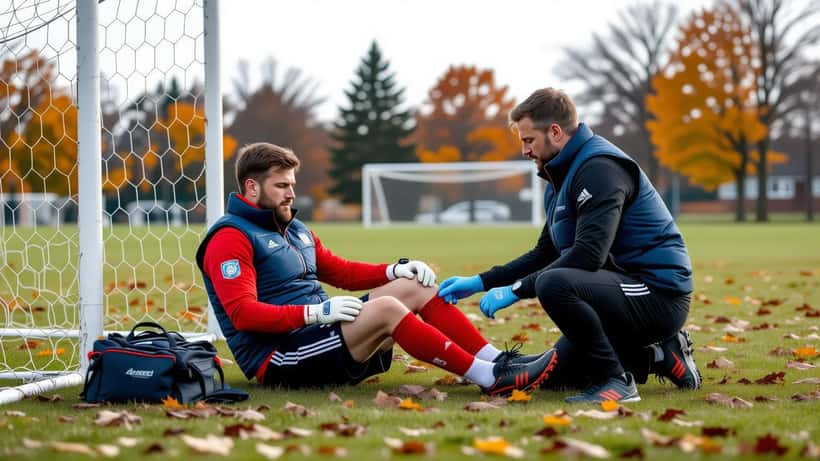
The sold-out international friendly between Mexico and Peru at Sports Illustrated Stadium in Harrison, New Jersey, on September 29, 2026 drew tens of thousands of Latin American fans — and inspired countless more Canadians to dust off their cleats this fall. What few of those weekend warriors realize, however, is that soccer consistently ranks as one of the top causes of sports-related emergency visits in Canada, accounting for 21 per cent of all sports injuries treated in Canadian hospital emergency departments, according to data from the Canadian Hospitals Injury Reporting and Prevention Program (CHIRPP). As excitement from the match spills over into fall leagues this week, sports medicine professionals across the country are urging recreational players to think before they sprint.
One Goal, Thousands of Inspired Players
Jairo Vélez's decisive opener for Peru on September 29 set off celebrations from Vancouver to Halifax — and, health experts say, triggered exactly what happens every time a marquee international match captivates the public imagination: a surge in amateur play followed by a predictable wave of preventable injuries.
Canada is home to an estimated 860,000 residents of Peruvian and Mexican origin, according to Statistics Canada community estimates. Sports medicine clinics and physiotherapy practices across the country typically report a 15 to 25 per cent increase in new patient bookings from recreational soccer players in the two to three weeks following major international fixtures. Coaches of community leagues in Toronto, Montréal, Vancouver, and Calgary confirm the pattern every time: a big international match drives registrations, fills practice pitches, and, within a fortnight, fills appointment books.
That dynamic has a name among Canadian sports medicine professionals: the "fan effect" — when spectator enthusiasm directly translates into amateur participation, often without adequate physical preparation, appropriate rest between sessions, or even a visit to a sporting goods store for properly fitted footwear.
Soccer's Real Injury Toll in Canada
The numbers make sobering reading. Between 2007 and 2010 alone, 11,941 soccer injuries were recorded across participating Canadian eCHIRPP hospital emergency departments, out of 56,691 total sports-related injury cases — placing soccer at 21 per cent of all presentations. Injury rates in recreational and adolescent players range from 0.51 to as high as 18.4 injuries per 1,000 playing hours, a wide band that reflects just how dramatically surface conditions, footwear quality, warm-up discipline, and fitness baseline affect outcomes.
The most common injury types break down as follows: sprains and strains (38 per cent), fractures and dislocations (31 per cent), and superficial cuts and contusions (23 per cent). Head injuries represent a further category of concern, with 3,970 soccer-related head injury cases tracked in one multi-year eCHIRPP analysis.
What makes fall soccer in Canada distinctly dangerous is a convergence of risk factors that do not apply to summer play: cooler temperatures reduce muscle elasticity and extend the time needed for warm-up; natural grass pitches harden as soil moisture drops; and players return after months of reduced lateral movement training during the summer. Each factor independently raises injury risk. Together, they create conditions where a perfectly routine tackle or directional change can end someone's season — or worse.
What Elite Matches Reveal About the Amateur Risk Profile
The Mexico vs Peru friendly showcased the kinds of high-speed, high-impact movements that define modern soccer: explosive 40-metre sprints, sharp changes of direction within a stride, contested aerial duels, and sustained physical effort across 90-plus minutes. For professional athletes, these movements are the product of years of progressive physical conditioning, daily access to physiotherapists and team doctors, and carefully structured recovery windows between matches.
Amateur players who watch elite soccer — and return to a community pitch to replicate those movements — face a fundamentally different risk profile. Canadian sports medicine specialists consistently note that the most serious recreational injuries do not come from direct contact, but from non-contact mechanisms: the planted foot that does not release cleanly, the ankle that rolls on an uneven section of artificial turf, or the knee that torques awkwardly during a sudden deceleration after chasing a loose ball.
Anterior cruciate ligament (ACL) tears are a particular concern. Canadian orthopaedic surgeons report that ACL injuries among recreational soccer players have increased approximately 12 per cent over the past decade, with adults aged 30 to 50 — often returning players inspired by major international events — representing the fastest-growing demographic. Recovery from a full ACL rupture typically requires 9 to 12 months of rehabilitation before return to sport, and surgical costs in Canada range from fully covered under provincial health insurance to $4,000–$8,000 for private facilities in provinces where public wait times extend beyond a year.
The Real Cost of Skipping the Pre-Season Check
Consider a scenario playing out across Canada this week. A 38-year-old logistics supervisor in Mississauga — a former recreational player who stopped playing five years ago — was inspired by the Mexico vs Peru match and registered for a fall outdoor league beginning October 5. He skipped a pre-season physical, assumed his old knee was "fine," and played in boots that no longer provided adequate ankle support after years of storage.
In his second match, a routine defensive change of direction leaves him with a Grade 2 lateral ankle sprain — the most common soccer injury in adult recreational players, affecting approximately 1 in 6 players each season. The financial impact cascades quickly:
- Two weeks off work: approximately $3,200 in lost income at Canada's median hourly wage of $32.39 (Statistics Canada, 2025)
- Physiotherapy: $450–$700 for a standard ankle sprain rehabilitation course, not covered under most standard employer health plans
- Risk of chronic instability: untreated Grade 2 sprains increase the likelihood of re-injury by up to 70 per cent within the first 12 months
Had he visited a sports medicine specialist before the season — a consultation costing $150 to $300 in most Canadian provinces, often partially covered by extended health benefits — the specialist would have identified weakened peroneal tendons from five years without lateral training and prescribed a four-week ankle strengthening protocol plus a boot replacement. Total preventive investment: under $400. Total reactive cost after injury: $3,600 to $4,500, not counting pain and missed playing time.
The rule is clear: if a recreational player returns to soccer after more than two years of inactivity without a health assessment, their risk of a significant lower-limb injury in the first two months of play increases by approximately 40 per cent, according to Sports Medicine Canada guidelines. That risk multiplier is almost entirely avoidable.
Red Flags That Mean You Should Book Before You Play
Sports medicine professionals recommend a pre-season consultation before returning to soccer if any of the following apply:
- You have not played regularly in the past 18 months
- You are over 35 and joining a competitive league for the first time in years
- You carry a previous knee, ankle, or hip injury that "feels fine most of the time"
- You plan to play primarily on artificial turf (injury rates for certain lower-limb injuries are 14 to 22 per cent higher on synthetic surfaces than natural grass)
- You experienced recurring muscle cramps or tightness in pre-season warm-ups this year
Concussion awareness deserves separate emphasis. Parachute Canada, the national injury prevention organization, recommends a baseline neurocognitive assessment for any player with a history of head trauma before the start of a new season. Soccer's heading mechanics — still in use across most Canadian adult recreational leagues — expose players to repeated sub-concussive impact events that accumulate over a season.
This article provides general health information and is not a substitute for professional medical advice. Consult a qualified healthcare provider for diagnosis, treatment, or questions about your personal health situation.
Connect With a Specialist Before Your First Match
Canada's sports medicine system offers multiple access points: family physicians with sports medicine training, CASEM-certified sports medicine specialists, registered physiotherapists (accessible without a referral in all Canadian provinces), and orthopaedic surgeons for surgical cases. The most accessible starting point for most recreational players is direct physiotherapy booking or a request for a sports medicine referral through a family doctor.
Expert Zoom connects Canadians with verified health specialists nationwide — from physiotherapists and sports medicine doctors to general practitioners who can order imaging and provide onward referrals. If the final score in New Jersey has you motivated to get back on the pitch, that motivation is worth protecting.
The final whistle in Harrison has already sounded. What happens on your pitch this weekend is still in your hands.
