 Megan Thériault
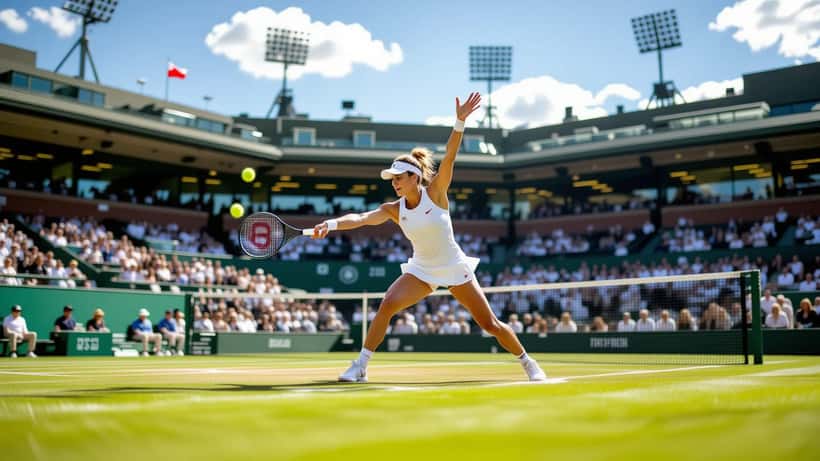
As the 2026 grass-court season reaches its climax at the All England Club, Czech rising star Linda Nosková has become one of the most searched names in Canadian tennis circles. Her blend of aggressive baseline hitting, improved serve consistency, and calm on-court problem solving has turned heads through the European warm-up events, and Wimbledon 2026 now offers the biggest stage yet to test whether that progress can translate into a deep Grand Slam run. For fans and analysts alike, the question is no longer whether Nosková belongs among the tour’s dangerous floaters, but how far her current form can carry her.
The interest around Nosková is about more than rankings or highlight reels. It reflects a wider trend in professional sport: the growing appetite for specialist insight that can decode performance under pressure. Whether the conversation turns to biomechanics, tactical preparation, sports psychology, or injury prevention, athletes at every level are increasingly supported by external experts who help them turn raw talent into repeatable results. That is precisely where an expert consultation marketplace becomes relevant, because it mirrors the ecosystem now surrounding players like Nosková.
What makes her Wimbledon 2026 storyline compelling is the timing. After a steady climb through the rankings and a strong showing in the lead-up tournaments, she arrives in London with momentum rather than simply hope. Her game is built for grass more than casual observers might assume: a flat, penetrating forehand, an ability to take the ball early, and a willingness to finish points at the net. Those traits matter on the slick lawns of SW19, where reactive footwork and first-strike tennis often separate contenders from early-round casualties.
Still, grass rewards experience. Reading low bounces, adjusting to unpredictable skips, and managing the unique physical load of the surface all take time. Analysts who have tracked her development note that Nosková’s camp appears to have addressed those details methodically. Reports from her pre-Wimbledon preparation suggest a focus on first-serve placement and return positioning, two areas that can produce free points on grass and reduce the physical toll of long rallies.
The marketplace of expert advice operates in a similar way. A tennis player might consult a sports physician to manage wrist or shoulder load, a data analyst to scout opponents, or a mental-performance coach to handle the isolation of a two-week Grand Slam. The same logic applies to anyone facing a high-stakes performance moment, from an executive preparing for a board presentation to a homeowner planning a major renovation. Expert Zoom was built on the premise that the right specialist, consulted at the right time, can change the trajectory of an outcome.
In that sense, Nosková’s Wimbledon campaign is a useful case study in expert-driven improvement. Her coaching team has clearly shaped her tactical identity, but the invisible support network around a modern player, physiotherapists, nutritionists, analysts, and psychologists, is often what keeps a season from derailing. Canadian audiences searching for context on her progress are not just following a player; they are observing how elite performance is constructed.
Some of that context already exists in our archive. Sports analysts recently examined Coco Gauff’s 2026 tennis season outlook, noting how structured expert support has helped the American refine her serve and decision-making. Meanwhile, our French-language preview of Wimbledon 2026 expert predictions breaks down the surface-specific variables that analysts weigh before the draw is made. For readers who want a closer look at Nosková herself, our earlier coverage of her Berlin final run explores the sports-medicine signals that often accompany a breakthrough week.
There are also cautionary notes worth keeping in mind. A good grass season does not guarantee Wimbledon success. The draw, the weather, and the day-to-day variance of best-of-three-set matches in the early rounds can derail even well-prepared favorites. For Nosková, the key will be to translate her evident confidence into disciplined match management. That means choosing the right moments to attack, accepting that some unforced errors are part of an aggressive game plan, and recovering quickly from sets that do not go her way.
From a consultation perspective, those challenges are familiar. Any specialist who works with performers, whether in sport, law, finance, or health, knows that preparation is only half the battle. The other half is adaptability: the capacity to adjust a plan when conditions change. Wimbledon is famously good at producing those moments. A rain delay, a switch to Court 1, a bad line call, or a suddenly inspired opponent can all demand mental flexibility. The athletes who handle those variables best are usually the ones with robust support systems.
Nosková’s 2026 Wimbledon run also raises interesting questions about how young players are marketed and discussed. In an era of algorithm-driven sports coverage, a single good week can produce outsized expectations. Expert voices, whether coaches, journalists, or data scientists, play an important role in tempering hype with measured analysis. That balance matters for fans who want to understand what they are actually watching, not just who is trending.
For Canadian readers, the story carries an extra local angle. Tennis participation and viewership in Canada have grown steadily, and the country now produces its own cohort of internationally competitive players. Watching a European prospect like Nosková navigate Wimbledon can offer useful reference points for how Canadian talent is developed, supported, and eventually scaled. The same expert networks that surround top WTA players are increasingly available to regional academies and ambitious amateurs.
If Nosková does make a deep run at Wimbledon 2026, the narrative will almost certainly focus on her shot-making and composure. Beneath the surface, however, it will also be a story about preparation, specialist input, and the ability to execute a plan under pressure. Those are the themes that connect elite sport to everyday decision-making. Whether someone is choosing a wealth manager, a veterinarian, an IT specialist, or a home-improvement contractor, the underlying question is the same: can I trust this expert to help me perform better than I would on my own?
That is the promise of Expert Zoom. By connecting users with verified specialists across categories such as health, legal, mechanics, information technology, and general consulting, the platform turns abstract curiosity into actionable guidance. Just as Nosková’s team relies on targeted expertise to prepare for the biggest tournaments, individuals and businesses can use on-demand consultations to solve problems faster and with greater confidence.
As the 2026 Wimbledon fortnight unfolds, Linda Nosková will be one of the names to watch. Win or lose, her trajectory illustrates a broader truth: in complex, high-stakes environments, expertise is not a luxury. It is the infrastructure that turns potential into performance.
