 Olivia Tremblay
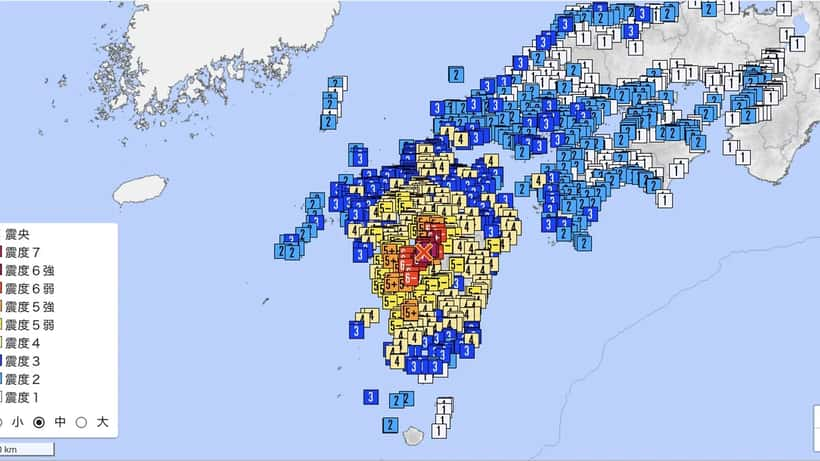
The Nikkei 225 closed at 64,179 points on August 19, 2026 — down nearly 1.89% in a single session — as Japan's investment landscape absorbed a rare convergence of seismic disruption, central bank uncertainty, and currency volatility. At the centre of the seismic story is the July 28 Kumamoto earthquake: a magnitude 7.1 event that struck Kyushu. It killed more than 30 people, injured over 350, and destroyed or damaged upward of 800 homes in the town of Hikawa alone. For the growing cohort of Canadian investors who added Japan equity exposure in 2026 — a year that began with the Nikkei posting double-digit gains — the timing raises an uncomfortable question: what does this compounding risk mean for portfolios right now?
Japan's 2026 Seismic Sequence: Two Earthquakes, One Compounding Risk
The Kumamoto earthquake was not an isolated event. Japan has endured two major seismic shocks in 2026. On April 20, a magnitude 7.5 earthquake struck the Tōhoku and Hokkaido regions — the Sanriku earthquake — injuring at least 10 people and rattling the same northeastern coastline most scarred by the 2011 disaster. The July 28 Kumamoto quake proved more destructive: 3,600 Self-Defence Force personnel were deployed, the death toll climbed past 30 by the final day of July according to NPR, and aftershocks continued through August as confirmed by Japan's seismic monitoring authorities.
The dual-event pattern matters for investors beyond its humanitarian scale. Two major earthquakes in different regions within the same calendar year places simultaneous pressure on municipal disaster budgets, national insurance reserves, and regional supply chains. The Kumamoto region is a critical node in Japan's semiconductor and automotive manufacturing network — Toyota, Sony, and TSMC all maintain Kyushu facilities. Disruption in that cluster propagates outward quickly.
Key figures at a glance:
- April 20, 2026 — M7.5 Sanriku earthquake, Tōhoku/Hokkaido: 10 injuries
- July 28, 2026 — M7.1 Kumamoto earthquake, Kyushu: 30+ deaths, 350+ injuries, 800+ homes destroyed or damaged
- Nikkei 225 (August 2026) — approximately 64,179 points, down roughly 1.89% in recent sessions
- 3,600 — Self-Defence Force personnel deployed to Kumamoto relief operations
- CI Japan Equity Index ETF — approximately +11.12% year-to-date in 2026 before the seismic sequence began
The Nikkei's Split Reaction and Why It Is More Complicated Than a Simple Drop
The market response to the Kumamoto earthquake has not been uniformly negative — and that nuance is precisely what confuses Canadian investors watching their brokerage statements.
Construction-related stocks actually rose in the immediate aftermath of July 28. Markets priced in reconstruction demand, with major engineering firms registering buying interest. Meanwhile, retailers with significant Kyushu footprints — including Aeon — and paper producers such as Nippon Paper faced selling pressure, according to Bloomberg analysis published in the hours following the quake.
The broader Nikkei decline in August 2026 reflects a layered macro story that extends well beyond earthquake news. Japan's consumer price inflation accelerated for a second consecutive month, reinforcing market expectations for a Bank of Japan rate hike in the near term. A coordinated yen intervention by Japanese and U.S. monetary authorities drove the yen to a three-month high against the dollar, squeezing the export-reliant companies whose earnings had been inflated by the previous weak-yen environment. Bond market anxiety — with surging yields dampening risk appetite in the AI trade — delivered an additional headwind in mid-August.
Canadian investors watching their Japan equity position decline are not seeing a simple earthquake story. They are seeing a seismic event layered on a central bank pivot layered on a currency shock. Disentangling those pressures — and deciding whether to hold, add, or reduce — is exactly the kind of portfolio challenge a wealth management specialist is equipped to address.
What Happens to a Canadian Portfolio When Japan Shakes: A Concrete Scenario
Here is what this situation looks like in dollar terms for a real investor.
Consider Alex, a 46-year-old professional in Calgary who built a $50,000 international equity position in early 2026 with deliberate Japan exposure. Alex was drawn by the structural bull thesis: the Nikkei's corporate governance reform dividend, rising shareholder returns, and a yen that made Japanese assets appear attractively priced in Canadian dollar terms.
Alex's Japan allocation breaks down as follows:
- $30,000 CAD in the CI Japan Equity Index ETF — CAD-hedged, tracking the WisdomTree Japan Equity Index
- $20,000 CAD in a diversified Asia-Pacific balanced fund with approximately 25% Japan equity weight
Scenario A — Nikkei declines a further 5% from August 2026 levels:
- CI Japan ETF loses approximately $1,500 CAD
- Asia-Pacific fund loses approximately $250 CAD (25% weight × $20,000 × 5% decline)
- Combined portfolio impact: roughly $1,750 CAD on the Japan-exposed positions alone
Scenario B — The yen strengthens a further 3% against the CAD (BOJ rate hike scenario, unhedged positions):
- Alex's CAD-hedged ETF is partially insulated from currency movement
- But the Asia-Pacific fund almost certainly holds some unhedged Japan equity — currency translation erases a portion of JPY-denominated gains even if the underlying stocks hold steady in yen terms
- Net effect: meaningful drag on the Asia-Pacific fund that does not appear in any Nikkei headline Alex reads
What Alex cannot see from a standard portfolio dashboard: whether the Asia-Pacific fund is overweight or underweight Japan relative to its benchmark; whether it holds construction stocks positioned to benefit from reconstruction spending or retailers exposed to the Kyushu consumer shock; and whether the CAD-hedge on the ETF rolls efficiently at current yen volatility levels. At Alex's position size, a 10% Nikkei correction represents a $3,000 hit to the Japan ETF alone, before any currency effects on the broader fund. A wealth advisor with Asia-Pacific expertise can stress-test that exposure against actual portfolio data — not generic market benchmarks.
You can see how other Canadian investors have navigated geopolitical market shocks in this article on Iran nuclear talks and investor portfolio risk.
The Reconstruction Premium: A Counter-Argument Worth Knowing
Investors tempted to exit Japan exposure entirely should consider the historical reconstruction premium embedded in Japan's disaster response cycle.
After the 1995 Kobe earthquake, Japanese construction and infrastructure firms outperformed the broader Topix over the following twelve months. After the 2011 Tōhoku disaster — vastly larger in economic magnitude than Kumamoto — Japan's materials and infrastructure sector recovered and outperformed within eighteen months of the initial shock. The 2026 Kumamoto event is substantially smaller in scale, which suggests the reconstruction tailwind may materialise more quickly this time.
The caveat is important: this pattern holds when the macro backdrop cooperates. A BOJ rate hike cycle that overshoots its natural stopping point, or a yen that strengthens past the level Japanese exporters can absorb, can neutralize the reconstruction premium by suppressing the large-cap exporter earnings that dominate Nikkei weighting. Japan's August 2026 situation — earthquake disruption, rate normalization, and currency strength pulling simultaneously — is unusual precisely because those forces do not all point in the same direction. For a Canadian investor deciding whether to treat this as a buying opportunity or an exit signal, the macro layer matters as much as the seismic one. You can explore how commodity-linked volatility interacts with international portfolio positions in this analysis of oil price volatility and Canadian wealth management strategies.
What to Do Before the Next Aftershock
The Japan Meteorological Agency — Japan's authoritative body for seismic monitoring — confirms that the Kyushu region remains in an elevated aftershock probability period following the July 28 event. Ongoing tremor activity means Canadian investors should expect continued earthquake-related news flow from Japan throughout the third quarter of 2026, creating windows for both short-term volatility and longer-term repositioning decisions.
Three concrete steps worth discussing with a wealth management professional before the next aftershock makes headlines:
1. Map your actual Japan exposure across all funds. Many Canadian balanced funds and global equity ETFs include Japan as 5–12% of the portfolio without listing it prominently in product names. Request your fund's geographic breakdown from your advisor and identify both direct Japan weight and the hedged-versus-unhedged split. The difference between a hedged and an unhedged position in a yen-appreciation scenario can mean hundreds of dollars on a $20,000 position.
2. Establish your rebalancing trigger in advance. If your Japan position declines more than 10–15% from its cost basis, do you add on weakness as a disciplined rebalancer, or trim to contain downside risk? This decision should be pre-committed in your investment policy statement — not improvised reactively during a breaking news cycle when emotions run high.
3. Separate the earthquake narrative from the structural macro story. The BOJ rate hike trajectory and yen appreciation are structurally more significant to a long-term Japan investment thesis than the Kumamoto aftershocks. A good wealth management advisor helps you distinguish between seismic noise — temporary and recoverable — and genuine thesis breaks that warrant a real portfolio change.
Japan in 2026 is not a broken investment case. It is a more complex one than it was in January. For Canadian investors, the difference between those two statements is worth clarifying with a professional before the next headline hits.
Disclaimer: This article provides general informational content only and does not constitute financial or investment advice. All investment decisions should be made in consultation with a licensed financial advisor or portfolio manager registered in your province.
