 Patrick Roy
A 25-kilometre circular scar in Quebec's Côte-Nord region has just been confirmed as one of the largest meteorite impact craters ever identified in Canada, and the discovery is quietly raising a very practical question for homeowners: what exactly sits beneath our foundations? On July 14, 2026, researchers from Western University in Ontario and the European Center for Research and Teaching in Environmental Geosciences confirmed that the depression amateur astronomer Joël Lapointe first spotted on Google Maps is the Uhaachatik Crater, a 390-million-year-old impact site centred on Lake Marsal.
The find is spectacular science. But for anyone building, buying, or renovating a home on the ancient rock of the Canadian Shield, the crater is also a useful reminder that the ground under Quebec is older, harder, and more fractured than most people assume.
What researchers actually found
According to Western University, the team confirmed the crater's origin by identifying shatter cones and impact melt rock, two signatures that only form under the extreme pressure of a meteorite strike. Named after consultation with the Ekuanitshit Innu council, Uhaachatik is now counted among roughly 200 confirmed impact craters on Earth and just 31 known in Canada. Lapointe's discovery took two years to travel from a cursor click to a peer-reviewed paper.
The impact shattered the surrounding bedrock hundreds of millions of years ago, fracturing rock across a wide zone. That word, "fractured," is where a remote scientific curiosity connects to everyday home ownership across the province.
Why fractured bedrock matters at home
Much of Quebec sits on the Canadian Shield, a vast expanse of some of the oldest exposed rock on the planet. Homeowners here rarely deal with the soft soils of southern Ontario or the Prairies. Instead, they build on, and often into, hard Precambrian bedrock that has been cracked and folded by geological events far older than the Uhaachatik strike.
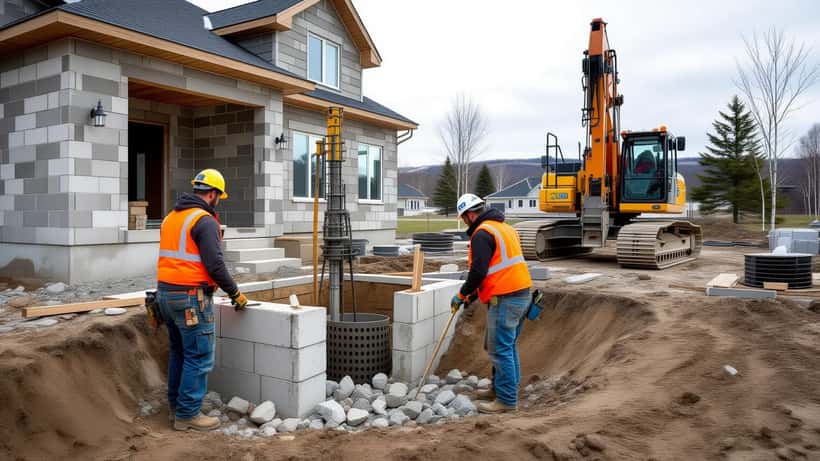
For a homeowner, fractured bedrock is not automatically a problem, but it changes how a house should be built and maintained:
- Foundations. Bedrock is an excellent, stable base, which is why Shield homes rarely suffer the settling seen in clay soils. But fractures channel water. If a foundation is poured over fissured rock without proper drainage, seasonal water can migrate straight toward the basement.
- Blasting and excavation. Digging a basement or a pool in bedrock often means blasting. The pattern of natural fractures affects how the rock breaks, how much vibration reaches neighbouring structures, and how much the job will cost.
- Wells. Rural Quebec homes frequently rely on drilled bedrock wells. Fractures are what actually deliver water to the well, but they can also carry surface contaminants downward if the casing is not sealed correctly.
None of these are reasons to avoid Shield property. They are reasons to understand the rock before you sign a contract.
The radon question
There is one issue that fractured bedrock makes especially relevant: radon. Radon is a naturally occurring radioactive gas produced by the breakdown of uranium in rock and soil, and fractures give it an easy path into basements. Health Canada notes that radon is the leading cause of lung cancer in non-smokers and recommends every home be tested, with action taken above 200 becquerels per cubic metre. You can read the federal guidance directly on the Health Canada radon page.
Testing is inexpensive and takes a few months to do properly over the winter heating season. Mitigation, when needed, is a well-established renovation involving a sub-slab depressurization system installed by a certified professional. This is a genuine health matter, so treat any radon result as information to discuss with both a mitigation specialist and, if levels are high, a medical professional.
When a home expert earns their fee
The Uhaachatik headlines make impact geology sound exotic, but the underlying lesson is ordinary: the rock beneath a house shapes the whole project. A qualified home-improvement or geotechnical professional can help you:
- Read a property before you buy. An expert can interpret a geotechnical report, spot drainage risks on sloping bedrock, and flag whether that "great deal" on rural Côte-Nord land will need costly blasting.
- Plan a basement or extension. Excavating bedrock is a specialized job. Getting a contractor who has worked with Shield rock avoids vibration damage and budget surprises.
- Protect against water and radon. From foundation waterproofing to radon mitigation, the fixes are routine when planned early and expensive when discovered late.
A short consultation before you buy or break ground almost always costs less than the repair it prevents. If you are weighing a rural or waterfront property, an expert can tell you in an afternoon what the rock will demand of your renovation budget.
A discovery that points back home
Lapointe's crater is a reminder that even a two-year-old cursor click can rewrite what we know about the Quebec landscape. It also underlines that the ground here has a long, violent geological history that still influences modern construction. The same fractured, ancient bedrock that recorded a meteorite strike 390 million years ago is what your foundation, your well, and your basement air quality depend on today.
The crater itself sits in remote wilderness, far from any home. But its lesson travels well: before you build on Quebec's ancient rock, it pays to know exactly what lies beneath. Those curious about the legal side of such discoveries can also read our explainer on who owns a meteorite or crater find in Canada.
