 Adèle Chartrand
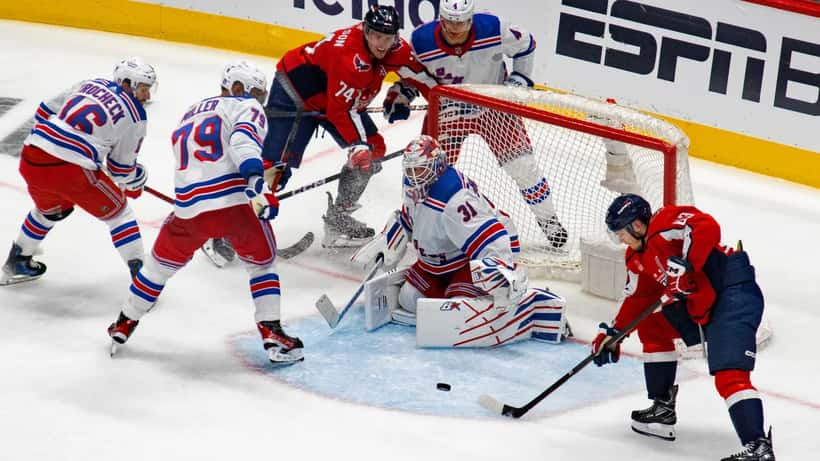
Rangers fans held their breath on October 9, 2026, when star goaltender Igor Shesterkin was helped off the ice during the first period of New York's game against the Washington Capitals at Capital One Arena. His right leg had struck the goalpost at pace, and he left the ice unable to bear weight — a detail that has become the single most discussed variable in every injury forum and fantasy hockey thread since. No official diagnosis has been released. Dylan Garand took over in net. And somewhere in every recreational sports league in Canada, a player with a recently banged-up leg is searching for the same answer Shesterkin's teammates were asking in the locker room: how serious is this, really?
What Happened in Washington
Shesterkin exited the Rangers' 2026-27 season opener against the Capitals after a lower-body incident that unfolded in full view of national television cameras. The Rangers, who were already without backup goaltender Joonas Korpisalo due to a separate lower-body issue, had no official timeline for their starter's return as of the morning of October 10, 2026. Coach Mike Sullivan declined to characterize the injury after the game, offering only that Shesterkin would be reassessed on Saturday.
The Rangers' silence is standard NHL injury protocol — but the image of a 30-year-old goaltender who cannot put weight on a leg is a clinically meaningful picture. In sports medicine, weight-bearing status after impact is not simply a comfort measure. It is a primary triage variable that determines the urgency of subsequent imaging and the window for optimal treatment.
Shesterkin had already missed significant time last season with a lower-body injury sustained during a January 2026 collision. He returned for the stretch run and was healthy for training camp. The recurrence of a lower-body concern this early in 2026-27 raises questions about load management, structural vulnerability, and the decision-making framework every competitive athlete — professional or recreational — should have in place.
Why Goalpost and Board Impacts Deserve Serious Attention
Ice hockey surfaces are engineered to be fast. The same physics that make skating exhilarating make contact injuries particularly concentrated. When a goaltender's leg strikes a goalpost — a fixed, rigid object — the force is absorbed across a contact surface of just a few centimetres rather than distributed across a body-to-body impact. The result is a higher localized stress on the bones, ligaments, and soft tissues of the lower leg.
According to the Canadian Physiotherapy Association, acute lower-limb injuries in ice sport typically fall into three categories: contusions (bruising to soft tissue), sprains (ligamentous stretching or tearing), and fractures. All three can initially present with the same constellation of symptoms: immediate pain, swelling within the first hour, and difficulty bearing weight. Without imaging, even experienced clinicians cannot reliably distinguish between them based on symptoms alone.
The key clinical signal is weight-bearing capacity in the first 30 minutes after injury. A player who cannot load the injured limb is presenting with one of the two most serious categories — significant ligamentous disruption or fracture — until imaging proves otherwise. The fact that Shesterkin was assisted off the ice rather than skating under his own power is not a minor detail. It is, in sports medicine terms, a flag that mandates same-day professional evaluation.
The 48-Hour Diagnostic Window
Sports medicine specialists consistently identify the first 48 hours post-injury as the most consequential for treatment outcomes. Within this window, the inflammatory response is still controlled, imaging is most predictive, and early interventions — whether immobilization, surgical consultation, or load-managed physiotherapy — produce measurably better outcomes than those deferred by even a few days.
For professional athletes like Shesterkin, a team physician, orthopaedic surgeon, and imaging suite are accessible within hours of any incident. For the roughly 2.5 million Canadians who play recreational hockey each season — a figure cited by Hockey Canada in its most recent participation report — the pathway to equivalent specialist care is rarely that direct.
Canada's publicly funded system provides emergency care for acute fractures, but the gap between "cleared at the emergency room" and "properly rehabilitated with a sports medicine protocol" is wide. An emergency physician will order plain X-rays and confirm or rule out gross fracture. They will not, in most cases, arrange MRI for ligamentous assessment, prescribe a graded return-to-play protocol, or identify a bone stress reaction that falls below plain-film detection threshold. That layer of care requires a sports medicine specialist — and accessing one within 48 hours often requires knowing exactly where to look.
The Martin Scenario: When a Three-Week Wait Costs $3,400
Consider a 34-year-old recreational hockey defenceman playing in a Saturday morning league in Calgary — we'll call him Martin. In November 2025, Martin's right ankle struck the boards hard during a scramble behind his own net. He managed to bear weight after a few minutes, which he read as a good sign. He iced it, took ibuprofen, and played again the following Saturday — and the Saturday after that.
By week three, the ankle was visibly swollen and his stride had become asymmetric. An urgent-care X-ray, ordered only after his spouse insisted, revealed a non-displaced lateral malleolus fracture with a 2-millimetre gap — a gap that was not present in a similar injury sustained by a teammate who had sought care within 24 hours of impact.
Martin's treatment pathway: six weeks non-weight-bearing in a cast, followed by eight weeks of physiotherapy at $120 per session, twice weekly. Total out-of-pocket physiotherapy cost: approximately $1,920. His teammate, diagnosed on day one and fitted with a walking boot immediately: four weeks of modified activity, four weeks of physiotherapy. Total: approximately $960.
The direct financial delta was $960. The indirect cost — Martin works as a self-employed electrician — added roughly $2,400 in lost billable time during the six-week casting period. The real cost of a three-week diagnostic delay: approximately $3,400. If Martin had consulted a sports medicine physician within 48 hours of that collision with the boards, the fracture would have been identified, the walking boot prescribed immediately, and the consolidation timeline compressed by an estimated six weeks.
Five Signs Your Sports Leg Injury Needs a Specialist Today
Note: This article is for informational purposes only and does not constitute medical advice. Always consult a licensed healthcare provider for assessment of any injury.
The following presentations, in any combination, warrant same-day professional evaluation — not a bag of ice and a search engine:
- Inability to bear full weight within 30 minutes of impact
- Point tenderness directly over bone rather than in surrounding muscle tissue
- Visible deformity or asymmetry compared to the uninjured limb
- Numbness or tingling below the impact site, suggesting nerve involvement
- Bruising that spreads rapidly downward from the original contact point
These criteria form the basis of the Ottawa Ankle and Knee Rules, evidence-based clinical decision tools developed in Canada that are used in emergency departments across the country to guide imaging decisions. The full public health guidance on acute injury assessment is available through the Public Health Agency of Canada. No single finding individually confirms a fracture or significant ligamentous injury — but the first two together, particularly after a high-velocity impact like a goalpost collision, indicate the need for immediate professional assessment.
For Canadians navigating a fragmented primary care system, the challenge is not recognizing these red flags — it is getting in front of a qualified specialist fast enough for early intervention to matter. Our earlier coverage of how Alex Newhook came back from an ankle fracture to play in Game 7 outlines what a structured, specialist-led rehabilitation pathway actually looks like from the inside.
Getting Assessed Without the Six-Week Wait
Igor Shesterkin will have MRI results, an orthopaedic consultation, and a return-to-play timeline well before most recreational players could schedule a sports medicine appointment through conventional channels. The question for everyone else is how to access comparable specialist attention without an NHL contract.
Expert Zoom connects Canadians directly with licensed sports medicine physicians and orthopaedic specialists who can evaluate acute lower-limb injuries without a GP referral, typically within 24 to 48 hours. A video consultation with a specialist who can review your imaging, assess your weight-bearing status, and establish a graded rehabilitation protocol is not a substitute for emergency care in a genuine high-trauma scenario — but it is precisely the right next step for the majority of sports leg injuries that fall between "fine in a few days" and "requires surgery."
Martin's diagnostic delay cost him $3,400 and six weeks of his season. Shesterkin's team will make sure the same mistake does not happen at Capital One Arena. Yours does not have to happen at the rink in Calgary, Ottawa, or anywhere else in Canada.
