 Olivia Dubois
When the Carolina Hurricanes completed a 4-0 sweep of the Philadelphia Flyers on May 9, 2026, eliminating them from the Eastern Conference Semifinals, most Canadian hockey fans focused on the scoreline. But the real story broke after the final buzzer: four Philadelphia Flyers had competed through injuries that would send most recreational players — or office workers — straight to a walk-in clinic, if not the emergency room.
Understanding what those injuries actually were, and how sports medicine professionals evaluate them, matters well beyond the NHL. Millions of Canadians play recreational hockey, soccer, tennis, and contact sports every season. And many of us look to elite athletes as a gauge of when it's acceptable to push through pain and when it isn't — a comparison that can be genuinely dangerous.
The Hidden Injury List That Changed the Series
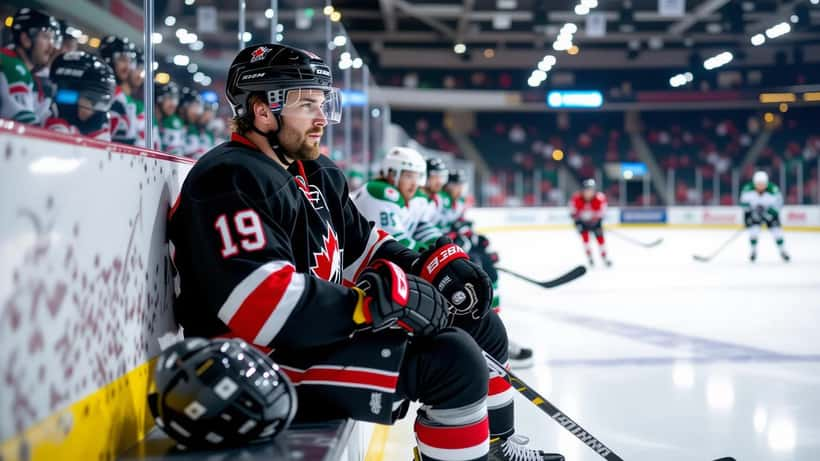
Post-series reporting confirmed a striking catalogue of ailments the Flyers carried through Round 2. Owen Tippett battled a separated shoulder for much of the playoff run. Christian Dvorak played an entire playoff series with a sports hernia. Defenseman Cam York took the ice with a broken rib — reportedly playing through acute pain shift after shift. Forward Noah Cates, who suffered a foot injury early in the series against Carolina, was eventually ruled out entirely for the remainder of Round 2.
On the Carolina side, defenseman Alexander Nikishin sat out Game 1 of the series after suffering a concussion from a hit by Tyler Kleven in the previous round. Seth Jarvis, though not injured mid-series, subsequently required shoulder surgery that will sideline him 4 to 6 months heading into the 2026-27 season.
These aren't minor ailments. They are the kinds of structural injuries that sports medicine specialists rank among the most consequential in contact sport — conditions whose outcomes depend enormously on whether they are assessed and managed correctly, or simply endured.
What an Expert Sees When They Hear "Separated Shoulder"
For most Canadians, "separated shoulder," "sports hernia," "broken rib," and "concussion" sound roughly equivalent in severity. They are not. The medical distinctions matter enormously for how quickly someone should seek care and what treatment pathway is appropriate.
A separated shoulder — technically an acromioclavicular (AC) joint injury — exists on a graded spectrum. Grade I involves minor ligament stretching with full stability. Grade III involves complete ligament rupture, visible deformity, and significant instability. A Grade I can often be managed conservatively with physiotherapy; a Grade III may require surgical reconstruction, particularly in overhead athletes or those with physically demanding jobs. The visible "bump" at the top of the shoulder that fans sometimes notice on players is the hallmark of a Grade II or III separation, and it is a red flag that warrants imaging.
A sports hernia is a different animal. Unlike an inguinal hernia, a sports hernia is a tear in the soft tissue of the lower abdominal wall or groin. It causes chronic pain with exertion but rarely produces a visible bulge. The critical issue: it does not resolve with rest alone. Without surgical intervention, continued athletic activity typically enlarges the tear. That Christian Dvorak played an entire playoff series with one is a testament to pain management — but almost certainly meant surgical correction was scheduled the moment the season ended.
Broken ribs, meanwhile, are evaluated on the basis of displacement, number of ribs involved, and proximity to the lung. A single non-displaced fracture is painful but typically not life-threatening; it heals over 6-8 weeks. The concern is complications: a pneumothorax (collapsed lung from a fragment piercing the pleural lining), or in cases involving multiple adjacent ribs, flail chest, which impairs normal breathing mechanics. These are scenarios that require emergency imaging to rule out.
Concussions — as covered in the Government of Canada's concussion management guidelines — are evaluated through a combination of symptom assessment and neurological testing, with return-to-play decisions made conservatively. The long-term risks of repeated unmanaged concussions, including post-concussion syndrome and chronic traumatic encephalopathy (CTE), have fundamentally changed how responsible medical teams approach them.
Expert Reaction: The Problem With Using NHL Players as a Pain Benchmark
The Flyers' injury list has sparked genuine debate in sports medicine circles, and it raises an uncomfortable question for the millions of Canadians who follow hockey: how much are we normalizing injury stoicism in ways that hurt us?
"Elite athletes operate within a completely different medical infrastructure," one sports physiotherapist would explain. "An NHL player with a suspected rib fracture gets same-day imaging, a chest X-ray, possibly a CT scan. A team physician monitors their breathing every shift. The decision to play them is not made casually — it's made with real-time data." For the rest of us, that infrastructure simply doesn't exist.
The danger is what researchers sometimes call injury normalization in recreational sport. Weekend hockey leagues, adult soccer divisions, and community rugby clubs are full of players who hear "so-and-so played an entire playoff round with a broken rib" and conclude that their chest pain at Tuesday night practice isn't worth getting checked. That is a false equivalence that sports medicine professionals flag consistently.
The Hurricanes swept the Flyers. But what the injury revelations really demonstrate is the gap between managed risk — taken by professionals with full diagnostic support — and unmanaged risk, which is what everyone else is taking when they play through undifferentiated pain.
For context on how these injuries compare to the wider picture of sports-related harm in Canadian adults, national injury prevention organizations consistently show that delayed care for musculoskeletal injuries is one of the leading drivers of long-term disability in Canadian adults under 50. Early assessment and proper staging of injuries like AC separations and rib fractures is associated with significantly better long-term outcomes across age groups.
You can also find related analysis on what happened to other NHL players navigating similar conditions this season: see coverage of Patrik Laine's injury recovery journey and what Brad Marchand's offseason surgery means for veteran NHL players.
A Concrete Scenario: Saturday Night Hockey in Mississauga
Consider this scenario: Marco is a 39-year-old project manager who plays in an adult recreational hockey league in Mississauga. He takes a heavy hit into the boards during a Saturday night game — a legal check, nothing spectacular — and feels sharp pain in his right shoulder and upper chest. His teammates tell him it's "probably just bruised." He finishes the game.
By Sunday morning, Marco's shoulder has stiffened considerably. There is a visible bump at the top of the joint, and he can raise his arm only to shoulder height before pain stops him. He can breathe normally, but deep breaths produce a sharp catch on the right side. He wonders if he should go to the ER, or just wait and see.
If/then logic based on what health experts would assess:
If the visible shoulder bump is present and the arm cannot be raised above the shoulder → this is the presentation of a Grade II-III AC separation. Imaging within 24-48 hours is indicated, not "in a week when it's still sore." A Grade III separation that is allowed to consolidate incorrectly can require surgical reconstruction where a promptly treated Grade II would not. Estimated difference in recovery: 8-10 weeks (conservative Grade II management) versus 4-6 months (post-surgical Grade III).
If deep breaths cause sharp right-side chest pain → rib fracture needs to be ruled out by imaging, not by waiting. The risk isn't the fracture itself; it is the 5% incidence of pneumothorax in isolated rib fractures from blunt trauma. A pneumothorax that goes undetected worsens gradually and becomes a medical emergency.
If Marco plays the following Saturday without assessment → he is making the same decision Tippett made, without the medical team that made that decision relatively safe. A Grade II AC separation under repeated compressive load has a documented risk of progressing to Grade III. A small, undetected pneumothorax can expand during aerobic exertion.
Marco is not Owen Tippett. He does not have an NHL team physician, same-day imaging, or a surgeon on standby. The decision that looked like toughness in the Flyers' locker room looks like avoidable risk at the Mississauga hockey rink.
When to Stop Playing Through It
The practical checklist that sports medicine professionals recommend for Canadian recreational athletes after a contact injury:
- Visible deformity or inability to raise the arm above shoulder height → same-day medical evaluation, not next-day
- Chest pain that worsens over several hours, or sharp pain with deep breathing → emergency evaluation to rule out pneumothorax or rib fracture
- Headache, brain fog, sensitivity to light or noise after a head impact → concussion protocol; no return to play until cleared by a physician; this is not optional
- Groin or lower abdominal pain that recurs with exertion → seek assessment; sports hernias do not heal with rest, and waiting until you have a "big game" to push through is how manageable tears become surgical urgencies
The Hurricanes swept the Flyers for reasons that had as much to do with depth, goaltending, and defensive structure as with any injury differential. But the post-series injury disclosures offer Canadian sports fans a useful reminder: elite athletes competing through serious conditions under expert medical supervision is not the same thing as ignoring the same conditions without any. If you've taken a hit and something feels wrong, the right call isn't to wait and see. It's to get an accurate picture of what you're dealing with — before the next game makes it worse.
A health expert on ExpertZoom can help you assess the severity of a sports-related injury and determine whether emergency imaging, physiotherapy, or surgical consultation is warranted — before you make the call to play through it.
Medical disclaimer: This article is informational and does not constitute medical advice. If you have sustained an injury, consult a qualified healthcare professional for individual assessment and guidance.
