 Sophie Leblanc
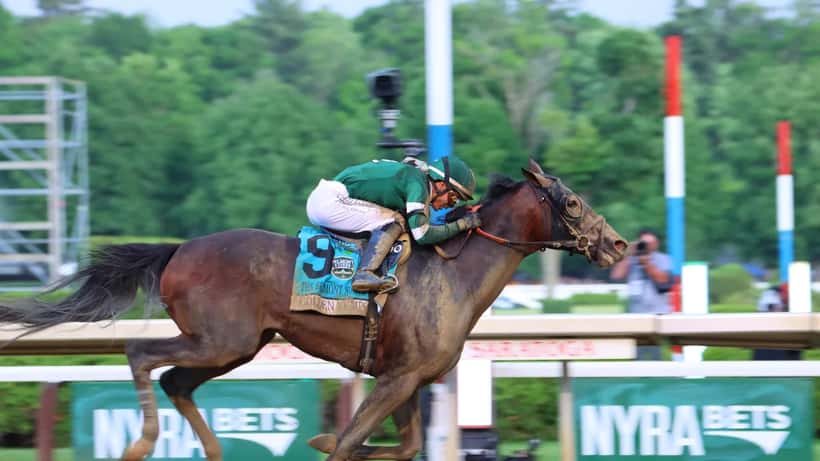
When trainer Cherie DeVaux announced on May 6, 2026, that Kentucky Derby winner Golden Tempo would skip the Preakness Stakes, she made history twice over — first as the inaugural female trainer to win the Derby, then as the person who publicly chose her horse's long-term health over a shot at the Triple Crown. Six weeks later, Golden Tempo surged from the back of the pack at Saratoga Race Course, caught Commandment at the wire, and won the 158th Belmont Stakes on June 6. With jockey Jose Ortiz aboard and odds of 9-2, the colt completed one of the most talked-about two-race campaigns in recent memory — and made DeVaux the first female trainer to win two legs of the Triple Crown. The biggest lesson, however, has nothing to do with racing history. It has everything to do with when to say no — and why that decision should involve a veterinarian.
A Season Defined by a Withdrawal
Golden Tempo entered the 2026 Triple Crown season as a longshot. His Kentucky Derby win on May 2 at Churchill Downs — timed at 2:02.27 at 23-1 odds — came as a genuine surprise. The buzz around a Triple Crown bid built immediately.
DeVaux moved quickly to end the speculation. Her reason was not tactical. It was medical. "In my career, I have never started a horse back on that short of rest," she said in the days after the Derby. The two-week gap between the Kentucky Derby and the Preakness Stakes on May 16 is one of the tightest scheduling constraints in professional sport. No other elite athletic competition — human or equine — asks a competitor to turn around at that pace at that intensity.
The decision drew debate in racing circles. Critics argued Golden Tempo was giving up a rare chance. Supporters pointed to a string of high-profile horse fatalities at major North American tracks in recent years that had triggered stricter veterinary protocols across the sport. DeVaux acknowledged the shift directly: "Oversight with the veterinarians has gotten quite strict," she said after the Belmont. Her willingness to sit out the middle leg, train deliberately, and protect Golden Tempo's musculoskeletal integrity over five additional weeks ultimately produced a winner — and a template.
What Equine Vets Know That Most Owners Don't
The science behind DeVaux's decision is grounded in how horse bodies respond to competitive stress. Unlike humans, horses cannot self-report discomfort early. By the time a horse shows visible lameness or behavioural distress, a soft-tissue injury has often already progressed past the most manageable stage.
Equine veterinarians use a suite of diagnostic tools to catch problems earlier. Blood panels measuring creatine kinase (CK) and aspartate aminotransferase (AST) can reveal muscle damage within 24 hours of a race, even when the horse looks sound. Thermographic imaging identifies heat signatures in tendons and joints — early markers of microtrauma that precede clinical lameness. A thorough veterinary gait assessment, conducted at the walk and trot in controlled conditions, can detect asymmetries that predict injury risk in a way that casual observation cannot.
For competition horses in Canada — whether racing at Woodbine, show jumping at Spruce Meadows, or competing on the provincial hunter circuit — these same principles apply. The intensity differs; the biology does not.
Standard recovery guidance for horses after significant competitive effort suggests a 21-to-28-day period of reduced training load before returning to full intensity. For horses showing clinical signs — reduced appetite, stiffness on one rein, heat or swelling in the lower limbs, reluctance to load weight on a specific leg — that window extends further. Only a veterinary assessment can determine where a specific horse sits on that continuum.
The cost calculus in Canada underscores the value of professional consultation. Routine equine veterinary care runs approximately $170 per year for vaccinations, $75 for deworming, and $200 for dental work — a base of roughly $445 annually, according to Canadian equine industry data from Mad Barn. A pre-competition soundness examination adds $150 to $300. Emergency colic treatment in Ontario ranges from $3,000 to more than $15,000 depending on whether surgery is required. Musculoskeletal injuries requiring surgical intervention frequently exceed that figure. A $250 consultation that catches a developing suspensory problem is not an optional expense — it is the cheapest intervention on the table.
Fourteen Days and a Foreleg: A Scenario Every Owner Should Recognize
Picture a four-year-old Thoroughbred mare competing on the Ontario racing circuit in the summer of 2026. She races on a Saturday at Woodbine, finishes third, and comes back to the barn without obvious distress. Her trainer enters her in a second race at a regional track fourteen days later.
On Day 10 post-race, the trainer notices she is tracking slightly short on her right foreleg during the morning trot-out. Not dramatically lame — just a subtle, recurring hitch. She is eating normally. She loaded onto the van without resistance. The trainer assumes she is a bit stiff and decides to see how she goes.
Under Canadian racing regulations overseen by the Canadian Pari-Mutuel Agency's Equine Drug Control Program, a pre-race veterinary examination is required before every start. That exam is designed to identify overt unsoundness. It is not, by design, a deep diagnostic workup. The gait asymmetry may not be pronounced enough to trigger a scratch on the morning of the race.
Here is what the numbers look like, depending on what that asymmetry actually means:
If the cause is residual muscle fatigue: A veterinary examination including a basic soundness assessment ($200–$300) and a blood panel ($100–$150) would likely identify elevated CK values and recommend four to seven additional rest days plus a graduated return to trot work. The mare races safely the following Saturday. Total cost: $350–$450.
If the cause is early-stage suspensory ligament strain: Racing on it converts a Grade 1 suspensory sprain — manageable with six to eight weeks of controlled rehabilitation — into a potential Grade 3 or complete tear. Rehabilitation time at that point: six to twelve months minimum. Estimated combined veterinary, imaging, and rehabilitation cost: $8,000 to $20,000, with no guarantee of return to competitive form.
The $350 pre-race workup is the same decision Cherie DeVaux made when she held Golden Tempo out of the Preakness. Her five weeks of patience and rigorous veterinary monitoring produced a Belmont Stakes winner. The alternative was unknowable, and potentially permanent.
The conditions that equine veterinarians recommend triggering a professional consultation: any gait change within 72 hours of a competition, any plan to compete again within three weeks of the previous event, and any behavioural change — increased agitation, reluctance to be bridled, flat ears during warm-up — that is out of character. These conditions arise more often than most owners acknowledge, and more often than casual observation catches.
What Canadian Horse Owners Should Do Before the Next Event
The Golden Tempo story offers a practical framework that applies at every level of horse sport in Canada.
Before entering a competition: Schedule a pre-competition soundness exam at least ten days out. That buffer allows time to act on any findings — rest, treatment, or a scratch — without losing the entry at the last moment. Standard cost: $150–$300 for the examination; add $100–$200 if recent competition warrants a blood panel.
After a competition: Observe the horse closely for the first 72 hours. Watch for off-feed behaviour, unusual sweating at rest, any heat or swelling in the lower limbs, or asymmetry during the morning walk and trot. Any of these signs warrants a call to your equine vet rather than a wait-and-see approach.
When returning from a layoff or injury: The return-to-competition timeline should be built around veterinary reassessment at each stage, not around the event calendar. A competition opportunity is replaceable. Soft tissue is not.
For Canadian owners who want a professional equine health assessment before committing to an entry, ExpertZoom connects you with certified veterinary specialists who can evaluate your horse's post-competition readiness and advise on recovery protocols. The consultation you book today could be the decision that protects your horse's season — or career.
Cherie DeVaux put it plainly after the Belmont. "He told us what he needed." Golden Tempo had a team equipped to listen. Every horse in Canada deserves the same.
This article is for informational purposes only and does not constitute veterinary advice. Always consult a licensed equine veterinarian for health and competition decisions involving your horse.
