 Nathalie Dubois
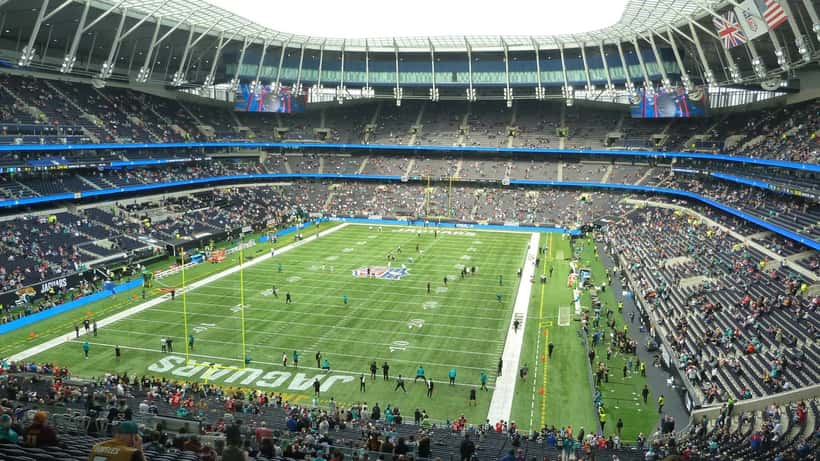
The Philadelphia Eagles and Jacksonville Jaguars faced off at Tottenham Hotspur Stadium in London on October 11, 2026 — the NFL's marquee International Series Week 5 matchup. But beyond the 9:30 a.m. ET kickoff and the 60,000-plus fans in north London, there is a quieter battle playing out entirely on paper: the performance-incentive clauses buried deep in every player's contract that quietly shift hundreds of thousands of dollars based on what happens on the field.
Why London Games Complicate NFL Contracts
The NFL International Series has become a fixture on the league calendar. The Jacksonville Jaguars have committed to playing multiple games annually in London, and the league formally requires certain designated "home" franchises to stage overseas games each season. For the players, this logistical arrangement is not just a travel inconvenience — it triggers specific contractual provisions that many athletes, and their agents, navigate carefully.
Under the NFL Collective Bargaining Agreement (CBA), a player's performance incentives are classified into two types: "Likely to be Earned" (LTBE) and "Not Likely to be Earned" (NLTBE). LTBE incentives count against the current year's salary cap, while NLTBE incentives are charged to the following season's cap if triggered. That classification hinges on whether the player achieved the statistical threshold the prior season. A Jaguars wide receiver who caught 900 yards in 2025 will have a 1,000-yard 2026 incentive classified as NLTBE — but one game in London, before a global audience of millions, can push them over the line.
According to the NFL Players Association, more than 70 per cent of active NFL contracts signed since 2024 contain at least one performance-incentive clause tied to cumulative season statistics. For players on the Eagles and Jaguars specifically, the stakes this October are particularly high — both rosters include players sitting close to statistical thresholds in receiving yards, quarterback completion percentage, and sack totals.
The Legal Mechanics Behind Performance Clauses
Performance incentive clauses in North American professional sports contracts are enforceable as standard terms within a collectively bargained framework, but their interpretation can be far from straightforward. Employment lawyers and sports contract specialists see disputes arise in three common scenarios: ambiguous statistical thresholds, mid-season trades that reset counting stats, and disputes over "per-game" versus "cumulative-season" language.
In the Eagles' case, the trade of offensive lineman Cam Jurgens earlier this season — reported widely across NFL media — illustrated exactly how a player's incentive structure can be disrupted when a contract moves to a new team. Incentive clauses negotiated with one franchise do not automatically transfer on identical terms. The receiving team can renegotiate, and in many cases the triggered thresholds are reset, costing the player bonuses they had already partially earned.
For Jacksonville, the Jaguars' London residency creates an additional wrinkle: travel provisions under the CBA entitle players to additional compensation for international games, but that supplement is fixed. It does not interact with incentive bonuses. Players and agents who conflate the two often discover the discrepancy only at year-end, when the season accounting is finalized.
From a legal standpoint, these clauses are valid and binding — but only when the language is precise. "Receiving yards in games started" means something different from "receiving yards in all games played." A single preposition can shift a bonus payout by six figures.
What Happens When Your Employment Bonus Depends on a Single Game
Take the case of a hypothetical defensive end on the Jaguars roster — call him Marcus, 27, in the third year of a four-year deal. His contract includes a $300,000 incentive for reaching 10 sacks in a season, classified as NLTBE based on his 2025 total of 7.5. Entering Week 5 against the Eagles, Marcus has 8 sacks in four games. One more sack in London locks the incentive into LTBE territory for 2027 and effectively guarantees the payout.
Now consider what happens if Marcus suffers a non-contact knee injury in the second quarter, is placed on Injured Reserve (IR), and misses the remainder of the season with 9.5 sacks recorded. His contract does not reach 10. The $300,000 goes unpaid.
Under the NFL CBA's injury protection provisions (Section 9, Article 45), a player on IR who was physically unable to perform due to an injury sustained in a game is entitled to their full base salary. But performance incentives are explicitly excluded from injury protection. The CBA is unambiguous on this point: incentive bonuses require the statistical threshold to be met, regardless of the circumstances that prevented it.
The if/then arithmetic is stark: if Marcus reaches 10 sacks, he earns $300,000 in bonus on top of a $2.1M base — roughly a 14.3 per cent income increase. If he falls 0.5 sacks short due to injury, he earns $0 of that bonus, and the clause converts back to NLTBE for 2027, meaning it counts against next year's cap only if earned again. A single play in London determines which outcome occurs.
For Canadian professional athletes operating under analogous structures — Hockey Canada contracts, CFL deals, or even high-level soccer agreements — the legal exposure is identical in principle. Employment contracts with performance-based bonus structures are common across professional sport, and a failure to understand the exact classification and protection of each clause is one of the most expensive mistakes an athlete can make.
What Athletes and Their Representatives Should Verify Before Signing
Whether you are an NFL lineman preparing for a London trip or a CFL running back reviewing a two-year extension, sports employment lawyers consistently flag the same checklist when reviewing incentive clause language:
Threshold classification. Understand whether each incentive is categorized as LTBE or NLTBE, and which year's salary cap it affects. This directly impacts a team's willingness to include certain bonuses in a deal.
Trade and waiver language. Does the incentive survive a mid-season trade? Does the statistical count reset, or does it carry over? The CBA provides a default answer for NFL contracts, but bespoke language can override it — and individual leagues have their own rules.
Injury interaction. Confirm explicitly whether injury protection applies to incentive clauses, or only to the base salary. In most professional leagues, it is only the base salary. Missing a threshold due to injury almost universally forfeits the incentive.
Per-game versus cumulative. A per-game incentive ($10,000 per game played) compounds differently from a cumulative season threshold ($100,000 for 16 games played). Players sometimes accept cumulative structures assuming they behave like per-game ones — a costly misreading.
According to the NFL Players Association's collective bargaining resources, detailed contract templates and the full text of the 2020 CBA (governing through 2030) are publicly available, though interpreting the interaction between individual contract language and CBA provisions typically requires legal expertise.
This gap between what athletes assume and what contracts actually guarantee is one of the most consistent findings in sports law practice. Many players — particularly younger athletes entering their first professional deal — rely on verbal assurances from front-office staff that "the team takes care of its own." Those conversations are not enforceable. What is written in the contract is enforceable, and only a qualified lawyer reading the specific document can tell you where your money is actually protected.
If you are a professional athlete in Canada — or the parent or agent of a young player approaching a first contract — a consultation with a sports employment lawyer before signing can be the most cost-effective legal expenditure of your career. The difference between a well-drafted incentive clause and a poorly worded one can easily exceed $200,000 over the life of a three-year deal. With the Eagles and Jaguars reminding the world this Sunday that the NFL's biggest moments happen in unexpected places, it is worth asking: do you know exactly how your contract pays out when it counts?
For athletes in Canada seeking legal clarity on performance-based contracts, AJ Brown's $96M Trade: The NFL Contract Mechanics Explained offers additional context on how major professional contracts are structured — and where disputes most often arise.
Disclaimer: This article is for informational purposes only and does not constitute legal or financial advice. Contract structures vary by league, jurisdiction, and individual agreement. Consult a qualified sports employment lawyer before signing or negotiating any professional contract.
