 Olivia Dubois
On December 2, 2025, the Toronto Blue Jays handed right-hander Dylan Cease the largest free-agent contract in franchise history: seven years and $210 million, according to MLB.com. The number blew past the six-year, $150 million deal George Springer signed five years earlier. But the most revealing part of the negotiation was not the money. It was what the Blue Jays were paying for — an arm that, in an era of constant elbow surgeries, simply refuses to break down.
That durability is now the talk of the sport in the summer of 2026. Through his first five starts this season, Cease has thrown 25.2 innings with a 2.10 ERA and an MLB-leading 44 strikeouts, per MLB.com — the highest strikeout-per-nine rate in the majors. And he has done it while so many of his peers sit on the injured list.
Why "Never Getting Hurt" Is Now a $210 Million Skill
Cease has not been on the injured list for an arm problem since his big-league debut in 2019, and he has made at least 32 starts in five straight seasons. That reliability is rare enough that Yahoo Sports called it the core reason the Blue Jays were willing to gamble nine figures on him — even while acknowledging the risk that any pitcher's arm can go at any time.
The contrast is stark. Heading into 2026, veteran starter Yu Darvish underwent ulnar collateral ligament (UCL) surgery and is expected to miss the entire season, according to MLB Trade Rumors. Others, like Joe Musgrove, are only now returning from Tommy John reconstruction. When healthy arms are this scarce, teams pay a premium for the ones that stay on the mound.
Here is the twist most fans miss: Cease himself had Tommy John surgery as a high-schooler. He rebuilt his elbow young, and more than a decade later he is the sport's iron man. His story is not "some people are just lucky." It is a case study in how throwing arms get damaged — and how they can be protected.
The Injury Behind the Headlines
The UCL is a small ligament on the inside of the elbow that stabilizes the joint every time you throw. Repeated high-velocity throwing stretches and frays it. When it tears, the fix is Tommy John surgery — reconstructing the ligament with a tendon taken from elsewhere in the body, followed by a recovery that typically runs 12 to 18 months for a competitive pitcher.
What alarms sports-medicine specialists is how young the patients now are. The number of throwing injuries has climbed most sharply not among professionals but among teenagers and even pre-teens. The growth plates in a young pitcher's elbow and shoulder stay open until roughly ages 14 to 17, which makes them uniquely vulnerable to repetitive stress long before a paycheck is ever on the line.
What Recreational and Youth Pitchers Should Actually Do
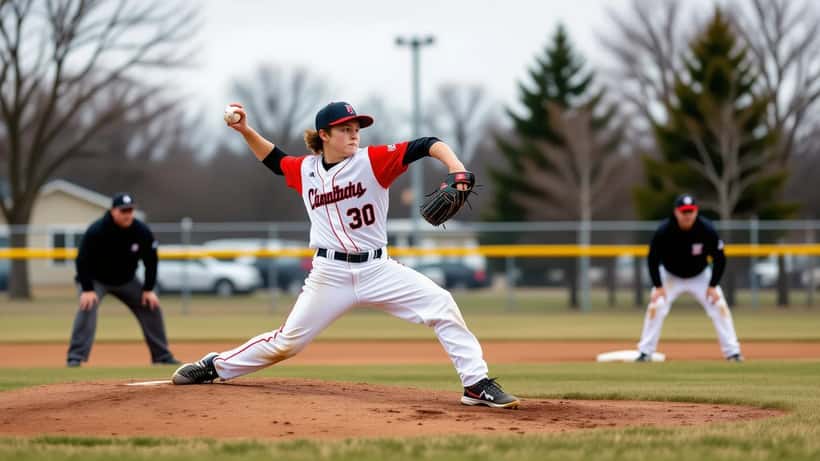
For the tens of thousands of Canadian kids playing spring and summer baseball in 2026 — and for the weekend players who still take the mound in beer leagues — the science points to a few clear, boring, effective rules.
The single most important risk factor is workload. Research summarized by Nationwide Children's Hospital shows that the more pitches thrown per game, per week and per season, the greater the injury risk — which is why pitch-count limits and mandatory rest days exist. The other major factors are throwing while fatigued and throwing breaking balls (curveballs, sliders) too young, before the arm is ready for the added torque.
Three habits do most of the protective work:
- Respect pitch counts and rest days. Track them like you track the score. Fatigue is the danger zone.
- Do not specialize too early. Playing baseball year-round with no off-season is strongly linked to overuse injuries. A few months away from throwing lets young tissue recover.
- Never pitch through elbow pain. Persistent inside-elbow soreness is not something to "shake off." It is the warning sign clinicians most want parents to hear.
When to See an Expert
This is where a headline about a Blue Jays contract becomes practical for an ordinary family. Arm pain in a young thrower — or a nagging elbow in an adult recreational player — is not a wait-and-see problem. Early assessment by a sports-medicine physician, an orthopedic specialist, or a licensed physiotherapist can catch a stressed ligament before it becomes a torn one, and can correct the mechanics or workload driving the strain.
A qualified professional can build a return-to-throw program, screen for the flawed mechanics that overload the elbow, and tell you the one thing an internet article cannot: whether that specific ache needs imaging now. Just as elite pitchers like Shane McClanahan lean on structured medical teams to come back from major arm surgery — a road we covered in our look at how athletes protect their income after injury — the same principle scales down to a 12-year-old with a sore elbow: get the right eyes on it early.
The Real Lesson of the Cease Deal
Dylan Cease is the exception that proves the rule. He survived an early UCL injury, rebuilt his arm the hard way, and turned durability into the most valuable currency in his sport. For everyone else holding a baseball this summer, the takeaway is not to throw harder. It is to throw smarter — count the pitches, respect the pain, and get an expert opinion before a small problem becomes a surgical one.
This article is for general information only and is not medical advice. If you or your child is experiencing elbow, shoulder, or arm pain, consult a qualified physician or physiotherapist for diagnosis and treatment.
