 Evan Bélanger
When Warner Bros. confirmed that Dune: Part Three would screen in IMAX 70mm film at Canadian theatres starting December 14, 2026, home theatre forums lit up overnight. The debate that followed was not about the film itself — it was about a format war: is a $32 Cineplex ticket worth it when you have spent thousands building a dedicated home cinema? A consumer electronics technician would tell you the answer depends on what your setup can actually see.
What Makes IMAX 70mm a Different Category of Cinema
IMAX 70mm film is not a marketing tier — it is a physically different projection medium. The film frame measures 69.8 × 48.5 mm, running horizontally through the projector in a 1.43:1 aspect ratio. At that scale, the projected image carries the equivalent of roughly 18,000 pixels of horizontal resolution, displayed across screens measuring up to 59 × 79 feet. Projection brightness reaches levels 7.5 times higher than a conventional multiplex lamp, and the proprietary 12-channel IMAX audio system is calibrated specifically to the room geometry.
In Canada, only two theatres are equipped to screen Dune: Part Three in true IMAX 70mm: Cineplex Cinemas Vaughan (Ontario) and Cineplex Cinemas Langley (British Columbia). Insider screenings open December 14, 2026, with wide IMAX release on December 18. Outside these two locations, even "IMAX" showings use digital laser projection capped at 4K — roughly a quarter of the IMAX 70mm film resolution.
This is the gap most Canadian viewers do not realize they are comparing against when they debate whether to drive to the theatre.
Why Dune: Part Three Is the Benchmark Film for This Debate
Denis Villeneuve partially shot Dune: Part Three using the latest generation of IMAX film cameras — making it only the second major theatrical release to do so, following Christopher Nolan's The Odyssey earlier in 2026. Key sequences — the Arrakis desert expanse, the Imperial court scenes — were specifically framed for the 1.43:1 IMAX aspect ratio. On any 16:9 display (ratio: 1.78:1), these shots must either be cropped or letterboxed, cutting off portions of the composition that Villeneuve intended to be visible in the frame.
This is not a case of a filmmaker "recommending" IMAX as an aesthetic preference. The physical aperture of the camera that recorded the image is wider than the rectangle of your television — and no post-production rescaling changes that fundamental geometric fact.
What Your Home Setup Delivers — and Where It Stalls
A well-specced 2026 Canadian home theatre accomplishes extraordinary things. An 85-inch 4K OLED positioned six feet from the viewer delivers a 53-degree viewing angle, meeting the minimum threshold that IMAX targets in its own venue design standard. A Dolby Atmos soundbar or 7.2.4 surround configuration provides cinema-grade positional audio. Current mid-to-high-tier QLEDs and OLEDs achieve 97–99% of the DCI-P3 cinema colour space in a calibrated environment.
Where the home system cannot follow is resolution and native aspect ratio. A 4K panel renders 3,840 horizontal pixels at 1.78:1. IMAX 70mm delivers approximately 18,000 horizontal pixels at 1.43:1. When Dune: Part Three arrives on 4K Blu-ray, the transfer will be mastered from the digital intermediate at 4K — not from the 70mm film print. The home version is not a scaled-down edition of the same master; it is a different output pipeline entirely.
An 8K television (7,680 horizontal pixels) narrows this gap but does not close it, and no consumer 8K display ships in the 1.43:1 aspect ratio the IMAX 70mm image was composed for.
Concrete Case: Liam's $6,800 Home Theatre vs a $32 Cineplex Ticket
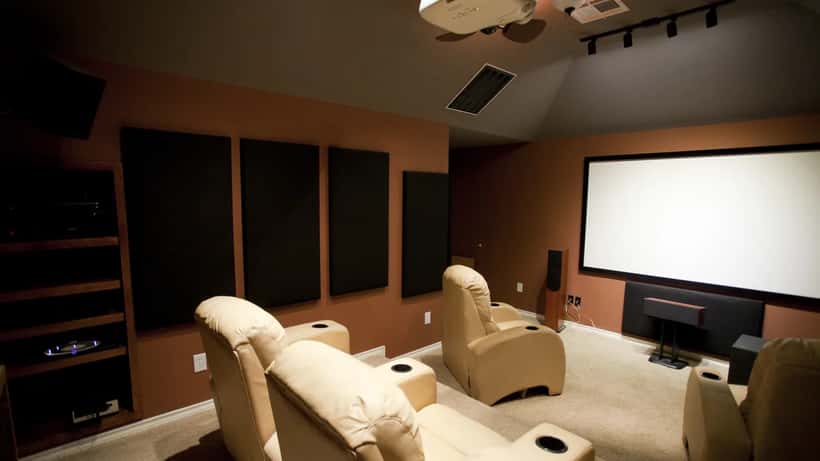
Liam, 41, lives in Abbotsford, British Columbia — 55 kilometres from Cineplex Cinemas Langley. Over three years he assembled a dedicated home cinema: an 85-inch Samsung QN85 QLED ($2,900), a Sony HT-A9M2 wireless surround system ($1,400), an LG UHD Blu-ray player ($180), an Nvidia Shield Pro streamer ($230), acoustic panels for the room, and a Furman power conditioner — total investment approximately $6,800.
If Liam watches Dune: Part Three at home on 4K Blu-ray: He receives 3,840 × 2,160 pixels at 1.78:1. Sequences shot natively in IMAX 70mm will be presented in a 1.43:1 box letterboxed inside his 16:9 frame, with black bars on the left and right edges — reducing the effective active screen area to roughly 63% of his 85-inch panel. Effective horizontal resolution: 3,840 pixels.
If Liam drives 55 km to Cineplex Langley for the December 14 insider screening at $32: He sees the full 1.43:1 frame at 18K-equivalent horizontal resolution on a screen exceeding 60 feet wide, with the 12-channel IMAX proprietary audio mix. The aspect ratio fills the screen exactly as Villeneuve designed. The IMAX 70mm frame contains approximately 4.5 times more image data than Liam's home system can render.
The break-even question is not purely financial — Liam's $6,800 system has paid for itself across hundreds of films. The decision is whether, for a film composed specifically for IMAX 70mm film cameras, a 110-kilometre round trip is worth receiving the image the director intended. According to Statistics Canada's Survey of Household Spending, Canadian households with high recreation expenditure consistently treat cinema attendance and home entertainment as complementary spending categories — not substitutes.
When a Consumer Electronics Technician Can Give You a Data-Based Answer
The IMAX-vs-home question is often treated as a matter of preference. For many viewers, the real question is whether their current setup justifies skipping the theatre. A consumer electronics technician can run a calibration audit on your existing display and sound system, measuring colour accuracy, peak brightness in nits, and audio frequency response, to give you specific numbers.
Common findings from professional home theatre calibrations in Canada in 2026:
- Most 65–75-inch TVs calibrate to 350–700 nits peak brightness in a darkened room. IMAX 70mm is projected at a target of 14 foot-lamberts on a 60+ foot screen — a perceptual experience no sub-1,000-nit panel replicates
- Factory-shipped TV settings typically run 15–30% above calibrated colour temperature, meaning most viewers are watching with a cooler, bluer picture than the colourist intended
- Soundbars labelled "Dolby Atmos capable" vary significantly: a technician measuring ceiling reflections in your specific room can determine whether height channels are actually rendering or collapsing into phantom stereo
None of these findings suggest your setup is inadequate. They give you precise information about what you are watching — and exactly how much you gain by making the 55-kilometre drive for a specific, historically significant film presentation.
What to Do Before December 14
IMAX 70mm insider screening tickets at Cineplex Langley and Cineplex Vaughan for December 14 are available through Cineplex.com. These screenings typically sell out within days: The Odyssey insider allocations at both locations closed within 96 hours. If you are within two hours of either location, the consumer electronics case is clear — no display available to Canadian buyers in 2026 reproduces the full IMAX 70mm image at native resolution for a film shot specifically on IMAX film cameras.
If you are outside driving range, the wide digital IMAX laser release on December 18 is a genuinely strong alternative — 4K laser projection with premium sound is excellent by any consumer benchmark. A consumer electronics specialist can help you calibrate your system to meet that content at its best, or advise whether a targeted upgrade (projector, screen size, audio calibration) closes the remaining gap before your home copy of Dune: Part Three arrives.
