 Victoria Stewart
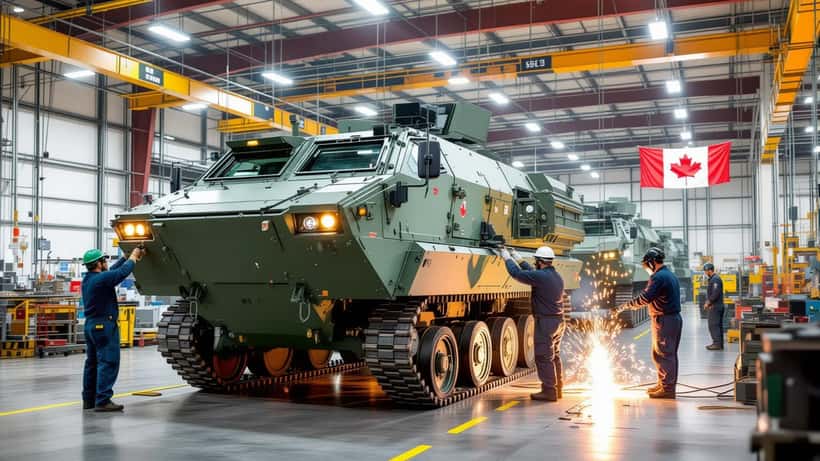
Ottawa will spend nearly $2 billion over four years to buy 190 Canadian-made armoured combat support vehicles, Prime Minister Mark Carney announced in London, Ontario on July 16, 2026. The deal, struck with General Dynamics Land Systems-Canada, grows the Canadian Armed Forces fleet from 360 to 550 vehicles and is projected to sustain more than 6,000 high-paying jobs a year for eight years. For Canadian investors, it is also the latest signal of a defence-spending cycle that is reshaping portfolios — and one that calls for a cooler head than the headlines invite.
What was announced
According to the Prime Minister's Office, the agreement makes GDLS-Canada the country's first Strategic Partner under the Defence Industrial Strategy's Strategic Partnership Framework. Every vehicle will be engineered and assembled at the company's plant in London, Ontario, which already employs more than 1,700 people and draws on a supply chain of over 600 Canadian firms spread across 100-plus communities.
The vehicles themselves combine heavy armour against mines, improvised explosive devices and direct fire with the mobility to keep pace with front-line units. But the number that matters for household finances is the direction of travel: after years of pressure from allies to spend more, Canada is committing serious, multi-year money to defence — and it is far from alone. Governments across NATO have been ratcheting up military budgets, and defence has quietly become one of the best-performing equity themes of the decade.
Why investors are paying attention
When a government signs an eight-year industrial partnership, it is telling the market that defence orders are not a one-off. That kind of visibility on future revenue is exactly what pushes up the share prices of prime contractors and their suppliers. Many Canadians have already noticed defence and aerospace names climbing and wonder whether they are late to the trade.
That instinct — chase the sector that is already up — is where mistakes happen. A single procurement announcement, however large in national terms, is a small slice of a global contractor's revenue. The real question is not "is defence going up?" but "does adding defence exposure fit my plan, my time horizon and my tolerance for risk?" A fee-only financial planner can help you answer that before you move any money.
Three ways Canadians typically get exposure
There is no single "right" way in, and each route carries trade-offs a wealth manager will walk you through.
Individual stocks. Buying a single defence contractor is the most direct bet, but also the most concentrated. Note that many of the largest players — including General Dynamics, the parent of the London plant — trade on U.S. exchanges, which introduces currency risk and different tax treatment for dividends held outside a registered account. Putting a meaningful share of your savings into one company, in any sector, is the classic concentration mistake.
Sector and thematic ETFs. Defence and aerospace exchange-traded funds spread your money across dozens of firms, softening the blow if one contractor stumbles or loses a bid. They are the more diversified choice, but thematic funds can carry higher fees and tend to be volatile, because they rise and fall with a single narrative.
Broad-market funds you may already own. Many Canadians hold defence exposure without realizing it, through index funds and pension plans that include these companies. Before buying anything new, it is worth checking what you already own — you may be less "underweight" than you think.
The ESG question you should not skip
Defence is one of the most divisive sectors in responsible investing. Some funds screen weapons manufacturers out entirely; others have recently reclassified defence as compatible with security and stability goals. If you invest according to environmental, social and governance values — or hold funds that claim to — a rising defence allocation may quietly conflict with what you thought you owned. This is a values decision as much as a financial one, and it is worth raising explicitly with your advisor rather than discovering it later in a fund fact sheet.
For the workers and communities in the deal
The announcement is not only a market story. For the thousands of employees at the London plant and across the supplier network, it offers something rarer than a hot stock: income stability over an eight-year horizon. That predictability is a financial asset in itself. Workers with confidence in steady earnings are better positioned to build an emergency fund, pay down high-interest debt, and make full use of tax-sheltered accounts like the RRSP and TFSA.
One caution cuts the other way, though. Employees of any single-industry town face a concentration risk of their own — their paycheque and, often, their home value both ride on the same employer. Loading a personal investment portfolio with shares in that same sector doubles down on a risk that is already large. A planner will usually suggest the opposite: diversify your investments away from the industry that already signs your cheque.
The practical next step
A $2-billion headline is a prompt, not a plan. Before acting, map any new defence exposure against your existing holdings, your time horizon, your account types and your comfort with volatility. If you are tempted to buy a specific stock or fund on the back of this news, treat that temptation as the moment to book a conversation with a qualified financial advisor rather than to place a trade.
You can read the full terms of the partnership in the Prime Minister's Office announcement. For broader context on the security backdrop driving these budgets, see our expert analysis of the global security picture.
This article is general information, not financial advice. Investment values can fall as well as rise, and past sector performance does not predict future returns. Speak with a licensed financial advisor before making investment decisions.
