 Leah Adams
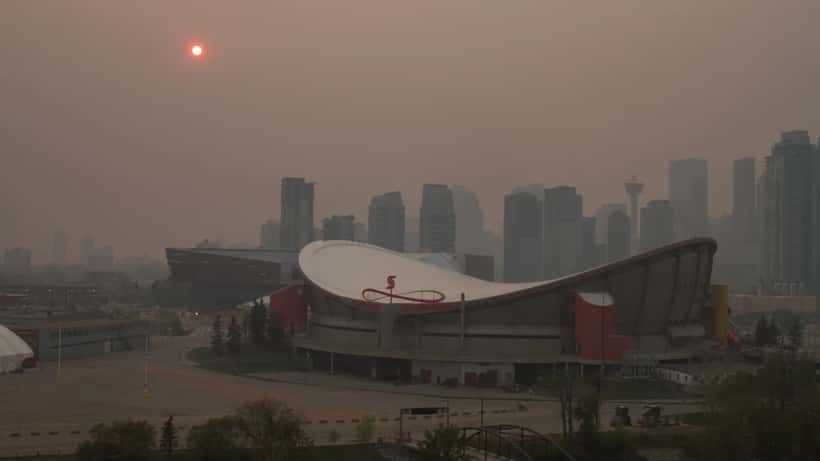
On July 24, 2026, Calgary recorded an Air Quality Health Index of 191 — the worst in Canada — as wildfire smoke from British Columbia and northern Saskatchewan blanketed the city. Only five locations in North America ranked worse that morning, according to IQAir. The Everstone neighbourhood in southwest Calgary peaked at an AQI of 206. While residents were warned to stay indoors to protect their lungs, very few were warned to protect their electronics.
Wildfire smoke is not merely a respiratory hazard. For anyone with computers, network equipment, home servers, or consumer electronics running in Calgary on July 24, it is an electrochemical threat that may still be active weeks after the sky clears.
What Happened Over Calgary on July 24, 2026
Smoke from active wildfires in northern Saskatchewan and the Northwest Territories, compounded by ongoing fires in British Columbia, drifted south through Alberta and settled over the city. According to Environment and Climate Change Canada, the Air Quality Health Index pushed into the highest-risk category across Calgary and surrounding communities including Airdrie, Banff, and Canmore. The federal government has confirmed the 2026 wildfire season is one of the most active on record, with fires burning across multiple provinces simultaneously.
Health advisories directed residents — particularly children, seniors, pregnant people, and those with heart or lung conditions — to remain indoors and run air purifiers. What the advisories did not address: staying inside is not enough to protect sensitive electronics. The particles that make wildfire smoke dangerous to lungs are the same particles that corrode circuit boards.
How Wildfire Smoke Damages Electronics From the Inside
Standard residential HVAC filters catch particles down to roughly 3 microns in diameter. Wildfire smoke particles average 0.1 to 1 micron — small enough to slip through most home air handling systems and penetrate through window seals and door gaps. Once inside a room, these particles begin infiltrating any device that draws in air for cooling.
The damage mechanism is chemical, not physical. Smoke from boreal forest fires carries nitrogen oxides (NOx) and sulfur dioxide (SO₂). When these gases combine with humidity — including the ambient moisture inside your home — they form dilute nitrous and sulphurous acids. These acids corrode the gold and copper plating on circuit board connectors, degrade solder joints, and attack the thin oxide layers that protect memory chips and processor pins.
Research from the 2024–2026 wildfire seasons found that during heavy smoke events, indoor PM2.5 concentrations in buildings without specialized filtration can reach 70% of outdoor levels within two to four hours of smoke arrival. By the time you see a visible haze inside your home, contamination has already reached the air intakes of your electronics.
The most important detail most people miss: the damage does not stop when the smoke clears. Acidic residue continues corroding internal components for days or weeks after the air quality improves, accelerated by temperature swings and any increase in humidity.
Which Calgary Devices Are Most at Risk
The electronics most commonly overlooked after a wildfire smoke event are not the devices people use daily — those get noticed when they fail. The quiet casualties are typically the ones that run continuously in the background:
Network equipment. Routers, mesh Wi-Fi nodes, and network switches typically sit in closets or on shelves with poor airflow management. They run warm, draw in air continuously, and accumulate soot on internal heatsinks where it bonds to warm metal surfaces.
Home servers and NAS drives. Devices used for local file backups, media streaming, or small business data run 24 hours a day and cycle large volumes of air across their drives. A NAS drawing air during a six-hour smoke event accumulates enough particulate on drive assemblies to accelerate bearing wear and trigger premature mechanical failure.
Smart home hubs and IoT devices. Many use loose-fitting plastic housings that provide no meaningful smoke barrier. Devices running on exposed shelves or countertops during the July 24 event are worth inspecting carefully.
Gaming consoles. The PlayStation 5 and Xbox Series X both use high-volume centrifugal fans moving several cubic feet of air per minute. During a smoke event, these fans function as particle pumps, drawing contaminated air across GPU heatsinks and memory modules.
As noted in our earlier report on weather-related electronics risks in Canada, extreme weather events in 2026 have repeatedly caught Canadian households unprepared for the secondary effects on their devices.
Concrete Case: A Calgary Home Office on July 24
Consider a freelance video editor living in Everstone — the neighbourhood that recorded Calgary's highest AQI of 206 on July 24. Their home office setup includes a workstation PC, a 4-bay NAS for client project backups, a mesh Wi-Fi router, and a secondary monitor. They followed health advisory guidance: sealed windows, activated an air purifier in the office, and stayed inside for most of the day.
The workstation and monitor in the air-purified room were likely adequately protected. The NAS device, however, was in a basement utility room with no air purifier running.
The if/then calculation: If the NAS ran continuously during the smoke event and the utility room had no dedicated filtration, indoor PM2.5 concentrations in that room likely reached 130–145 µg/m³ — approximately 70% of the outdoor peak of 191 that afternoon. Over a six-hour smoke window, the NAS's three cooling fans would have drawn an estimated 1.2 to 1.8 cubic metres of contaminated air across the drive assemblies and internal circuit board.
If those fans ran at that contamination level for six or more hours — which Calgary's July 24 event made possible — the internal components are statistically likely to carry acidic soot deposits. If the device is not cleaned within two to four weeks, ongoing corrosion raises the risk of drive controller or motor failure by an estimated 15 to 30%, based on remediation data from Sedgwick's industrial equipment loss division.
The cost of professional electronics cleaning for a 4-bay NAS in Calgary typically runs between $120 and $280 CAD, depending on contamination level and the number of drive bays requiring inspection. Replacing the unit and its drives runs $800 to $2,000 or more. Recovering data from a failed drive can cost $1,500 to $3,500+. The cost equation strongly favours early inspection.
An electronics technician performing post-smoke remediation will check four things: visible soot accumulation on heatsinks and fan blades, corrosion on exposed connectors and card edge slots, device logs for unexpected shutdowns or errors during the smoke window, and in some cases impedance testing on connectors to identify early-stage corrosion before it produces failures.
What to Do If You Were in Calgary on July 24
Within 48 hours of the event: Power down network equipment, consoles, and secondary devices that were running in unfiltered spaces during the smoke. Inspect external air vents for visible grey or brown discolouration — a sign that particles have accumulated on internal heatsinks. Photograph any you find.
Within one to two weeks: If any device was running in a basement, garage, utility room, or other space without an air purifier during the event, schedule an inspection with a certified electronics repair technician. Do not wait for symptoms. By the time a device begins crashing or overheating, the corrosion is already in an advanced stage.
Before the next smoke event: The Government of Canada's 2026 wildfire season update confirms the season is far from over. HEPA-13 or HEPA-14 rated air purifiers — which capture particles down to 0.1 microns — provide meaningful protection for electronics during events like July 24. Placing one near any equipment that runs continuously is a worthwhile investment given Calgary's current wildfire smoke exposure.
For devices more than five years old, a professional inspection is worth considering even without obvious symptoms. Older components have reduced plating thickness and are significantly more vulnerable to the acid corrosion produced by even moderate smoke exposure.
This article provides general guidance on electronics protection during wildfire smoke events. For specific device assessment, data recovery, or repair, consult a certified electronics technician. Advice in this article does not substitute for a hands-on professional evaluation.
