 Maxime Boucher
When Bryson DeChambeau tees off at The Open Championship this July 2026, he brings more than a powerful swing. He brings a laboratory's worth of data. The man nicknamed "the Scientist" has 3D-printed his own irons, obsesses over launch-monitor numbers, and turned club-fitting into applied physics. Yet as of this week he is trying to avoid a clean sweep of missed cuts at the majors — he was cut at the Masters, the PGA Championship and the U.S. Open this season, even after winning twice on LIV Golf. His strong opening round at The Open suggests the data-driven approach may finally be clicking again.
For the millions of amateurs watching, the question is simple: if a physics graduate with a budget most weekend players can only dream of leans this hard on technology, are the launch monitors, rangefinders and swing sensors filling pro-shop shelves actually worth buying?
The gadgets DeChambeau made famous
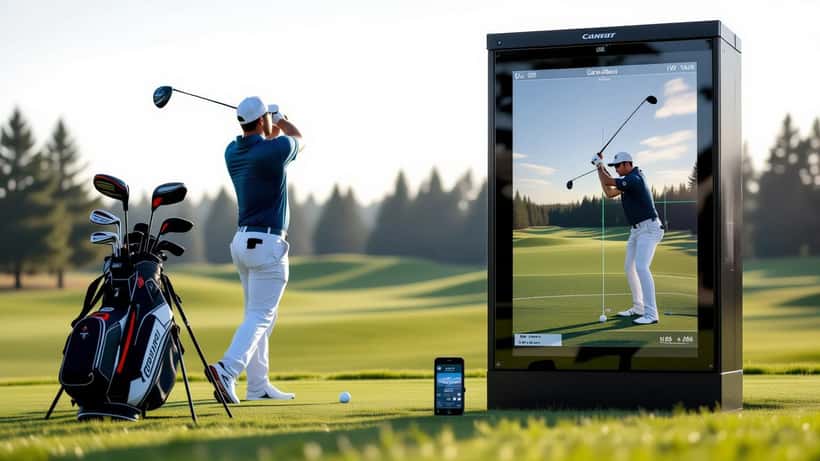
DeChambeau's public embrace of data has pulled a whole category of consumer golf electronics into the mainstream. Portable launch monitors that once lived only in fitting studios now sell to garage golfers. These devices use radar or high-speed cameras to measure clubhead speed, ball spin, launch angle and carry distance — the same metrics DeChambeau cites when he explains a swing change on his YouTube channel, which has grown past 2.7 million subscribers, according to reporting from Golf Digest.
The consumer versions range from roughly a hundred dollars for a basic rangefinder to several thousand for a photometric launch monitor. Add wearable swing sensors, putting mats with sensors, and app-connected grips, and a hobby that once needed only clubs and a ball can now carry a five-figure electronics bill.
What the numbers actually do for an amateur
Here is where an honest expert assessment matters. A launch monitor is a measurement tool, not a coach. It tells you that your seven-iron carries 145 metres with 3,200 rpm of spin; it does not tell you why, or what to change. For a disciplined player who already understands cause and effect, that feedback loop is genuinely valuable. For a beginner, a screen full of numbers can create false precision — chasing a spin rate while ignoring a grip that needs fixing first.
Accuracy also varies widely between price tiers. Entry-level radar units can be reliable on clubhead and ball speed but far less trustworthy on spin, which they often estimate rather than measure. That distinction is rarely printed clearly on the box. A rangefinder, by contrast, does one job well and is the single most cost-effective gadget most amateurs can buy, since accurate distance beats a guessed yardage almost every round.
Read the claims before you buy
Golf electronics are marketed with the same bold performance language as any consumer tech category. In Canada, the Competition Bureau requires that performance and comparison claims be truthful and not misleading, and shoppers can review their consumer-protection resources through the federal Office of Consumer Affairs (see ised-isde.canada.ca). Phrases like "tour-accurate" or "professional-grade" carry no standard definition, so treat them as marketing, not measurement. Ask the seller for the stated error margin on spin and carry, and check the return window before you commit.
Compatibility is the other quiet cost. Many devices only unlock their best features through a paid subscription app, and some wireless units need a strong phone connection to function outdoors. Battery life, indoor-versus-outdoor range, and whether the data actually exports to a format you can use months later all matter more than the headline metric count.
When to bring in an expert
A consumer-electronics specialist can save an amateur golfer far more than the price of a consultation. Before spending on a launch monitor, an expert can match the device tier to your actual goal — casual practice, structured improvement, or club fitting — and flag which "must-have" metrics you will realistically never use. They can also compare radar versus camera-based systems for your typical practice environment, since a unit that shines on a driving range may struggle in a netted garage.
For anyone weighing a major purchase, an independent review beats a pro-shop upsell. The same logic that makes DeChambeau test everything before trusting it applies to your wallet: verify the numbers before you pay for them.
The bigger 2026 story
DeChambeau himself has hinted that his future may tilt away from week-in, week-out tour golf. His LIV contract expires at the end of the 2026 season, and he has openly discussed focusing on major championships and his hugely popular "Break 50" YouTube series, per reporting from Front Office Sports. In other words, even the sport's most famous gadget evangelist is increasingly a content creator as much as a competitor — which only accelerates how quickly consumer golf tech reaches ordinary players.
That trickle-down is good news and a warning at once. The tools are better and cheaper than ever, but the marketing has never been louder. For the weekend golfer, the winning move is not to buy what the Scientist uses. It is to buy only what your game can actually use — and to get a straight answer before you do.
If you are planning a golf-tech purchase this season, connect with a consumer-electronics expert on Expert Zoom for an independent, jargon-free assessment before you spend.
