 Ella Singh
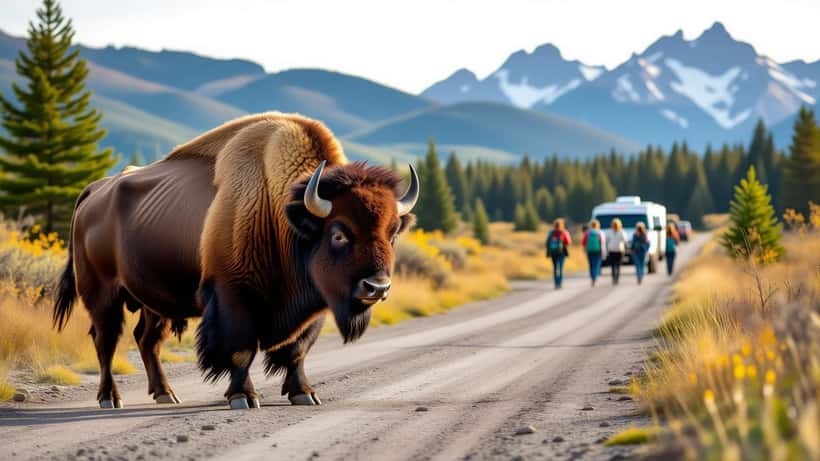
A bull bison hurled a 65-year-old grandfather roughly eight feet into the air at Yellowstone National Park on the evening of July 10, 2026, breaking his femur and sending him to hospital. Carl McDaniel was walking near the Bridge Bay Campground with his 13-year-old grandson after dinner when the animal, which had been rolling in the dust nearby, suddenly drove the top of its head into him. According to Cowboy State Daily, witnesses described the bull as "agitated" and "charging anything and everything." It was the park's second human-bison injury of the year — the first, on June 26, hurt a 12-year-old near Mud Volcano.
For Canadian travellers, the incident is more than a distant American headline. Bison roam several of Canada's most-visited national parks, and the same seasonal biology that turned a docile-looking bull dangerous in Wyoming is unfolding right now in Alberta, Saskatchewan and Manitoba. Understanding why bison attack — and how far to stay back — is the difference between a great photo and a trip to the emergency room.
Why a "calm" bison suddenly charges
The animal that tossed McDaniel was not defective or unusually vicious. It was behaving exactly as a bull bison behaves in mid-summer. Bison enter their annual mating season, called the rut, from roughly June through September. During the rut, bulls compete aggressively for cows, their testosterone surges, and their tolerance for anything nearby — including humans — collapses. A bull that appears to be peacefully wallowing in the dust one minute can wheel and charge the next, with no drawn-out warning.
Wildlife-behaviour specialists stress that bison are deceptively fast and powerful. A mature bull weighs up to 900 kilograms and can sprint at more than 50 km/h — three times faster than most people can run. That combination of mass and speed is why a shove from the head alone was enough to launch a grown man into the air. Bison injure more visitors in North American parks each year than bears do, precisely because tourists misread their slow, grazing posture as tameness.
There are warning signs, and an expert can teach you to read them. A bison that raises its tail, snorts, paws the ground, shakes its head or turns to face you directly is signalling agitation. By the time those cues appear, you are already too close. The correct response is to back away slowly and immediately — never turn and sprint, and never try to retrieve a hat, phone or camera left inside the danger zone.
The Canadian distance rule is stricter than you think
Here is where many Canadian visitors get caught out. In Yellowstone, the U.S. National Park Service asks people to keep at least 25 yards — about 23 metres — from bison. Parks Canada sets the bar far higher. At Elk Island National Park east of Edmonton, home to one of the country's largest bison herds, visitors on foot are required to stay at least 100 metres away from the animals at all times.
Parks Canada offers a simple field test: hold your thumb up at arm's length, and if a single bison is completely hidden behind your thumb, you are roughly 100 metres away — a safe distance. If any part of the animal peeks out, you are too close and must retreat. The agency warns bluntly that "even though bison look docile, they are dangerous, unpredictable, and may charge without warning," with extra caution needed in May and June, when cows fiercely guard newborn calves, and through the July–August rut, when bulls are at their most volatile. Detailed guidance is published on the official Parks Canada "Be bison wise" page.
The rules carry real teeth. Disturbing, feeding or enticing wildlife in a Canadian national park is illegal under the Canada National Parks Act, and visitors who violate distance restrictions — including stepping out of a vehicle within 100 metres of bison — can face fines of up to $25,000. Those penalties exist because the agency has watched the same preventable injuries repeat year after year.
When to call in an expert
Wildlife encounters sit at the intersection of animal behaviour, first aid and, sometimes, liability — and each has a professional worth consulting.
An animal-behaviour specialist or a veterinarian with large-animal experience can explain herd dynamics before a family trip, brief you on seasonal risk windows, and help you plan wildlife viewing that is genuinely safe rather than luck-based. If you keep bison, cattle or other large livestock on your own land — increasingly common on Prairie acreages — a veterinarian's guidance on handling animals during the rut and calving seasons is not optional; it is basic risk management.
Should the worst happen, a goring or trampling injury is a medical emergency. Bison horns and sheer force cause deep puncture wounds, fractures and internal bleeding that are easy to underestimate in the adrenaline of the moment. Anyone struck by a bison should be assessed by a medical professional immediately, even if they feel able to walk away, as McDaniel's broken femur illustrates. This article is general information and is not a substitute for professional medical, veterinary or legal advice.
The takeaway before your next park visit
The Yellowstone attack is a timely reminder as Canadian families head into peak summer park season. The biology is not going to change: from June through September, bulls are primed to charge. The single most effective safeguard costs nothing — give every bison the full 100 metres, keep children and pets close, stay in your vehicle where required, and treat that thumb-at-arm's-length test as a hard rule rather than a suggestion.
If you are planning a trip that puts you near large wildlife, or you manage animals of your own, a short consultation with a veterinary or animal-behaviour expert can turn a season of anxiety into a season of confident, safe viewing. The bison were here long before the campgrounds — the responsibility to keep a respectful distance rests with us.
