 Adèle Chartrand
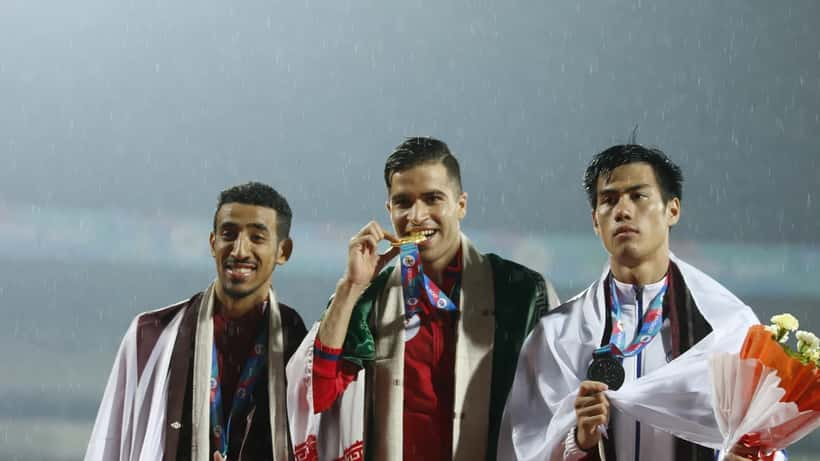
Right now in Nagoya, 777 male athletes from 41 nations are in the final stretch of the athletics program at the 2026 Asian Games — sprinting, throwing, jumping, and competing under conditions that push the human body to its limit. India's Neeraj Chopra, the javelin champion who spoke publicly about fighting injury setbacks this month just as he felt he had "rediscovered his best form," is one of the most visible examples of a challenge that defines elite men's sport: the collision between ambition and physical vulnerability. For Canadians who are active at any level, his story holds a lesson that extends well beyond Nagoya.
What Is Happening on the Track in Nagoya This Week
The 20th Asian Games officially opened in Aichi-Nagoya, Japan, on September 19, 2026, and the men's athletics program is scheduled through September 29 — meaning competition is at its most intense right now. The games feature 43 sports disciplines, from athletics and swimming to kabaddi, kurash, and newly added padel, with over 10,000 athletes competing from across the continent. Japan's Ohashi Shin delivered one of the most memorable performances of the games already, setting a world record of 2:04.83 in the men's 200m breaststroke on September 24, according to the official Asian Games results portal.
The conditions have been demanding from the start. Record-breaking torrential rain struck Nagoya in early September, disrupting training schedules and forcing several hundred athletes housed in temporary structures near the port to evacuate. While venue damage was limited, the disruption to preparation — sleep, training rhythm, and pre-competition warm-up routines — is significant. For men's athletes competing in sprinting, jumping, and throwing events, even small disruptions to their physical preparation can create the conditions for acute injury.
Hamstrings, Achilles tendons, rotator cuffs, and knee ligaments absorb enormous forces at competition-level intensity. For most athletes, these injuries are not dramatic collapses. They are the quiet cumulative load of months of training arriving at a single moment of rupture — often at a transition point between preparation and peak performance.
What Elite Athletes Know That Weekend Warriors Often Don't
Professional athletes competing at the Asian Games operate with full medical support: physiotherapists, sports medicine physicians, ultrasound imaging available pitch-side, and individualized load management protocols built around years of performance data. When Neeraj Chopra describes dealing with an injury setback just as he had "rediscovered his best form," he is articulating a pattern every sports medicine specialist in Canada recognizes immediately: the transition back from injury is statistically the most dangerous phase of athletic preparation.
This principle applies as directly to a 45-year-old playing recreational hockey in Hamilton as it does to an Olympic-level javelin thrower. The Canadian Academy of Sport and Exercise Medicine (CASEM), the national body representing sports medicine physicians in Canada, consistently highlights that the majority of acute sports injuries treated in Canadian clinics involve either overuse — where athletes ignored early warning signals — or premature return-to-play decisions, where the athlete felt ready before the tissue had actually healed.
The gap between "feels okay" and "is structurally ready to perform" is invisible without a proper clinical assessment. That gap is exactly what sports medicine professionals are trained to evaluate. In Canada's recreational sport landscape, most amateur athletes do not have a regular sports medicine relationship. They see a physiotherapist reactively — after the second or third injury to the same area — rather than proactively. The athletes competing in Nagoya did not reach that level by managing pain with guesswork.
What separates elite athletes from recreational ones is not just physical capacity. It is the quality of information they use to make return-to-play decisions — and in Canada, that same quality of information is available to anyone through a sports medicine consultation.
The Toronto Weekend Warrior: When the Numbers Change Everything
Consider a 40-year-old recreational soccer player in Toronto who pulls his right hamstring during a Sunday league match in late September 2026. A sprint for the ball, a sharp pop, and a burning sensation in the back of the thigh. He walks off the field slowly, is sore on Monday, but decides it is "just a strain" — the same diagnosis he would give himself every time. He plans to return to play in two weeks, because that is what he always does.
Here is what the evidence actually says about that decision:
- A Grade 1 hamstring strain (mild micro-tear with intact overall muscle structure) typically requires 10–14 days of active, physiotherapy-guided recovery before safe return to sport.
- A Grade 2 strain (partial tear, which presents similarly in the first 24 hours but with moderate swelling and difficulty jogging at pace) requires 4–8 weeks of structured rehabilitation.
- If this Toronto player has a Grade 2 injury and returns to play at the 14-day mark, research reviewed by Canadian sports medicine specialists indicates a re-injury risk of 40–60% within the same sporting season — to the same muscle, at greater severity.
The critical if/then: If you can jog at approximately 50% of your normal pace by Day 4 without pain, and swelling is visibly absent by Day 3, you are likely dealing with a Grade 1 strain and a graduated self-managed return is reasonable. If you cannot reach a comfortable walking pace without pain by Day 2, have visible bruising forming in the thigh, or feel a deep aching sensation even at rest by Day 3 — you are likely looking at a Grade 2 or Grade 3 tear, and a professional assessment before Day 5 is not optional.
The clinical difference between acting on that assessment versus waiting is, on average, 3–5 additional weeks of recovery if a Grade 2 tear is treated as Grade 1. In practical terms, that is the difference between finishing the fall soccer season or ending it early. It is also the difference between a muscle that heals correctly and one that builds scar tissue around an inadequately treated partial tear — creating the structural vulnerability for the next injury.
This is one of the most common presentations in sports medicine clinics across the country every autumn, when recreational leagues resume after summer. The pattern is predictable — and it is also largely preventable.
Five Warning Signs That Require Professional Evaluation
Athletes competing in Nagoya have immediate pitch-side medical coverage. For Canadians playing recreational sport, the equivalent is a sports medicine physician or physiotherapist. The following warning signs, after any sports injury, indicate that self-management alone is not the right approach:
1. Pain persisting beyond 72 hours at rest, not only during activity — this suggests tissue damage that goes beyond simple delayed-onset muscle soreness, which typically improves with gentle movement.
2. Swelling or bruising appearing within 24 hours of the injury — rapid bruising signals bleeding within muscle or connective tissue, which alters rehabilitation protocol significantly and requires professional grading.
3. A "pop" or snapping sensation at the moment of injury — this is a classic indicator of ligament or tendon involvement rather than a simple muscle strain, and the treatment pathway diverges significantly.
4. Loss of range of motion that does not improve within 48 hours of initial rest and ice — a consistent sign that imaging may be needed to rule out structural damage before beginning rehabilitation.
5. A second injury to the same area in one sporting season — recurrence signals underlying structural vulnerability that rest alone will not address; supervised rehabilitation is needed to rebuild tissue integrity.
For sports injuries in Canada, a consultation with a sports medicine physician or physiotherapist does not require a GP referral in most provinces. Most assessments can be completed in a single 30-minute session — enough to distinguish a self-managed recovery from one requiring targeted clinical treatment.
Disclaimer: This article provides general health information only. It is not a substitute for professional medical advice, diagnosis, or treatment. If you are experiencing acute pain or suspect a serious injury, consult a qualified health professional.
What the Asian Games Teach Us About Our Own Bodies
The men competing in Nagoya — including those who, like Neeraj Chopra, have navigated serious injury setbacks — built their athletic careers by treating their bodies as systems to be understood, not just pushed. That approach is not exclusive to elite sport. For Canadians who play recreational soccer, hockey, tennis, or weekend trail running, the same investment in professional sports medicine guidance pays off across years of healthy, active participation.
Earlier this season, our piece on World Cup 2026 athlete injury protocols explored how top clubs approach rehabilitation differently from recreational athletes — the core principle is the same: the earlier a proper assessment happens, the shorter and safer the recovery.
Expert Zoom connects Canadians with licensed health professionals — from sports medicine specialists and physiotherapists to general practitioners — for online consultations available quickly, without a referral and without a waiting room. If your body is sending signals this season that you are not sure how to interpret, a professional second opinion now is far less costly — in time and in physical consequence — than finding out too late that you pushed through something that needed proper care.
