 Clara MacDonald
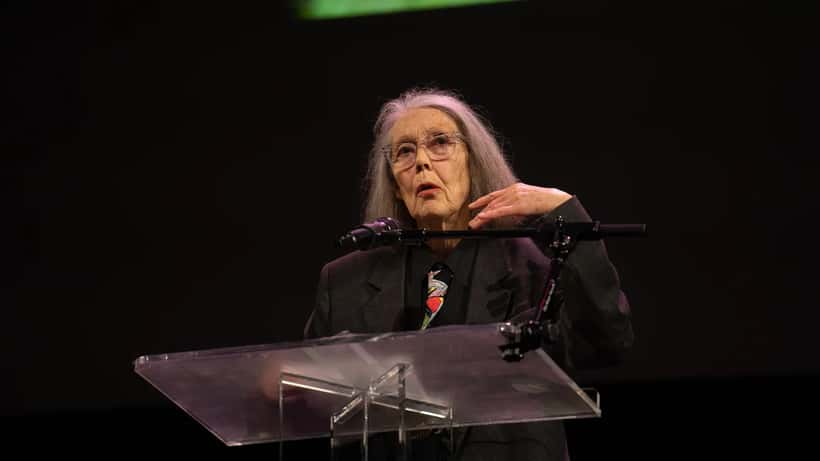
On October 8, 2026, the Swedish Academy announced that Anne Carson — a 76-year-old poet, essayist, translator, and classicist from Toronto — had won the Nobel Prize in Literature. The prize carries a value of 12 million Swedish kronor (approximately CAD 1.65 million), and the citation described Carson's work as "bold and inventive oeuvre that, in playful dialogue with the classical tradition, has created new forms for contemporary literature." Swedish Academy chair Anders Olsson added that almost all her literary production "has centered upon the intersection between the philologist's obsession with words and the poet's desire for new meaning."
For Canadian readers, the announcement is not merely cultural news. It is a curriculum event with direct consequences for every student currently enrolled in a senior English, IB, or AP literature course — and for anyone preparing university application essays that require close engagement with Carson's famously demanding texts.
Four Numbers That Frame the 2026 Nobel
The data around Carson's win illuminates why this moment matters in classrooms, not just libraries:
- 12 million SEK (~CAD 1.65 million): The Nobel Prize value — the largest single literary prize on the planet
- 76 years old: Carson is among the oldest recipients in recent memory, with a body of work spanning four decades and more than a dozen major publications
- 19th woman in 125 years: The rarity of female Nobel laureates in literature is precisely why Canadian education systems are moving quickly to integrate Carson's work into core curricula
- 400%+: The reported surge in orders for Carson's backlist within 24 hours of the announcement, straining university bookstore inventories from Victoria to Halifax
The Nobel Prize press release notes that Carson's work performs a singular act: it makes classical antiquity feel urgent and contemporary, not academic. That quality is what drives both her critical acclaim and the steep learning curve students face when they meet her texts for the first time.
Why Carson's Work Is Harder Than It Looks on a Syllabus
Carson holds a PhD in Classics from the University of Toronto and has taught at McGill, the University of Michigan, and NYU. Her signature literary form — what critics call the "essay poem" — fuses lyric verse with footnotes, essay fragments, translation, and visual collage. Her 1998 verse novel Autobiography of Red retells the Greek myth of Geryon through a contemporary coming-of-age story. Nox (2010) is a hand-sewn, accordion-folded artist's book built around a translation of Catullus. If Not, Winter (2002) is her translation of the fragmentary Sappho corpus, arranged so that the white space of lost lines becomes part of the poem's meaning.
Three specific challenges recur in student work on Carson:
- Intertextual density: Carson assumes familiarity with Stesichoros, Catullus, Sappho, and their scholarly traditions. Students who lack that background often read her irony as sincerity, or her classical allusions as ornament rather than argument.
- Genre instability: Markers at Canadian universities reward students who can name and explain a text's formal choices. When a text resists being called "poem" or "essay," students trained on fixed rubrics struggle to produce the analytical vocabulary that earns the highest grades.
- Emotional indirection: Unlike confessional poets such as Anne Sexton or Sylvia Plath, Carson withholds direct statement. The emotional payload of The Beauty of the Husband or Nox arrives through accumulation and omission, not explicit declaration — a technique that demands a particular kind of close-reading discipline.
These are not signs that a student is wrong for the text. They are gaps that a specialist literature tutor — one who has navigated the secondary literature on Carson, understands close reading in a Classics-inflected framework, and knows what Canadian university English departments reward — can close systematically and quickly.
When a Final Grade Determines University Admission
Consider the situation facing Ethan, a Grade 12 student in Hamilton, Ontario, applying to the Honours English program at McMaster University and the Creative Writing program at the University of Toronto. Both programs set a minimum admission average of 75% across six Grade 12 courses. Ethan's current average sits at 72%, held down by a 65% in his Grade 12 English course (ENG4U).
His most recent assignment — a comparative essay analyzing Carson's Autobiography of Red against Margaret Atwood's The Penelopiad — received a grade of 63%. His teacher's feedback identified three recurring problems: he treated Carson's classical references as background decoration rather than argumentative structure; his essay had a clear topic but no controlling analytical claim; and his close reading of individual passages described what Carson said rather than what formal choices produced that effect.
Ethan works with a literature specialist tutor for eight sessions over six weeks, at a rate of $75 per hour: $600 total.
- Sessions 1–2: The tutor builds Ethan a comparative grid — myth-revision as argumentative framework, aligning Geryon's transformation in Carson with Penelope's subversion in Atwood. He learns to move from plot summary to formal analysis.
- Sessions 3–4: Close reading drills on Carson's syntax: how fragmentation and white space generate meaning, why the tutor has him read passages aloud and annotate silence as a formal device.
- Sessions 5–6: Essay structure under exam conditions — the tutor introduces the "analytical claim sandwich" that his marker rewards: observation → formal device → interpretive consequence.
- Sessions 7–8: Full-draft feedback on his next assignment (Nox and The Stone Diaries by Carol Shields), revision until the essay demonstrates consistent analytical movement from evidence to claim.
Ethan's next major essay earns 78%. His ENG4U grade rises from 65% to 71–74% across the semester, lifting his overall admission average from 72% to 73–75%.
The if/then logic is direct: if Ethan does not work with a literature specialist before his next assignment, his analytical pattern — summarizing content rather than interpreting form — is likely to persist, keeping him below the 75% threshold at both programs. With $600 in specialist tutoring, he changes that pattern structurally, not just for one essay, but for every close-reading task he faces through to final exams. The cost of a gap year — foregone wages, deferred graduation, supplementary tuition — typically runs CAD 15,000–30,000. The $600 investment changes the probability of that outcome significantly.
Carson's Win Reshapes the Canadian Literature Canon
For decades, Margaret Atwood has served as the primary anchor of Canadian literature in secondary and post-secondary curricula. Carson's Nobel Prize introduces a second major female author whose work is simultaneously national and international in scope — born and educated in Ontario, writing about grief, desire, and classical antiquity in a way that has reshaped what English-language poetry can look like.
Curriculum committees in Ontario, British Columbia, and Quebec are already reviewing their senior literature units. Provincial IB coordinators have flagged Autobiography of Red as a strong candidate for the Paper 2 comparative list in the 2027–2028 exam cycle. AP Literature coordinators are noting Carson's potential as a prose and poetry selection in future released exams.
Students who build their analytical fluency with Carson's texts now — learning to navigate hybrid forms, track classical intertexts, and interpret emotional indirection — will carry a durable advantage through the years ahead. These are transferable skills that apply to any formally complex text, not just Carson's.
The Next Step for Canadian Students and Families
If you or a family member is currently working through Carson's texts in a senior English, IB, or AP course — or expects to encounter them in the next academic year — connecting with a literature specialist is the highest-leverage action available. ExpertZoom connects students across Canada with tutors who specialize in literary analysis, Canadian literature, essay writing for university admissions, and classical texts.
A 45-minute session with the right specialist can transform the way a student reads Autobiography of Red — and with it, the grade that follows. Anne Carson just became Canada's most important living author. The students who learn to read her well will be recognized for it.
