 Maya MacDonald
From World Number 91 to Roland Garros Round 3
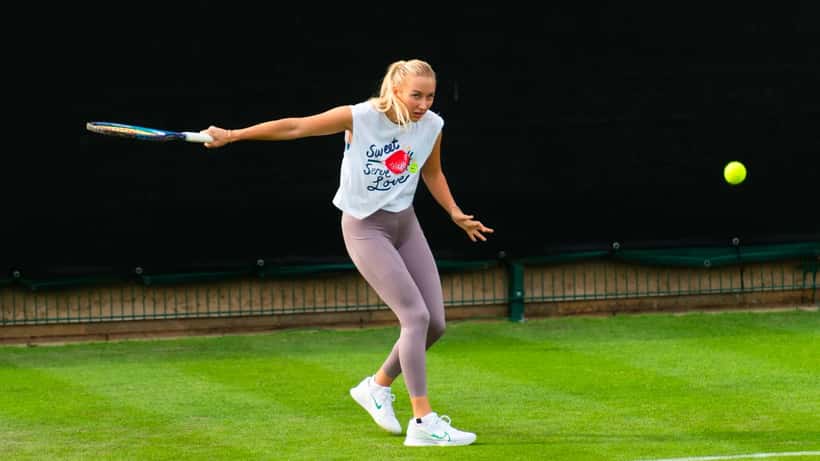
Anastasia Potapova entered the 2026 clay season ranked 91st in the world. On May 30, 2026, she steps onto Court Philippe-Chatrier to face Coco Gauff, the defending Roland Garros champion, as the world's 30th-ranked player. Gauff arrives on a 9-match winning streak at the tournament. That 61-position climb happened across approximately three months of consecutive clay court competition, involving extra qualifying rounds, back-to-back tournament weeks, and a 3-set comeback victory at the sport's most physically demanding Grand Slam.
The results are striking enough. The physical story behind them is more instructive.
The Clay Swing That Drove the Ranking Surge
Potapova's ranking jump was built on an extraordinary sequence. She reached the Madrid Open semifinal as a lucky loser — meaning she failed in the qualifying draw, then was called into the main draw as a replacement when a seeded player withdrew. As a lucky loser who went deep, she played up to four qualifying matches followed by four or five main draw rounds. Her competitive load in Madrid alone reached eight or nine matches in roughly 10 days.
From Madrid, she travelled to Rome and came through the qualifying draw — three more matches before the main draw even began — then reached the round of 16. At Roland Garros 2026, she beat Maya Joint in the first round, then came from behind against Katie Boulter, winning 5-7, 6-4, 6-2 in two hours and seven minutes on May 28.
In competitive terms, Potapova has played more matches in the last three months than most top-30 players play in twice that time. That volume, on clay specifically, has a distinct physiological signature.
What Makes Clay Court Play Medically Demanding
Red clay is the slowest Grand Slam surface. Rallies are longer, points last more shots, and players cover more ground per game than on hard courts or grass. The surface also requires intentional sliding — a technique that imposes eccentric loading on the quadriceps, hip flexors, and patellar tendon with every deceleration and change of direction.
Sports medicine clinicians who work with clay court players typically monitor three risk areas during extended clay seasons. First, lower limb soft-tissue fatigue — particularly in the calf complex and Achilles — accumulates when recovery time between matches is shorter than 48 hours, which is standard at Masters-level events with deep runs. Second, hip flexor strain from repeated sliding mechanics increases with match volume; asymmetric fatigue on the dominant side is common. Third, the patellar tendon carries sustained compression during baseline exchanges. Clay rallies average significantly more shots than equivalent hard-court points, and tendon stress can become symptomatic over a three-month season without structured unloading periods.
What makes Potapova's run unusual is not just the results — it is that she has maintained her movement quality and match intensity through this volume without a visible injury withdrawal.
The Recovery Window Between Tournaments
The Madrid Open ends in early May. Rome begins approximately one week later. Roland Garros starts one week after Rome. For a player who went deep in Madrid and through qualifying in Rome, the recovery window between each event is four to five days — enough for basic restoration, not enough for full soft-tissue regeneration.
Sports medicine protocols for this scenario typically include active recovery sessions on the day after elimination, prioritizing circulation over rest. Soft tissue work — massage, dry needling, or foam rolling — targets the hip, quadriceps, and calf groups that carry the highest clay-specific load. On-court time is reduced significantly in the first 72 hours post-tournament. Minor tendon complaints receive early attention before they become structural issues.
The SportMedBC model — used widely by British Columbia's competitive athletes across racket sports and endurance events — emphasizes that the window between competitions is where injury prevention actually happens. What an athlete does in the days after one event determines their physical capacity for the next.
What This Means for Canadian Recreational Athletes
Recreational tennis players in Canada face a version of the same challenge. Spring and summer leagues often run simultaneously. Weekend tournaments are scheduled back-to-back across May and June. Amateur players frequently move from one competition to the next with less than a week of recovery — and without the sports medicine support that professional players carry.
The injury patterns are predictable: plantar fasciitis, patellar tendinopathy, hip flexor strain, and calf tears are the most common presentations in recreational clay court players who compete through fatigue. These injuries do not require dramatic trauma — they accumulate through repetition over a compressed schedule.
A sports medicine physician or physiotherapist who specializes in racket sports can provide a musculoskeletal assessment that identifies stress patterns before they become injuries. A basic tendon screening and movement assessment — something that takes less than an hour — can identify whether a player is approaching a load threshold before their body enforces the rest. ExpertZoom connects Canadians with sports medicine and health professionals who offer this kind of assessment and can design recovery protocols tailored to a specific tournament schedule.
The Match on May 30 and What It Will Reveal
Gauff and Potapova have met four times on tour, splitting the results 2-2. Potapova won their only clay-court meeting heading into this match and has won her last two encounters with the American. She enters May 30 as the lower seed, but with clay-court form that has been better than almost any player on the tour this spring.
What the match will reveal medically is whether the cumulative load of this clay swing has left any trace in Potapova's movement. The first set of a long clay match tends to surface fatigue that shorter exchanges conceal — restricted first step, slightly slower recovery from wide balls, or reduced racket speed on the second serve. If Potapova moves through the first set as she moved through the Boulter match, the sports medicine case for her peak-load management will be as strong as her tennis.
Potapova's Roland Garros run is already a detailed case study in how an athlete can compress an enormous competitive load into a short season. She has emerged, at least for now, playing the best tennis of her career — with today's match still to play.
This article is for informational purposes only and does not constitute medical advice. If you are experiencing musculoskeletal pain or sports-related injury, consult a qualified health professional.
