 Dave Campbell
Australia's quarter-final window opens on July 10 at 6am AEST, when France takes on Morocco in Boston. Three of the four World Cup 2026 quarter-finals land between 5am and 7am AEST, with the fourth — provisionally Sunday morning — offering a rare window of civilised viewing. If you are planning to watch all four matches from home between July 9 and July 12, you have less than 72 hours to make it worth your while.
With SBS broadcasting every World Cup 2026 match free-to-air in Australia, viewership during the knockout rounds is set to reach its highest point of the tournament. Renovation experts say this is the most overlooked moment to make permanent home improvements that will outlast any four-year cycle.
Why Quarter-Final Viewing Is a Different Challenge
The group stage invites casual watching. Quarter-finals — featuring France, Morocco, England, Norway, and a field that still includes Spain, Portugal, Argentina and USA — are appointment television of a different order. Every match carries elimination stakes for genuine title contenders, and the viewing experience at home either rises to that or it does not.
For Australians on the eastern seaboard, the AEST scheduling of the 2026 World Cup has been broadly favourable throughout the group stage. The quarter-finals tighten that window. Three early-morning kick-offs and one mid-morning slot mean different setup requirements: blackout conditions for the pre-dawn matches, ambient control for the late-morning fixture.
1. TV Placement and Sightlines
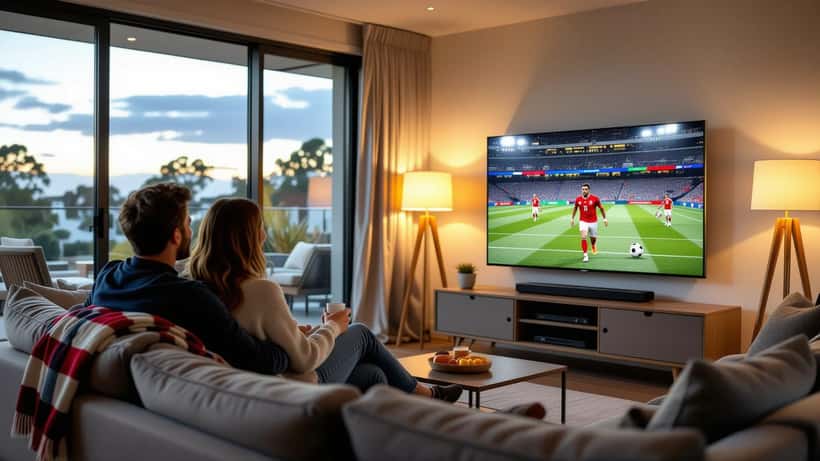
The most common renovation mistake in home entertainment spaces is treating the television as an afterthought. Mounting height, viewing angle and ambient light interference are structural decisions that affect every match you will ever watch — not just the quarter-finals.
For a 65-75 inch screen (now the dominant size sold in Australian retail during major sporting events), optimal mounting height places the screen centre at seated eye level: approximately 100-115 centimetres from the floor. An incorrectly mounted 30-kilogram screen is a safety risk, not just a viewing inconvenience.
Wall mounting requires confirmation of stud positions and load capacity. In homes built before 1990, wall cavity construction is often non-standard. A licensed tradesperson should assess the wall before any fixed mounting proceeds.
2. Sound: The Underrated Upgrade
A quarter-final match without adequate audio is half an experience. Renovation professionals consistently identify sound as the area where homeowners under-invest.
In open-plan spaces, a soundbar positioned at ear level directly below the screen provides the directional audio that enclosed rooms enjoy naturally. For dedicated viewing rooms, acoustic panels available from major Australian home improvement retailers reduce echo without structural work.
If you are planning a more involved audio retrofit, the Australian Building Codes Board publishes guidance on acoustic performance standards in residential buildings — a useful reference before any contractor begins work on walls or ceiling panels.
3. Seating Arrangement and Room Layout
Viewing comfort determines how long people stay in the room. A U-shaped or L-shaped sectional arrangement — with the screen at the open end — provides unobstructed sightlines for multiple viewers. Ottomans and floor cushions handle overflow without blocking the primary viewing axis.
For a quarter-final crowd, renovation specialists recommend planning for 1.5 times your usual number of seats. In a living room of 25-30 square metres, that typically means rethinking furniture placement entirely rather than adding chairs around the edges.
Note which walls receive morning sunlight before committing to a layout. For the 6am AEST kick-off on July 10, east-facing windows produce direct glare at exactly the moment you need a clear screen.
4. Outdoor Viewing in Winter Australia
July is winter, but in Queensland and northern New South Wales temperatures remain mild enough for outdoor viewing setups. Demand for permanent outdoor entertainment areas has risen sharply across Australian residential renovation activity since 2022, particularly for households investing post-tournament rather than mid-season.
A compliant outdoor entertainment structure typically requires council approval once decking exceeds a certain size. Any outdoor power outlet must be installed by a licensed electrician — running an extension cord from inside is both a code violation and a fire hazard. Battery-powered projectors rated for outdoor use sidestep the certification question entirely for one-off setups, provided you stay within manufacturer specifications.
For a match at 6am in July, shelter from overnight dew and a windbreak matter more than shade. A pergola with a cafe-blind on the southern or westerly face handles both.
For streaming setup at home, see also Switzerland vs Algeria at WC2026: Is Your Home Screen Ready? — a breakdown of which streaming resolutions require hardware changes.
5. Lighting Control
Blackout blinds or motorised roller shades typically cost between AUD $400 and $1,800 per window depending on size and installation. For three early-morning quarter-final kick-offs in pre-dawn darkness, blackout control may seem unnecessary — but east-facing bedrooms and living rooms will face sunrise glare before the 90 minutes are up.
Smart lighting that dims to a pre-set cinema mode costs under $300 in a standard lounge configuration and is available from major Australian hardware retailers. More importantly, it is reversible: no structural work, no council application, and it works for every event after the final whistle of this tournament.
When a Professional Makes the Difference
Four of the five upgrades above can be planned in an afternoon and completed over a weekend. Wall mounting in non-standard walls, outdoor electrical work, structural decking, and acoustic retrofitting in older homes all benefit from professional assessment before you begin.
ExpertZoom connects Australians with verified home improvement experts available for paid video consultations. A 30-minute session with a renovation specialist before you start drilling costs considerably less than fixing a structural mistake after the quarter-final.
Quarter-finals begin July 9. France and Morocco open proceedings on July 10 at 6am AEST. Your setup window is tight — but it is there.
