 Chloe Wilson
Victor Wembanyama rewrote the NBA record books on 18 May 2026: 41 points, 24 rebounds, as the San Antonio Spurs stunned the Oklahoma City Thunder 122-115 in Game 1 of the Western Conference Finals. The 22-year-old Frenchman joined Wilt Chamberlain as the only player in history to record 40 or more points and 20 or more rebounds in a Conference Finals debut. That performance left Australian sports fans asking the same question professional teams grapple with every night: how do you keep a body performing at that level, game after game?
The Physical Reality Behind One of the Greatest NBA Nights
At 2.24 metres tall and built to match the physical demands of professional basketball, Wembanyama represents one of sport's most unusual physiological profiles. His Game 1 output required roughly 38 minutes of explosive movement, constant jumping, physical contact against players who are themselves elite athletes, and sustained mental concentration across four quarters.
His rookie teammate Dylan Harper added a historic line of his own: 24 points, 11 rebounds, 6 assists, and 7 steals. Harper became the first rookie to post those numbers in a playoff game since Magic Johnson in 1980. The Spurs' comeback from a 60-loss season to 62 wins is partly a story of talent, but also a story of systematic physical management: conditioning staff, load protocols, and real-time injury response.
For Australian sports enthusiasts, the gap between what NBA teams do for their athletes and what recreational players do for themselves is vast. That gap represents real injury risk.
When Should You See a Sports Medicine Specialist?
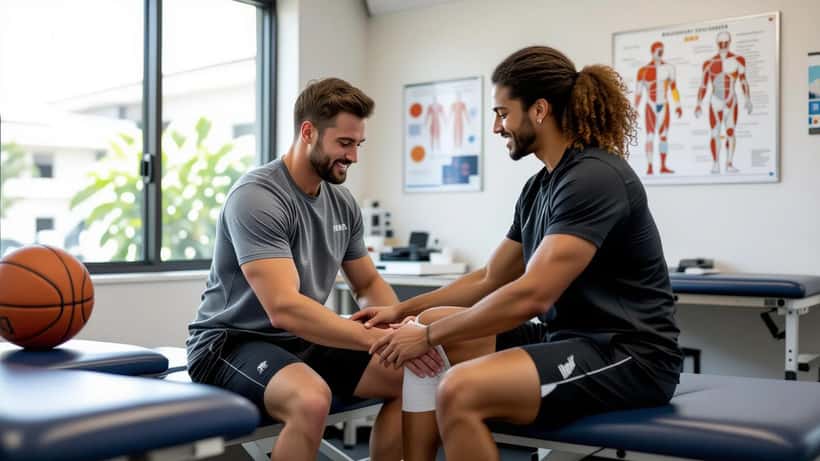
Sports medicine in Australia covers a network of specialists: sports physicians, physiotherapists, exercise physiologists, and sports dietitians, many of whom work together in multidisciplinary clinics. The most persistent mistake among recreational athletes is treating professional assessment as something only elite players need.
Three situations consistently warrant a consultation rather than the more common approach of rest and hope.
Pain persisting beyond 72 hours. Delayed onset muscle soreness fades within two to three days. Pain that intensifies or fails to resolve after that window signals something more complex than normal post-exercise soreness. NBA teams assess new complaints within hours of a game ending. Most Australian club players wait weeks, turning a manageable strain into a season-ending problem.
Joint swelling that doesn't subside. Any swelling around the knee, ankle, or shoulder should be assessed within 24 to 48 hours of onset. Swelling is the body's response to internal damage and will not resolve safely without understanding what caused it. Pushing through a swollen joint risks transforming a ligament strain into a chronic instability problem.
Movement compensation. If you find yourself favouring one leg, altering your running stride, or adjusting technique to protect a sore area, secondary injuries are building on top of the original complaint. A sports medicine assessment identifies the compensation pattern before it compounds into something harder to treat.
The Load Management Lesson
One of the most discussed concepts in elite basketball in 2026 is load management: deliberately monitoring and controlling how much physical work athletes perform to preserve their capacity across a long season. The Oklahoma City Thunder entered the Western Conference Finals with an 8-0 record in the playoffs, with coach Mark Daigneault widely credited for managing his roster's minutes and physical condition throughout the regular season.
This principle translates directly to Australian recreational athletes, and it does not require a team of specialists to apply the basics.
Returning athletes face the highest risk. Anyone returning to sport after illness, injury, or an extended break carries significantly elevated injury risk during the re-entry phase. Load should increase gradually and systematically, not jump to pre-break levels. A sports medicine specialist can design a structured return-to-sport program based on individual history and capacity.
Masters athletes need load monitoring most. The number of Australians over 40 competing in football leagues, running events, and recreational competitions has grown steadily. Recovery rates slow with age, and tissue resilience changes in ways that generic training advice does not account for. Sports medicine input into training structure is the most protective measure available.
Young athletes benefit from early guidance. The Australian Institute of Sport's long-term athlete development framework identifies overuse injury as a critical risk for junior athletes with high training volumes. Early involvement of a sports medicine professional can protect both performance potential and long-term physical health.
What Access Looks Like in Australia
Australia's sports medicine infrastructure is well-developed. Accredited sports physicians, physiotherapists, and exercise physiologists practise across every major city and most regional centres. Medicare provides rebates for certain sports medicine consultations when referred through a GP, and private health insurance extras cover typically includes physiotherapy benefits.
For most Australians, the practical entry point is a GP consultation with a sports medicine interest, followed by referral where needed. Direct referral to accredited physiotherapy practices is also available without a GP referral in most states. For complex cases, sports physicians and orthopaedic surgeons can be accessed from there.
The national professional body Sports Medicine Australia maintains a practitioner directory and publishes evidence-based guidelines for common sports injuries across all age groups and activity levels.
The Takeaway From the Thunder-Spurs Series
The 2026 Western Conference Finals is shaping up as one of the great playoff series in recent NBA memory. Wembanyama's Game 1 performance, alongside Harper's record-breaking contribution, puts elite human performance on display in a way that resonates with sports fans across Australia.
But the most useful thing most Australian athletes can take from watching that level of sport is not inspiration alone. It is the recognition that systematic, expert-supported physical management is what keeps extraordinary bodies performing under pressure, and that access to sports medicine guidance is not exclusive to professional teams.
For more on how elite player injuries translate to lessons for everyday athletes, read: Luka Doncic's Hamstring Recovery: What NBA Rehab Means for Aussie Athletes
Whether you are managing a persistent complaint, preparing for a competition, or returning from time off, a consultation with a sports medicine specialist provides the kind of personalised assessment that generic advice cannot replace. In a sport defined by bodies pushed to their limits, the experts who protect those bodies are worth knowing.
