 Chloe Wilson
The third and final T20I between Pakistan and Sri Lanka lands in Rawalpindi on 13 October 2026 — and for Australian cricket fans who stayed up past midnight to follow the opening two matches, a question is growing that has nothing to do with the scoreboard: what is all this late-night screen time actually doing to your eyes?
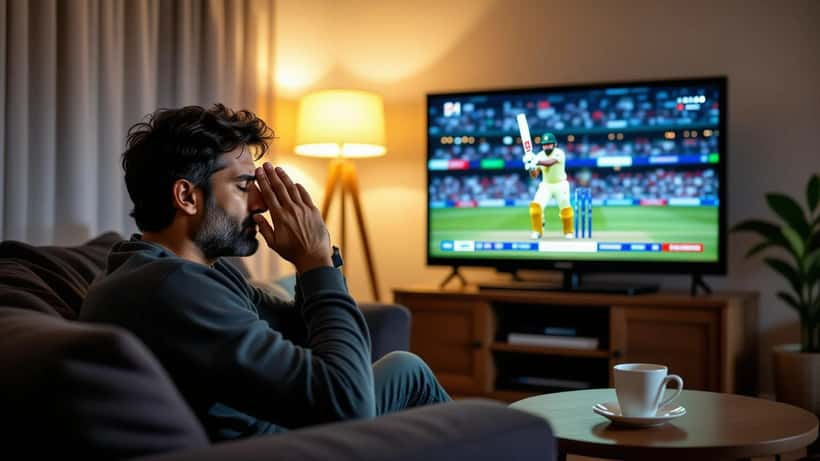
Pakistan's home T20I series against Sri Lanka kicked off on 9 October 2026, drawing strong interest from Australia's substantial cricket audience. The schedule creates an unavoidable time-zone problem: matches start around 7pm PKT, which translates to midnight to 1am AEST for east coast viewers. Three T20Is over five nights means dedicated fans have been stacking consecutive late-night screen sessions — on televisions, tablets, and phone streams — precisely the pattern that optometrists identify as most likely to trigger acute digital eye strain.
Why Late-Night Cricket Is a Different Kind of Screen Problem
The concern is not simply about total hours of screen exposure. Late-night cricket watching combines three factors that stack on top of each other: a high-contrast bright screen in a darkened or dimly lit room, reduced blinking as viewers concentrate on every ball, and disruption to the body's natural wind-down process just when melatonin production is ramping up.
Blink rate is the core mechanism that matters here. During normal conversation or outdoor activity, adults blink roughly 15 to 20 times per minute. During focused screen use — particularly when watching something engaging and fast-moving — that rate can drop to fewer than 7 times per minute, a reduction of more than 50 per cent, according to research published in the British Journal of Ophthalmology. Each blink refreshes the tear film across the corneal surface. Fewer blinks means faster tear evaporation, dry patches forming, and the burning, itching, and blurring that most fans chalk up to "just being tired."
Adding to this: research on the physical toll of late-night international cricket viewing has shown that the combination of physical alertness and screen exposure past midnight produces compounding physiological stress — not just eye fatigue in isolation.
What the Evidence Actually Says About Blue Light and Screen Strain
Blue-light filtering glasses are widely marketed as the solution for exactly this scenario. The scientific evidence, however, does not support that pitch. A 2023 Cochrane review of 17 randomised controlled trials found that blue-light filtering spectacle lenses "may not reduce eye strain symptoms associated with computer use compared to non-blue-light filtering lenses." A 2026 update published in Therapeutic Advances in Ophthalmology reinforced that finding, reporting minimal measurable effect on contrast sensitivity, colour discrimination, or subjective comfort ratings.
What does appear to work is far more straightforward. Healthdirect Australia, the national health information service, recommends the 20-20-20 rule as the most accessible and evidence-consistent intervention: every 20 minutes, shift focus to an object at least 6 metres away for 20 seconds. This gives the ciliary muscle — the small internal muscle that controls lens curvature for near-distance focus — a brief recovery window before it locks back onto the screen. Adjusting screen brightness to match room lighting, increasing font or interface size, and using preservative-free lubricating drops for persistent dryness are all established strategies that cost little and carry no side effects.
For late-night streaming specifically, enabling a device's "night mode" to reduce colour temperature (shifting the display amber) from around 10pm AEST is the most practical sleep-protective step. The mechanism is not primarily about the eyes themselves but about the circadian system: suppressing melatonin while the body is trying to prepare for sleep shortens sleep duration and reduces its restorative quality — which then feeds back into next-day eye fatigue.
What Happens When You Watch Every Match: A Concrete Case
Consider Ravi, a 41-year-old project manager in Melbourne who watched all three T20Is in the Pakistan vs Sri Lanka series. Each match ran approximately 90 minutes of playing time, but with breaks, commentary, and the occasional replay, his total screen time across the three evenings came to roughly five hours — all between midnight and 2am.
By the morning after the second match, Ravi was experiencing persistent blurring when shifting focus from his phone screen to objects across the room, a symptom consistent with accommodative spasm: the ciliary muscle tightening and struggling to release after extended near-distance work. He also noted a gritty sensation under his eyelids and a dull headache behind both eyes.
If Ravi visits an optometrist within a few days, the likely outcome is a standard bulk-billed consultation (Medicare covers optometry consultations in Australia at no out-of-pocket cost for card holders) plus a recommendation for lubricating eye drops, which retail between $12 and $28 per bottle. That is the best-case resolution — minor cost, quick recovery with rest and drops.
The scenario shifts significantly if Ravi's symptoms are not pure fatigue but are instead revealing an underlying, undiagnosed refractive error — mild short-sightedness or astigmatism that was compensated for during normal screen hours but becomes apparent under prolonged stress. An unmanaged refractive error with intensive screen exposure can produce progressive symptom worsening. The corrective pathway — professional assessment plus prescription glasses or contact lenses — typically costs between $200 and $600 for an initial pair. The if/then logic is direct: if symptoms persist beyond 48 hours of screen-free rest, the cause is no longer simple fatigue and a professional assessment is warranted. The ODI tri-series (Pakistan, Sri Lanka, and England) begins on 18 October, and Test matches follow in November — there are more late nights ahead for fans, and carrying an unaddressed refractive issue through the rest of the season compounds the risk.
The Four Warning Signs That Mean "See Someone Today"
Most digital eye strain resolves within one to two days of adequate sleep and reduced screen time. The symptoms that require same-day or next-day professional assessment — not a "wait and see" — are:
- Sudden blurring affecting one eye only, rather than both eyes equally
- New floaters (dark shapes or threads moving across the visual field) or flashing lights
- Pain behind one eye specifically, rather than the general tiredness of both eyes
- Any vision change that does not improve after a full night of screen-free sleep
These symptoms can indicate conditions entirely unrelated to screen use, including early retinal issues, that are time-sensitive to treat. The PAK vs SL series does not end here — with the ODI tri-series starting 18 October and Test matches in November, late-night viewing opportunities will continue for weeks. If any of these warning signs appear before then, do not wait for the cricket to finish.
What to Do Before the Next Match
For Australian fans planning to follow the rest of the series — or any future late-night international cricket — five adjustments will meaningfully reduce eye strain without sacrificing the viewing experience:
- Match your screen brightness to room light levels — a bright screen in a dark room creates the highest-contrast, most fatiguing viewing condition
- Set night mode on your device from 10pm AEST — shifting the display warmer reduces blue-wavelength exposure during the melatonin window
- Keep your viewing distance at least 50–70cm from phones or tablets — closer distances force the ciliary muscle to work harder for longer
- Set a timer for a 20-second eye break every 20 minutes — this one step makes a measurable difference to accommodative fatigue over a full match
- Have lubricating drops nearby if you already experience dry eyes during ordinary daytime screen use
If you have not had a comprehensive eye examination in the past two years, or if this series has produced symptoms that feel different from ordinary tiredness, booking an appointment with an eye health professional is the practical next step. An optometrist can distinguish between temporary digital eye strain and underlying refractive or surface conditions that late-night cricket has simply pushed to the surface.
This article provides general health information only and does not constitute medical advice. If you are experiencing sudden or severe vision changes, seek urgent medical attention immediately.
