 Liam Ryan
Jordan Hermann smashed 150 runs on his ODI debut for South Africa against Namibia on 9 September 2026. He didn't just equal a world record — he played every ball under Hawk-Eye ball-tracking cameras, Zing LED stumps flashing at 1/1,000th of a second, and a fully operational Decision Review System (DRS) at the Namibia Cricket Ground in Windhoek. Days earlier, Namibia had already pulled off a historic 18-run upset of the Proteas in their very first T20 meeting. Now Australian cricket clubs, watching an associate nation host top-tier technology for the first time, are asking the same question: how long before our local oval gets the same gear?
The NAM vs SA Series That Redefined Associate Cricket
The South Africa tour of Namibia has been unlike anything associate cricket has seen. Namibia beat South Africa by 18 runs in the opening T20I on 28 August 2026 — the first time the two nations had ever met in any format. South Africa levelled the T20I tri-series 4-2 before the 1st ODI on 9 September. That was when 24-year-old left-hander Jordan Hermann walked out to open and scored 150 from 126 deliveries — 17 fours and three sixes. According to reports from Cricket Times and Yardbarker, only Matthew Breetzke had ever matched that total on an ODI debut — and Breetzke took 148 balls to do it. Hermann reached his in 126.
The series is part of direct preparation for the 2027 Men's ODI World Cup, co-hosted by Namibia and South Africa. The ICC allocated full-format DRS — Hawk-Eye ball tracking, Snickometer, Hot Spot edge detection, and LED-equipped Zing stumps — to every match. For most Namibian venues, it was a first. For Australian club administrators watching the coverage, it was a signal: this technology is moving down the pyramid faster than anyone expected.
Why Australia's Amateur Clubs Are Now Paying Attention
The Darwin District Cricket Club made history in 2026 as the first Australian club to trial DRS at premier cricket level. According to Northern Territory Cricket, the system uses a high-resolution camera mounted on an umpire's chest harness to track whether a delivery would have struck the stumps. The trial began with Women's Division 1 matches under the supervision of accredited umpires, with plans to expand to additional grades once the protocols are refined.
This matters because for years, the assumption was that DRS required a broadcast infrastructure — multiple cameras at fixed angles, fibre optic connectivity, production trucks. The DDCC trial proves otherwise. Compact, single-camera systems approved for club-level use are now commercially available. Zing LED stumps, originally costing thousands of dollars per set, are now manufactured under licensed agreements at consumer price points for community cricket. Meanwhile, smartphone-based ball-tracking apps — running proprietary versions of the algorithms Hawk-Eye introduced at professional level — have appeared on the Australian market with monthly subscription models starting under $50.
The question is no longer whether amateur Australian cricket will adopt this technology. The question is which clubs should buy what, and when. And how to avoid spending $3,000 on gear that fails in outdoor UV conditions, isn't ICC-compatible for representative fixtures, or voids its warranty the moment a club modifies the stump housing.
Concrete Case: A Sydney Grade 3 Cricket Club Evaluating Its First DRS System
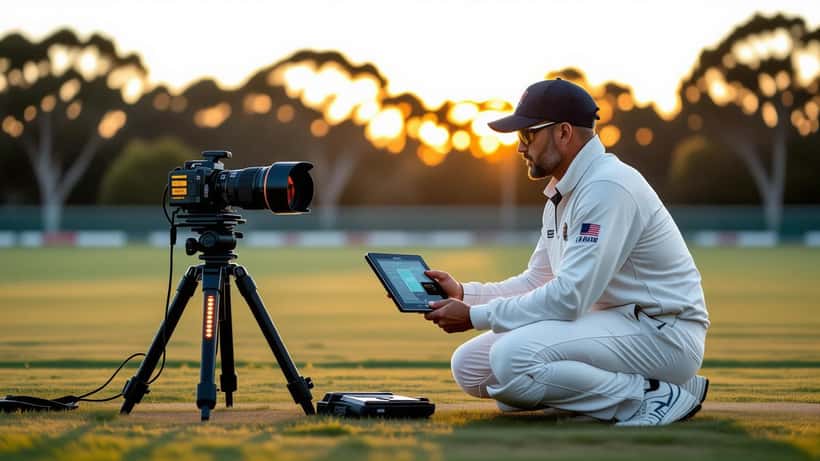
Consider a Grade 3 Sydney club — 180 registered players, six senior teams, three junior sides — that has budgeted $4,500 to purchase a DRS-compatible package ahead of the 2026-27 domestic season. The package advertised online includes: a pair of LED stump sets (six stumps, six bails), a tripod-mounted tracking camera, and a 12-month licence for the ball-path reconstruction software.
If the club installs this system and uses it for representative district matches, it immediately runs into an ICC compatibility question. Not every commercially available LED stump meets the technical specifications required under the Playing Conditions for ICC-sanctioned events. The ICC requires that LED stumps illuminate within 1/1,000th of a second of bail dislodgement — a precise threshold that cheaper unlicensed copies frequently fail under independent testing. If the club selects a non-approved stump set, any district association could rule the equipment ineligible for graded competition, rendering the $4,500 investment unusable for the matches it was purchased for.
Then there is the software licence. The $4,500 package includes a "Standard" tier licence that limits tracking resolution to 25 frames per second. Professional DRS systems used in Windhoek this month operate at 340 frames per second for the critical segment around stump impact. At 25fps, the system may generate inconclusive results for marginal LBW decisions — precisely the calls clubs want to review. Upgrading to a resolution tier sufficient for confident decision-making adds $1,800 to the first-year cost.
If/then logic: if the club spends $4,500 on the advertised package without independent verification of ICC compliance and software resolution tier, then it faces a realistic scenario of spending the equivalent again within 12 months — or pulling the system from graded competition entirely.
A Consumer Electronics expert who specialises in sports technology procurement can review the full technical specification sheet against current ICC equipment standards before purchase. They can confirm warranty terms under Australian Consumer Law — particularly for gear used outdoors in high-UV environments. They can also clarify whether the software licence constitutes a "service" or "goods" for the purpose of statutory guarantee protections under the Australian Consumer Law. That distinction matters: it determines what remedies are available if the system underperforms.
What a Consumer Electronics Expert Can Do for Your Cricket Club
Consumer Electronics specialists who work in the sports technology space bring three things to a club committee that a general retailer cannot.
First, they understand the standards hierarchy. ICC standards for electronic equipment filter down into Cricket Australia's Playing Conditions and then into State Association by-laws. A product that is marketed as "DRS-compatible" may have passed only the manufacturer's in-house testing — not third-party certification. An expert can request the compliance documentation and verify it against current standards, which were updated in June 2026 to include tighter tolerances on stump sensor response latency.
Second, they can evaluate total cost of ownership rather than sticker price. The LED stump sets used at the NAM vs SA ODI in Windhoek require calibrated sensor replacement after approximately 400 hours of use — roughly two seasons of club cricket if every Saturday and mid-week match runs to 80 overs. That recalibration service is not included in most starter packages and typically costs $180-$250 per set per season. A Consumer Electronics expert builds this into the procurement comparison upfront.
Third, they can assess installation requirements. Hawk-Eye and similar tracking systems require a stable, glare-controlled camera angle that accounts for Australia's specific sun elevation across a cricket day — roughly 10am to 6pm AEST across summer months. The sun angle in Sydney in December differs significantly from Darwin, and camera positioning that works in Windhoek's southern hemisphere winter light may generate shadow artefacts in a Brisbane November afternoon. Site-specific setup assessment is a specialist task.
Clubs interested in the broader health and conditions context of the NAM vs SA series can also read how altitude affects cricket performance in Namibia. For equipment procurement, a Consumer Electronics specialist is the right starting point.
What to Do Before Your Club Buys Cricket Tech
The NAM vs SA series has made one thing clear: the technology that once seemed exclusive to World Cups and international venues is commercially available and moving into Australian community cricket now. Jordan Hermann's record-equalling 150 was verified in real time by systems your club could, in principle, buy this week. But buying the wrong version of that technology wastes money and may leave your club without ICC-eligible equipment at the most important time of the season.
Before committing a single dollar:
- Get the ICC equipment standards document for the current season — request it from Cricket Australia or your state association.
- Request independent compliance documentation from any supplier, not just marketing claims.
- Have a Consumer Electronics expert review the full technical specification, warranty, and software licence terms against your club's specific use case — outdoor, multi-pitch, Australian conditions.
- Factor in recalibration and replacement cycles across a five-year horizon, not just year one.
The technology is real, it works, and it is arriving in Australian club cricket faster than most committees have planned for. The clubs that get this right in 2026-27 will be ahead of the curve. The ones that rush an uninformed purchase will be explaining the gap in the equipment budget to members who watched Hermann's 150 and wondered why their LBW reviews still rely on a raised finger.
format_used: News brief
