 Liam Campbell
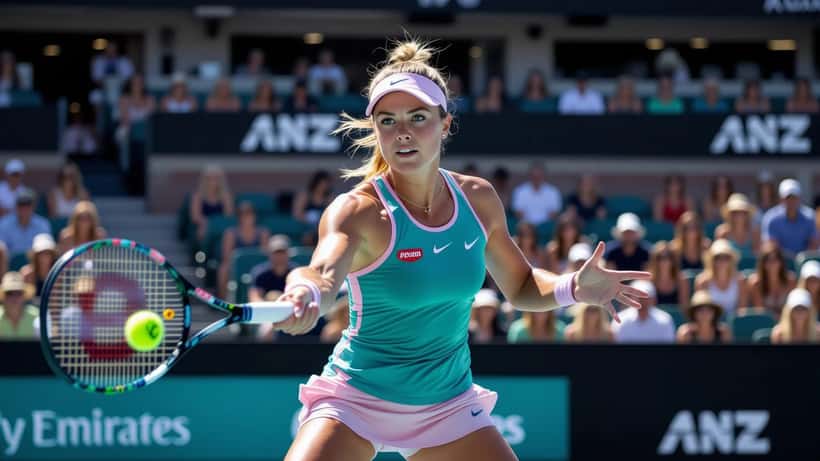
Linda Nosková enters the 2026 Australian Open as one of the most talked-about names on the WTA Tour, and not only because of her booming forehand. The 21-year-old Czech has turned heads with a disciplined climb up the rankings, a serve that has become measurably more reliable, and a team that quietly includes a growing roster of specialist consultants. In a sport where the margin between a second-week Grand Slam run and a first-round exit is measured in millimetres and milliseconds, her progress is a case study in how targeted expertise off the court can shape results on it.
For fans, Nosková is the headline. For anyone building a high-performance career—athletic, professional, or entrepreneurial—her setup is the story. She is part of a generation of tennis players who treat coaching as a multidisciplinary function rather than a single voice on the practice court. Fitness trainers, physiotherapists, nutritionists, data analysts, and mental-performance coaches now share responsibility for a player’s trajectory. The Australian summer, with its punishing heat and back-to-back events, is where that infrastructure gets stress-tested first.
What Nosková’s 2026 Melbourne campaign reveals about momentum
Heading into Melbourne, Nosková’s 2025–26 form has been defined by consistency rather than flash. She has cut down on unforced errors in the opening rounds of hard-court events and has shown a new willingness to shorten points when conditions turn physical. Those are not stylistic preferences alone; they are tactical decisions shaped by match-data review and conditioning work designed to preserve her legs across a two-week major.
The Australian Open often rewards players who arrive with rhythm. The off-season is short, the travel from Europe or North America is long, and the first Grand Slam of the year can expose anyone who skipped detail work in December. Nosková’s camp appears to have treated the preparation block as a project-management exercise: measurable load targets, clear recovery windows, and a schedule that balances match play with restoration. That is the kind of operational discipline that performance consultants preach to executives and athletes alike.
There is also a psychological dimension. A younger Nosková was praised for raw power but occasionally undone by impatience in key moments. Observers in 2026 note a calmer decision-making pattern, especially on second serves and break points. Sports psychologists often describe this not as a personality change but as the result of repeated exposure to pressure scenarios, combined with routines that help a player reset between points. If Melbourne confirms the trend, she will be dangerous not because she hits harder, but because she thinks clearer under stress.
The expert economy behind a tennis breakthrough
Nosková’s rise is inseparable from the broader professionalisation of women’s tennis. Where a player once travelled with a coach and perhaps a parent, top-50 athletes now operate like small businesses. Each specialist is a consultant brought in to solve a specific problem: improve first-serve percentage, manage a recurring shoulder complaint, optimise sleep across time zones, or interpret analytics on an upcoming opponent.
This mirrors the Expert consultation marketplace model in a different domain. Whether the client is a tennis player or a growing company, the underlying logic is the same: identify a gap, bring in a verified expert, implement a targeted plan, and measure the outcome. The best consultants do not replace the core team; they extend it. In Nosková’s case, that could mean a biomechanics specialist who refines loading patterns, or a nutritionist who adjusts hydration strategy for Australian humidity.
The lesson for non-athletes is that high performance is rarely the product of one heroic intervention. It is the accumulation of small, expert-led adjustments repeated over months. A founder refining a pitch deck, a lawyer preparing for a high-stakes hearing, or a homeowner planning a renovation faces the same challenge: the right specialist at the right moment can prevent a small issue from becoming an expensive one.
How injuries and comebacks shape the narrative
Tennis in 2026 has already been marked by dramatic comebacks. Karolína Muchová’s 2026 Australian Open Comeback showed what is possible when a player rebuilds trust in a body that has betrayed them, and the Roland Garros 2026 finals illustrated how injuries at the top of the sport can redraw the competitive map overnight.
Nosková has so far avoided the long layoffs that have defined some of her peers, but she has dealt with the niggling setbacks that come with a power game. Managing those requires more than rest. It requires a diagnostic approach: which movement patterns load the vulnerable area, which surfaces aggravate it, and which training modifications reduce risk without dulling effectiveness. Physiotherapists and sports-medicine consultants who specialise in overhead athletes are the unseen architects of many Grand Slam runs.
That is why her team composition matters as much as her ranking. If Melbourne goes deep, analysts will credit her forehand; the smarter observation will be that she stayed healthy enough to swing it freely across seven matches.
What Australian audiences can take from the storyline
For Australian readers, Nosková is both an international attraction and a local reminder. Every January, Melbourne Park becomes a global stage for expertise in action. The players are the visible product, but the tournament is also a showcase of sports science, logistics, and media strategy. Fans watching a late-night match rarely see the morning recovery session, the consultation with a tournament doctor, or the data review that informs the game plan.
The same principle applies closer to home. A small business preparing for a product launch, a family navigating a complex legal matter, or a student deciding on career coaching is making the same calculation Nosková’s team makes: is this a problem I can solve alone, or is it time to bring in someone who has solved it before? The Australian market has become more comfortable with that question, partly because digital platforms make specialist access faster and more transparent.
Looking ahead: the long game beyond Melbourne
Regardless of where Nosková finishes in the 2026 Australian Open draw, her trajectory points upward. She has the weapons, the age profile, and—crucially—the support structure to contend at majors for the next decade. The immediate question is whether she can convert improvement into deep runs; the strategic question is whether her team can keep adapting as opponents study her more closely.
That is where expert input becomes iterative. A game plan that works in January may need revision by May. A fitness programme that holds up in mild weather may need adjustment for a North American summer hard-court swing. The best consultants are not one-time hires; they are ongoing partners who recalibrate as circumstances change.
In that sense, Linda Nosková’s 2026 Australian Open campaign is not just a tennis story. It is a real-time example of how talent, when organised around the right expertise, becomes durable success.
