 Chloe Anderson
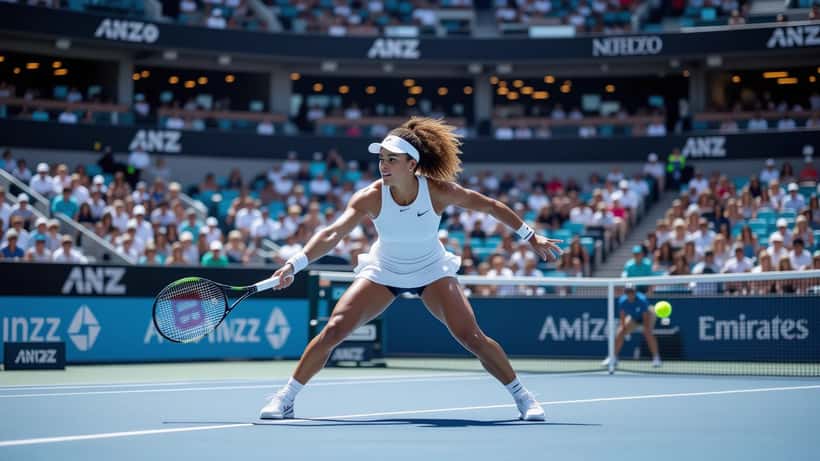
Karolína Muchová is back on court at the 2026 Australian Open, and her return is already one of the most closely watched comeback stories of the season. The Czech star, whose 2024 season was cut short by a wrist injury that required surgery, has spent the past eighteen months rebuilding her game through a carefully managed rehabilitation programme. For a player whose elegant all-court tennis once took her to the 2023 French Open final, the 2026 Australian Open represents more than a tournament—it is a referendum on whether modern sports medicine can restore a shot-maker’s rhythm after a complex wrist injury.
Wrist injuries are notoriously difficult for tennis players because the wrist is the final link in the kinetic chain that generates racquet-head speed. Every serve, forehand and volley places torque through the radiocarpal and distal radioulnar joints. When Muchová withdrew from the 2024 US Open and subsequently underwent surgery, the question was not whether she would return, but whether she could return with the same feel that made her one of the WTA Tour’s most creative players.
The early evidence from Melbourne is cautiously encouraging. Muchová has described her preparation as “conservative but complete,” working with a team that includes a wrist surgeon, a hand therapist, a strength coach and a tennis-specific physiotherapist. That multidisciplinary model mirrors the approach behind Elina Svitolina’s Roland Garros comeback after maternity, blending tissue-load monitoring with gradual reintroduction of match play. Svitolina at Roland Garros 2026: Sports Medicine offers a useful parallel for anyone interested in how elite athletes balance recovery with Grand Slam demands.
What makes Muchová’s case particularly interesting to experts is the nature of her game. She is not a baseline grinder who can win through repetition alone. Her success depends on variation—drop shots, sliced backhands, changes of pace, and forehands hit with late wrist acceleration. Each of those shots demands proprioception and confidence in the wrist at the moment of contact. A player can test physically recovered tissue in the gym and still discover limitations under the pressure of a tie-break. That psychological hurdle is one reason comebacks from wrist surgery often follow a jagged trajectory: the body is cleared, but the stroke production lags until trust is rebuilt through live competition.
Sports-medicine consultants who work with tennis players note that wrist surgery rehabilitation typically follows three overlapping phases. The first phase is protective, focused on reducing inflammation and protecting repaired structures. The second phase restores range of motion and begins loading the wrist in controlled patterns—often starting with stationary ball contacts before progressing to feeding drills. The third, and longest, phase is sport-specific: returning to serves, adding spin, reintroducing the slice, and only then playing best-of-three sets. Muchová’s camp has reportedly spent extra time in that third phase, using practice blocks that simulated match intensity without the calendar pressure of an official event.
The Australian Open timing is also medically significant. Hard courts place different stresses on the wrist than clay or grass. The surface is less forgiving, meaning joint reaction forces are higher on serves and overheads, but the predictable bounce allows players to position themselves more consistently and avoid the awkward, stretched contacts that increase injury risk. For Muchová, Melbourne offers a compromise: a high-stakes environment with a surface that rewards timing more than scrambling. It is a calculated gamble, and one her team has been open about wanting to take early in the year rather than risking a rushed return during the European clay swing.
From a consultation-marketplace perspective, Muchová’s comeback illustrates several themes that recur when experts advise recreational and amateur athletes. The first is the value of patience. Many players want a fixed timeline after surgery, but tissue healing and motor-skill recovery do not always align. The second is the importance of interdisciplinary care. A surgeon may clear the wrist, but the return to sport requires input from physiotherapists, strength coaches and sometimes sports psychologists. The third is load management. Muchová’s reported decision to skip several warm-up events in favour of focused practice blocks is the elite version of a principle any injured club player can apply: competing too soon can turn a healed injury into a chronic problem.
Mental health has become an equally visible part of tennis comebacks, as Naomi Osaka’s return to Roland Garros 2026 showed. Naomi Osaka Returns to Roland Garros 2026: The Men is a reminder that the pressure to perform after time away can be as draining as the physical workload. Muchová has spoken about the loneliness of rehabilitation and the difficulty of watching peers compete while she did wrist exercises in a Prague clinic. That emotional dimension is one reason many sports-medicine clinics now integrate psychology into injury rehabilitation.
If Muchová progresses deep into the draw, the narrative will shift from “Can she come back?” to “How far can she go?” Early rounds allow a player to test match rhythm; consecutive deep matches are the truest test of whether the wrist can tolerate repeated stress across a fortnight. Alexander Zverev’s Munich Victory: What His Ankle demonstrated how a player can look sharp in patches while still rebuilding durability.
For Australian fans, Muchová’s presence adds narrative depth to a tournament already rich with storylines. The local interest in Grand Slam tennis was visible during Roland Garros 2026 finals: How injuries reshaped t, where injury narratives shaped both draws. The same pattern is likely in Melbourne. Fans will be watching not just the scoreboard but the fluidity of her service motion and whether she still attempts the drop-shot variations that define her style.
Professional tennis has become a domain where marginal gains come from specialised knowledge. Muchová’s team reportedly used video analysis to compare pre-injury and post-rehabilitation stroke mechanics, looking for compensations that could overload the shoulder or elbow. That kind of expert-led review is what separates a successful return from a premature one.
Janice Tjen at Wimbledon 2026: What Her Historic R offers another useful comparator. Tjen’s breakthrough was built on physical conditioning and match toughness, qualities that take months to develop after a layoff. Muchová’s challenge is different but related: she must rebuild not just fitness but the delicate timing that allows her to compete with the world’s best ball-strikers. If she succeeds, her 2026 Australian Open run could become a case study in how artistry and medical science can be reconciled after a career-threatening injury.
The first week in Melbourne will not provide a final verdict. Comebacks are measured over seasons, not single tournaments. But every clean winner Muchová hits, every serve she lands on a big point, and every post-match press conference in which she describes the wrist as “fine” will add data points to a story that began in an operating theatre and may yet end with a trophy. For now, the most accurate expert opinion is also the most cautious one: she is back, she is competitive, and the real test is still ahead.
