 Olivia Miller
On 28 July 2026, Lachlan Kennedy ran 9.94 seconds in the men's 100 metres — a new personal best and the fastest 100m ever recorded by a man living with Type 1 diabetes. For Australia's 145,000-plus people managing T1D day to day, Kennedy's sprint is more than a sports story. It's a prompt to ask a question that too many active Australians with the condition have never properly put to a specialist: am I managing this safely enough to do what I want to do?
From Diagnosis at 13 to a 9.94 Personal Best
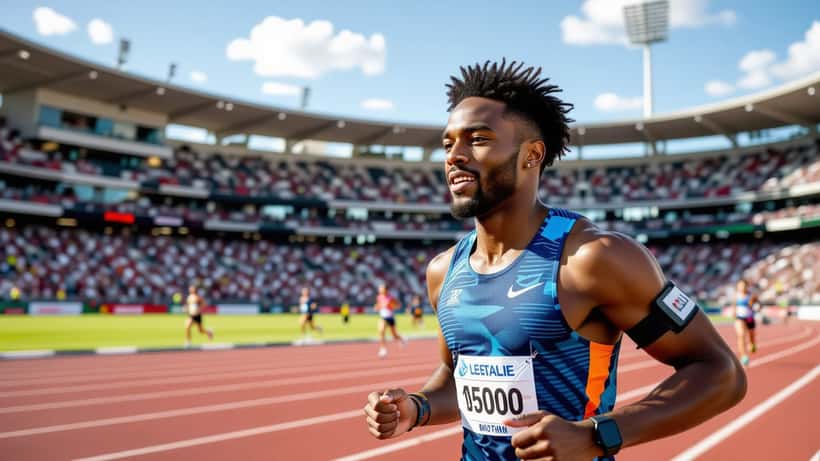
Kennedy was thirteen years old when he was diagnosed with Type 1 diabetes in 2018. Eight years later, wearing a Dexcom continuous glucose monitoring (CGM) sensor on his arm, he lined up at a World Athletics competition and clocked 9.94 — the fastest time recorded globally on this date. Earlier in 2026, at the Australian Athletics Championships in April, he became the first Australian to run sub-10 seconds on home soil, storming to a national 100m title in 9.96 seconds.
He spoke to the Australian Olympic Committee ahead of the 2026 Commonwealth Games in Glasgow about what the technology means to him: "The technology nowadays is really incredible, I'd say life-changing." He was also clear about the mindset behind it: "Type 1 diabetes doesn't have to limit what you can achieve."
That's a remarkable statement from someone competing at the absolute pinnacle of short-sprint athletics. But it comes with an important caveat that Kennedy himself would be the first to acknowledge — the freedom to push hard comes directly from a rigorous, expert-guided management framework that most active Australians with T1D have not yet put in place.
What Type 1 Diabetes Demands From an Active Body
Type 1 diabetes is an autoimmune condition in which the pancreas produces little or no insulin. Every person with T1D depends on external insulin — via injections or a pump — for survival. That dependency creates a complex relationship with physical activity that is fundamentally different from the challenges facing people with Type 2 diabetes.
The core difficulty is that exercise affects blood glucose in opposing directions depending on the type of effort involved. Intense anaerobic activity — sprinting, weightlifting, short-distance intervals — can raise blood glucose by triggering adrenaline and stress hormones that release stored glycogen. Sustained aerobic exercise — running at a comfortable pace, cycling, swimming — typically lowers blood glucose by increasing insulin sensitivity and glucose uptake into muscles. Many training sessions combine both effects.
According to the Australian Institute of Health and Welfare, more than 145,000 Australians are living with Type 1 diabetes, representing roughly 10% of all diabetes cases nationally. The condition is most often diagnosed in childhood and adolescence: around 65% of new diagnoses in Australia involve people aged 0–29. That means a significant proportion of Australians with T1D are in their most physically active years — and navigating exercise safely is not a niche concern, it is a central one.
The Numbers That Actually Matter — A Blood Glucose Framework
The glucose targets that endocrinologists set for active people with T1D are specific and non-negotiable. The evidence-based benchmark is a minimum 70% of time spent in the "safe range" of 3.9–10.0 mmol/L, with less than 3% of time below 3.9 mmol/L (hypoglycaemia) and less than 25% above 10.0 mmol/L (hyperglycaemia). For exercise specifically, specialists recommend entering activity with blood glucose between 5.0 and 10.0 mmol/L.
Consider a concrete scenario: a 29-year-old sales manager in Brisbane, diagnosed with T1D in 2023, who has started training for his first 10km fun run. He runs four mornings a week, 40–50 minutes each session, on a basal-bolus insulin injection regimen. He knows roughly what his fasting glucose looks like in the morning, but he's never had a formal conversation with a diabetes specialist about how to adapt his short-acting insulin dose before a run.
Here is what the numbers should be telling him — and almost certainly aren't:
- If his pre-run glucose is below 5.0 mmol/L: he should not start the session. The correct response is 15–20 grams of fast-acting carbohydrate, a 15-minute wait, and a recheck. Starting a 40-minute aerobic run below this threshold is a meaningful hypoglycaemia risk.
- If his pre-run glucose is above 14.0 mmol/L: high-intensity aerobic effort at this level can drive glucose higher and, in the presence of ketones, increase the risk of diabetic ketoacidosis. He should check for ketones and contact his specialist before proceeding.
- If his session exceeds 60 minutes: research supports reducing basal insulin by approximately 20–30% for injection users in the two-to-three hours before a session of this length. On an insulin pump, a temporary basal rate reduction of 50% starting 60–90 minutes before exercise is a common starting point — but the exact figure needs to be personalised, not guessed.
For our Brisbane runner, a single appointment with an endocrinologist or credentialled diabetes educator to establish his personal thresholds could be the difference between a safe, enjoyable training block and a preventable medical event mid-run.
When Exercise Changes Everything — And Why Your GP May Not Be Enough
General practitioners provide excellent foundational care for T1D — including prescriptions, routine HbA1c monitoring, and referrals. But exercise physiology for people with T1D sits at the intersection of endocrinology, sports science, and device management in a way that often exceeds the scope of a standard GP consultation.
Signs that an active person with T1D should seek specialist review include:
- Experiencing hypoglycaemia (glucose below 3.9 mmol/L) more than twice per week during or after training
- An HbA1c reading above 7.0% (53 mmol/mol) despite following treatment instructions
- Starting a new training programme with significantly different intensity — including transitioning from walking to running, or from gym work to team sports
- Preparing for a structured event such as a fun run, triathlon, or cycling race
- Upgrading to a CGM for the first time and needing guidance on how to act on its alerts — not just read them
- Managing T1D in a child or teenager whose glucose patterns shift with growth spurts, school sport, and hormonal changes
These are not edge cases. They are the ordinary circumstances of an active life with a serious chronic condition, and they warrant more than a 10-minute GP review.
CGM Technology: What Kennedy Uses and What It Can Do for You
Lachlan Kennedy's performance is inseparable from his Dexcom CGM. The device places a fine sensor just beneath the skin that measures interstitial glucose every few minutes and transmits readings to a phone or smartwatch in real time. For sprint athletes, the data comes with a lag — glucose can shift significantly in the 15 to 30 seconds it takes Kennedy to run a race — but for training sessions and warm-up monitoring, continuous data is transformative.
In Australia, CGM access has improved substantially. Since July 2022, the federal government has subsidised CGM products through the National Diabetes Services Scheme (NDSS) for all Australians with T1D. Adults over 21 pay a maximum co-payment of $32.50 per month. People under 21, concession card holders, and pregnant women access CGM devices at no cost. Despite this, many active Australians with T1D are either not using a CGM at all, or are using one without the guidance needed to act meaningfully on its data.
A specialist consultation is also the right place to explore whether an insulin pump — which can be paired with CGM data in a "closed-loop" or hybrid closed-loop system — would suit your lifestyle and activity level better than daily injections. These systems can automatically adjust basal insulin delivery based on real-time glucose readings, dramatically reducing the manual calculation burden on an active person.
For more context on how elite athletes manage sport-related health conditions at the highest level, see our recent coverage of youth athlete health at the Diamond League.
A Personal Best as a Prompt to Act
Kennedy's 9.94 will be discussed in athletics circles for years. But for the hundreds of thousands of Australians living with T1D who admire his achievement — and wonder whether their own active ambitions are compatible with their diagnosis — the most useful takeaway isn't the time on the clock. It's the infrastructure behind it: the CGM sensor, the specialist team, the personalised glucose protocols, and the years of iterative expert-guided management that made 9.94 possible.
According to the Australian Institute of Health and Welfare, T1D affects Australians of all ages, but the majority of those newly diagnosed are young and physically active. If that description fits you or someone in your family, Expert Zoom can connect you with qualified endocrinologists and diabetes educators who specialise in active-life management — so that the only thing limiting what you can achieve is the training you're prepared to put in.
This article is for informational purposes only and does not constitute medical advice. Type 1 diabetes is a serious medical condition. Always consult a qualified healthcare professional before making changes to your insulin regimen or exercise programme.
