 Andrew Thompson
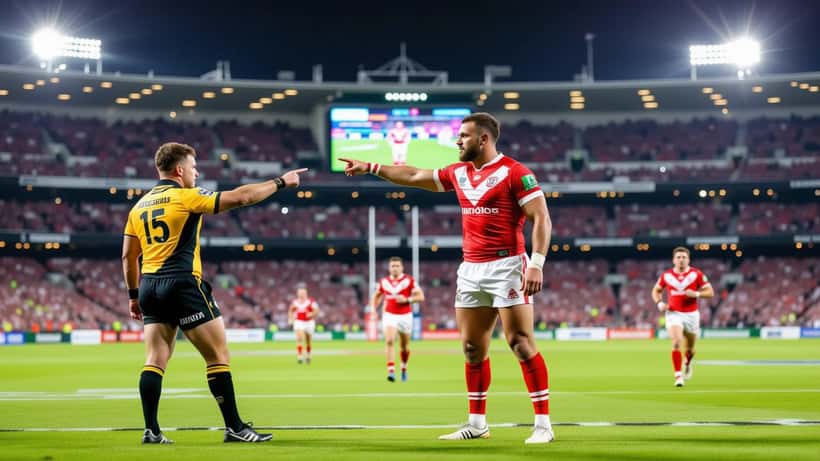
Jaydn Su'a became the first NRL player to be sent off since Justin Olam in Round 22, 2024, when he was dismissed in Round 7 of the 2026 season for a high shot on South Sydney's Cam Murray during the St George Illawarra Dragons' 30-12 loss at Accor Stadium. On 19 April 2026, the NRL Match Review Committee handed him a three-match suspension — ending his involvement in critical games during a difficult period for the club. With Su'a also having announced his departure from the Dragons to join the Parramatta Eels on a three-year deal from 2027, the case raises important questions about player rights when disciplinary action and contract transitions collide.
What Actually Happened on the Field?
In Round 7, Su'a made contact with Cam Murray via a shoulder charge to the head — a category of tackle the NRL has been actively cracking down on since implementing stricter head contact protocols. The referee deemed the offence serious enough to warrant an immediate send-off, with the NRL's Bunker not overturning the decision.
The Match Review Committee later assessed the tackle and applied a three-match ban under the NRL's grading framework. Send-offs are relatively rare in modern NRL — Su'a being only the second in two years underscores how the game has changed its approach to player welfare.
How Does the NRL Disciplinary Process Work?
When a player is cited or sent off in the NRL, the process follows a structured pathway:
The Match Review Committee (MRC) reviews video footage and applies a grading matrix. Offences are graded from Grade 1 (minor) to Grade 3 (serious), with each grade carrying a set suspension range based on the player's career history.
The player has three options:
- Accept the charge — the player takes the suspension without appearing before the judiciary, often with a 25% reduction for early guilty plea
- Dispute the charge — the player contests the grading or the offence type at the NRL Judiciary
- Appeal — if found guilty at the Judiciary, the player can apply to an independent appeals panel
Players must notify the NRL of their election to go to the Judiciary within a specific window — missing this deadline forfeits their right to challenge the charge.
What Are a Player's Rights in NRL Disciplinary Proceedings?
NRL players are bound by the NRL's Rules and the standard provisions of the NRL Player Agreement. However, under Australian contract and administrative law principles, players retain several important rights:
Natural justice — the player must be given proper notice of the charge, the evidence against them, and a genuine opportunity to respond. If a player believes this process was not followed, a challenge may extend beyond the NRL's own processes.
Right to legal representation — players may be represented at the NRL Judiciary, including by a lawyer or a players' association representative. The Rugby League Players' Association (RLPA) provides representation support to members facing disciplinary proceedings.
Proportionality — sentences must be proportionate to the offence and consistent with how similar incidents have been treated. If a player believes the suspension is disproportionate compared to a like-for-like incident, this can be argued at the Judiciary or on appeal.
Independent appeals — the NRL's appeals panel includes independent adjudicators separate from the MRC. Players who feel the Judiciary outcome was flawed have the right to escalate through this channel.
What Happens to Su'a's Contract During a Suspension?
An NRL suspension during an active contract period raises a question many fans don't consider: does a suspended player still get paid?
Under standard NRL Player Agreements, a player who is suspended by the NRL continues to receive their base salary during the suspension period, unless the suspension arose from criminal conduct or a wilful act of serious misconduct as defined in the agreement. A high tackle, while subject to disciplinary penalty, does not typically constitute the kind of breach that would allow a club to withhold salary.
However, where Su'a's situation becomes more complex is his announced departure from the Dragons at the end of 2026. The transition from one NRL club to another involves:
- Salary cap obligations — the player's 2026 contract still counts against the Dragons' cap regardless of the Eels deal
- Player welfare protections — the NRL Player Agreement includes provisions that prevent clubs from unreasonably restricting a departing player's training access or professional development
- Mutual release conditions — if either club or player wants to bring the departure forward to 2026, any agreed settlement would need to comply with NRL rules on contract terminations
For players navigating this kind of dual situation — active discipline plus a looming contract transition — legal advice is not just useful, it is essential.
When Should an NRL Player Seek Legal Advice?
NRL players face unique legal challenges that a general solicitor may not be equipped to handle. Specialised sports lawyers or employment law practitioners with knowledge of collective bargaining in the NRL context can assist with:
- Assessing whether a disciplinary decision was correctly graded
- Advising on whether natural justice obligations were met
- Reviewing the Player Agreement for provisions triggered by suspension, trade, or club-side conduct
- Representing players in Judiciary hearings or appeals
- Negotiating early releases or contract amendments during inter-club transfers
The earlier a player seeks advice after a charge is laid, the more options remain available. Missed deadlines in the NRL disciplinary process can permanently foreclose avenues that were otherwise open.
A Broader Point on Player Rights in Contact Sports
The Jaydn Su'a case is not an isolated event. The NRL's stricter head contact protocols, introduced to reduce concussion and long-term brain injuries, are generating more high-profile disciplinary decisions across the competition. As the ruleset continues to evolve, players need to stay informed about their rights — and so do administrators, clubs, and even fans who are affected by the outcomes.
Sport Integrity Australia, the federal government body responsible for protecting clean and fair sport, notes that all national sporting organisations operating under Commonwealth funding must maintain transparent and fair disciplinary processes. Reviewing these frameworks and understanding how they interact with employment law is increasingly part of how professional sport is managed in Australia — and where legal expertise adds genuine value. For more on sports integrity frameworks in Australia, see Sport Integrity Australia's resources.
If you are an athlete, club official, or agent dealing with an NRL or other professional sports disciplinary issue, connecting with a sports law specialist through Expert Zoom can help you understand the process before decisions are locked in.
Disclaimer: This article provides general legal information only. It is not a substitute for professional legal advice. For advice specific to your circumstances, consult a qualified Australian sports or employment lawyer.
