 Olivia Miller
New York Giants quarterback Jaxson Dart was helped off the field on 21 September 2026, his left knee buckled awkwardly mid-throw during a third-down play in the Giants' Week 2 road game against the Los Angeles Rams. Dart — who had electrified the NFL just seven days earlier with a 23-of-29, 230-yard, three-touchdown performance in a 28–20 victory over Dallas — was ruled out for the remainder of the contest, with Jameis Winston stepping in as the Giants' lead dissolved.
For millions of Australians watching from their lounge rooms — or who had been on a local oval the very same weekend — the moment was painfully recognisable. A knee twisting under contact, a player going down, that moment of uncertainty before the pain sets in. The difference between Dart and the average Australian weekend athlete is not just the fame or the $16.9 million fully guaranteed contract. It is the immediate access to a team of athletic trainers, an MRI booked within hours, and a specialist already on speed dial. Most Australians have none of that.
Why Dart's Injury Mirrors 23,000 Australian Surgeries Each Year
Dart's mechanism of injury — hyperextension under impact, full bodyweight transferred to a partially rotated knee — is identical to the mechanism behind thousands of sporting knee injuries recorded across Australia every week. According to the Australian Institute of Health and Welfare, sports and recreation injuries account for approximately 15% of all injury hospitalisations in Australia, with lower limb injuries consistently representing the largest share.
Sports Medicine Australia estimates that approximately 23,000 Australians undergo anterior cruciate ligament (ACL) reconstruction every year. That figure does not include the substantially larger number of Grade 1 and Grade 2 sprains — ligament stretches and partial tears — that are managed, or mismanaged, without specialist input. Knee injuries are not confined to elite football. They are most common in field sports (AFL, rugby league, rugby union, soccer) and court sports (basketball, netball) played at amateur club level, and they are most common in the under-35 age group: people who are active enough to get hurt but often do not have the systems in place to get the right care, fast.
The knee is the body's most mechanically demanding joint. Four ligaments, two menisci, articular cartilage, and a precise arrangement of tendons all share the load of running, pivoting, landing, and absorbing contact. When any one of those structures is overloaded in a sudden, uncontrolled movement, the damage can be singular — or it can cascade. The ACL is the most commonly ruptured ligament, but a complete ACL tear often involves secondary injury to the medial meniscus or the articular cartilage of the joint surfaces, particularly when the initial injury is not promptly assessed and appropriately managed.
The Sports Medicine Expert Angle You Won't Hear From Your Mates
The most dangerous thing about a knee injury is how easy it is to minimise. Research published in the British Journal of Sports Medicine shows that roughly 40% of complete ACL ruptures are initially described by the injured player as "not that bad" — because adrenaline during competition blunts the perception of pain. By the time the adrenaline clears, the match is often over, the ice is on, and the decision has already been made: walk it off, see how it goes tomorrow, probably just a sprain.
The clinical red flag that cuts through that noise is swelling — specifically, swelling that develops within the first two to four hours after impact. Early-onset joint effusion is almost always haemarthrosis: bleeding inside the joint capsule. A haemarthrosis is associated with structural ligament rupture in approximately 70% of cases. Swelling that takes twelve to twenty-four hours to develop, by contrast, is more likely to be soft-tissue oedema, which carries a better prognosis.
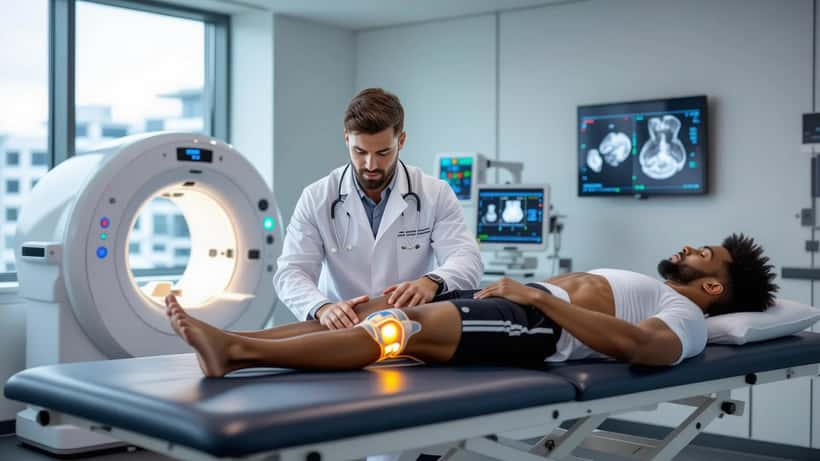
Sports medicine physicians and physiotherapists with postgraduate sports training use a series of physical tests — the Lachman test, the anterior drawer test, the pivot shift — to assess ligamentous integrity within a clinical setting. These are not things a GP without sports medicine training or a well-meaning teammate will reliably detect. The subtlety of a positive Lachman test (a few millimetres of anterior tibial translation with a soft endpoint) is something that requires trained hands and a controlled environment. The absence of a reliable field assessment is exactly why Sports Medicine Australia's clinical guidelines recommend that any acute knee injury involving joint effusion, instability, inability to fully weight-bear, or mechanical symptoms (locking, giving way, clicking) be reviewed by a sports medicine clinician within 72 hours of the injury.
The Brisbane Rugby League Player Who Waited Three Weeks — and What It Cost
Take this scenario: a 29-year-old amateur rugby league forward in Brisbane — physically active, no prior knee injuries — takes a tackle on a Saturday morning, plants his right foot, and pivots to pass. His knee rotates inward under load. He hears something. There is immediate pain, and the joint swells over the next two hours.
He ices it through the afternoon and takes ibuprofen. By Sunday it is sore but manageable. Work is busy; he leaves a message for his GP on Monday. The earliest appointment is Thursday — five days after the injury. The GP suspects a sprain and refers him to an orthopaedic surgeon. The first available appointment is eighteen days later. An MRI is ordered on day twenty-three.
The scan results: a complete ACL tear with a Grade 2 medial meniscal tear, and early chondral wear — cartilage surface damage — in the medial compartment. The surgeon explains that the chondral wear is consistent with delayed loading through the unstable joint over the three weeks since the injury. What began as an isolated ACL rupture has become a combined ligament-meniscus-cartilage injury.
If the player had presented to a sports medicine clinic within 72 hours, a timely MRI (available bulk-billed or low-gap at most radiology practices with a referral letter) would have confirmed an isolated ACL rupture. Conservative management — crutches, targeted physiotherapy, swelling control — would have protected the meniscus and cartilage in the weeks before reconstructive surgery. The out-of-pocket cost for that pathway: approximately $300 for the sports medicine consultation (with Medicare rebate), $150–$400 for an MRI gap, and $900–$1,500 for six to eight weeks of physiotherapy. Total: $1,350–$2,200.
Instead, the delayed diagnosis and secondary meniscal involvement pushed the surgical cost to approximately $26,000. With his Extras private health insurance contributing around $9,500, the out-of-pocket gap came to $16,500. The extended surgery and additional meniscal repair also pushed his estimated rehabilitation from the standard nine months for ACL-only reconstruction to a projected fourteen months — with a significantly elevated long-term risk of knee osteoarthritis before the age of forty.
4 Warning Signs That Demand a Specialist Within 72 Hours
Sports medicine clinicians consistently identify four signals that distinguish a structural injury from a manageable soft-tissue strain:
- Rapid swelling within four hours of the injury — indicates haemarthrosis (blood in the joint), associated with ligament rupture in the majority of cases.
- A distinct pop or snap at the moment of injury — classically associated with ACL rupture, though it is not always present or audible.
- Inability to fully straighten or fully flex the knee — can indicate a displaced bucket-handle meniscal tear, which may cause permanent cartilage damage if not surgically addressed within days.
- A sensation of the knee "giving way" — instability under load is a marker of significant ligamentous laxity that will not resolve with rest alone.
Two or more of these signals correlates strongly with structural injury rather than a simple sprain. None of them require a specialist on the sideline to identify — but all of them require a specialist within the week to manage.
What to Do in the 72 Hours After a Knee Injury
In the first 24 to 72 hours, apply the POLICE framework (Protection, Optimal Loading, Ice, Compression, Elevation) to control swelling and prevent further loading on an unstable joint. Avoid heat, alcohol, and massage in the acute phase — all of which increase blood flow and worsen haemarthrosis.
Most importantly: book. Many Australian sports medicine clinics — and physiotherapy practices with sports medicine specialisations — accept self-referrals without a GP letter, and urgent appointments are typically available within one to two business days. If you have Extras private health insurance, consultation and physiotherapy costs attract a rebate; if you are not insured, Medicare bulk-billed options exist through GP referral pathways.
The decision to see a specialist quickly is not about alarm — most acute knee injuries are not season-enders. It is about protecting the secondary structures that keep a manageable injury from becoming a complex, expensive, years-long recovery.
This article is for general informational purposes only and does not constitute medical advice. If you have sustained an acute knee injury, consult a qualified sports medicine professional or general practitioner for assessment.
Expert Zoom connects Australian patients with accredited sports medicine specialists and health professionals who can assess your injury and advise on the right pathway — from initial consultation through to rehabilitation.
