 Chloe Wilson
Rockstar Games released the GTA 6 launch trailer on 15 October 2026, with just under two minutes of new footage and a firm release date of 19 November on PlayStation 5 and Xbox Series X|S. For Australians, that leaves roughly five weeks before a game likely to invite very long play sessions arrives, and health professionals say now is the time to plan for them.
What Rockstar has confirmed so far
According to Gaming Bible, the trailer debuted on 15 October and features heists, police chases and driving through Vice City, with Jason and Lucia at the centre of the story. The Shortcut reports that the footage was captured on a base PlayStation 5 and that retailers are listing the standard edition at US$79.99. Rockstar has not said how long the main story runs.
Pre-orders opened on 25 June 2026, and Take-Two reaffirmed the November date on its 7 August earnings call. For many players the launch is the first major open-world release in years, and that matters for health. Big releases tend to pull people into long, uninterrupted sessions, often late at night and often on a couch or desk chair that was never set up for it.
This article is about that physical side. If you want the data-privacy and account-security angle, we covered it in our earlier guide for Australian gamers.
Why launch-week sessions are different
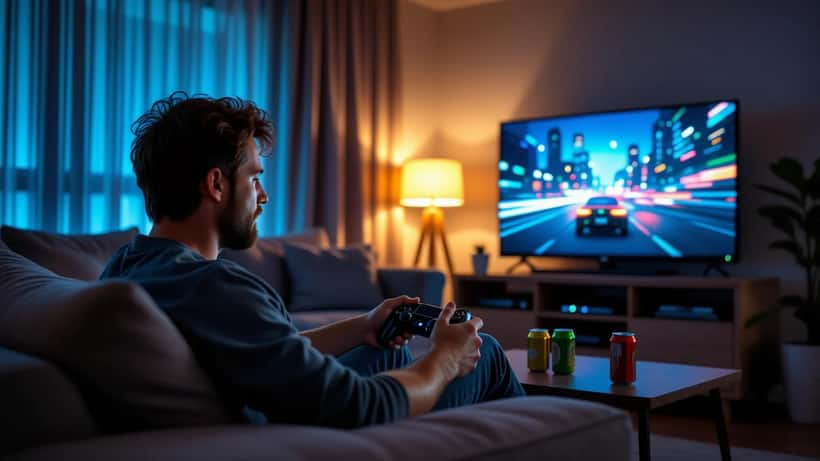
A normal evening of gaming runs one to two hours. Launch week can look very different: a six-hour Saturday, a late finish before work, then another long session the next day. Three problems show up repeatedly in clinics.
Hands and wrists. Controller play involves repetitive thumb and finger movements, often with the wrists held in a fixed position. Healthdirect, the national health advice service funded by Australian governments, lists numbness, tingling and pain in the hand as typical features of carpal tunnel syndrome, and notes that repetitive hand movements can contribute.
Eyes. Staring at a screen reduces how often you blink, which dries the eye surface. Optometrists describe the result as tired, sore or itchy eyes and headaches after prolonged close work, which is exactly what a marathon session produces. It is common, usually temporary, and easy to reduce with simple habits.
Circulation and posture. Sitting still for hours stiffens the neck, shoulders and lower back. Sitting also slows blood flow in the legs, which is why physiotherapists suggest standing up regularly, not only at the end of the night.
We previously looked at a similar pattern around another big release in our piece on when adults should see a professional about gaming-related pain. The advice there applies even more strongly to a release of this scale.
Who is most at risk
Not everyone faces the same exposure. People who already work at a computer all day start the weekend with a head start on strain, because their hands, eyes and necks have had no recovery time. Shift workers who game after a night shift add sleep debt on top. Students heading into the end-of-year exam period often swap study breaks for gaming breaks, which means the same eyes and wrists are working almost around the clock.
Players returning from a long break from gaming are another group. Muscles and tendons adapt to load gradually, and a sudden jump from zero hours to eleven in a weekend is the kind of spike that tends to trigger overuse complaints. The same principle applies to runners who double their distance in a week.
Parents should also expect to be asked about the game. It carries a mature rating in Australia, and that is a separate conversation from the physical one, but session length and sleep are things a household can agree on in advance.
What a health professional would tell you to do before 19 November
GPs, physiotherapists and optometrists tend to give consistent advice for long sessions:
- Take a break of two to five minutes every 30 to 45 minutes. Stand, stretch your forearms and look at something far away.
- Keep your wrists in a neutral position. Rest your forearms on a support instead of holding the controller in mid-air.
- Use the 20-20-20 habit: every 20 minutes, look at something about 20 feet (6 metres) away for 20 seconds.
- Set the screen at or slightly below eye level, and reduce glare from windows and lamps.
- Drink water and avoid replacing sleep with a late-night finish. Fatigue makes repetitive strain feel worse.
None of this requires giving up the game. It requires treating a long campaign like any other repetitive activity that deserves a plan.
A simple way to make the plan stick is to link breaks to the game itself. Stand and stretch at every loading screen, every save point or every time a mission ends. Players who tie breaks to in-game events are far more likely to take them than those relying on a phone timer they will ignore halfway through a police chase. Setting a hard stop time for the night, agreed before you pick up the controller, protects sleep as well.
A concrete case: the launch-weekend player
Consider a 34-year-old office worker in Brisbane who already spends eight hours a day at a keyboard. On the launch weekend of 21 and 22 November, she plays six hours on the Saturday and five on the Sunday, 11 hours in two days, on top of a normal working week of roughly 40 hours at a desk.
By the following Wednesday she notices tingling in her right thumb and index finger, mostly at night. If the tingling clears within two or three days of reducing play to under two hours a night and adding a break every 40 minutes, it is most likely overuse, and pacing sessions is a reasonable first response. If, however, the tingling lasts longer than about two weeks, wakes her at night more than twice a week, or comes with weakness when gripping a cup, then it is time to see a GP, who may refer her to a physiotherapist or occupational therapist for assessment.
The numbers matter because they give the player a decision rule: under two weeks and improving, adjust habits; beyond two weeks or worsening, book an appointment. The same logic applies to eye symptoms. Dry, tired eyes that settle after a night's rest are usually strain. Headaches that return daily, blurred vision that does not clear, or flashes and floaters need an optometrist or doctor promptly.
When to book a professional
Seek advice sooner if you notice any of the following:
- Numbness, tingling or weakness in the hand lasting more than two weeks.
- Pain that wakes you at night or does not ease with rest.
- Swelling, redness or pain in one calf, which needs urgent medical attention.
- Persistent headaches or blurred vision after sessions.
- Back or neck pain that spreads into the arms or legs.
Children and teenagers deserve particular attention at launch. Parents should agree on session lengths and break rules before the game arrives, not after a weekend that has already gone badly.
The practical takeaway
The trailer shows a huge, detailed world, and players will want to spend time in it. The sensible approach is to plan breaks, set up your space and know the warning signs in advance. Expert Zoom lists Australian health professionals, including GPs, physiotherapists and optometrists, who can assess hand, eye and posture problems and tailor advice to your situation. If a symptom lasts longer than you expected, book a consultation before the next big session, not after it.
This article is general information and not medical advice. If you have symptoms that worry you, speak to a registered health professional.
