 Chloe Wilson
Capcom's Onimusha: Way of the Sword landed on 4 September 2026 to near-universal acclaim — an 86 on Metacritic, an 85 on OpenCritic, and headlines proclaiming it the best action title of the year. For the roughly 100,000 Australians health researchers estimate are living with gaming disorder, that kind of reception isn't just exciting news. It's a warning sign worth taking seriously.
What the Buzz Around Onimusha Reveals About Modern Gaming
Way of the Sword is the kind of game that swallows hours without warning. A deep action RPG set in feudal Japan following Miyamoto Musashi, it layers satisfying swordplay, a parry-driven combat system, and an escalating demon-hunting narrative into a loop that reviewers consistently describe as "just one more encounter." Capcom has produced a masterclass in engagement design — and that same design is exactly what makes it worth asking: at what point does engagement tip into something a health professional needs to assess?
The answer isn't straightforward, but Australia's emerging clinical data on gaming disorder gives us useful markers. According to research cited by the ABC's Behind the News and Macquarie University studies, adults aged 18 to 34 show the highest problematic gaming rates in Australia — 10.4% of that demographic meets criteria associated with hazardous play. Males report gaming disorder at 8.5% compared to 3.5% for females. And the tipping point, in clinical terms, is often quantifiable: those meeting gaming disorder criteria average approximately five hours of daily gaming, compared to three hours among those who don't.
The World Health Organization formally recognised Gaming Disorder as a diagnosable condition in 2019 under ICD-11. Australia's medical community has followed. A survey of Australian GPs found that 52% had seen one or more patients experiencing problematic effects from excessive gaming — and 14% noted that the issue was often raised not by the patient themselves, but by a partner or family member.
The Expert Reaction: What a Health Specialist Would Flag
Health professionals who specialise in behavioural patterns aren't sounding alarms about games like Onimusha specifically — they're watching for a cluster of signs that can emerge when any highly engaging entertainment hits critical mass. A compelling new release is often what tips a person from "habitual gamer" into "someone who needs support."
The clinical signals worth monitoring include: gaming that continues despite knowing it's interfering with sleep, work, or relationships; an inability to cut back even when deciding to; physical symptoms including eye strain, headaches, wrist or shoulder pain from sustained sessions; and mood changes — irritability or low mood — when unable to play.
Dr Vladan Starcevic, a psychiatrist at the University of Sydney who has researched gaming disorder, has noted that the condition remains under-recognised in Australia because many adults don't frame excessive gaming as a medical concern. They manage it quietly, often until occupational performance or relationships begin to deteriorate visibly.
Health professionals in Australia — including GPs, psychologists, and occupational therapists — are increasingly equipped to assess gaming patterns through validated screening tools. An early conversation with a GP is the recommended first step for anyone unsure whether their habits have crossed a clinical threshold.
When Should You Actually See Someone? A Concrete Case
Here is the scenario that health professionals describe as a typical presentation — and one that maps onto the release window of a major game like Onimusha: Way of the Sword.
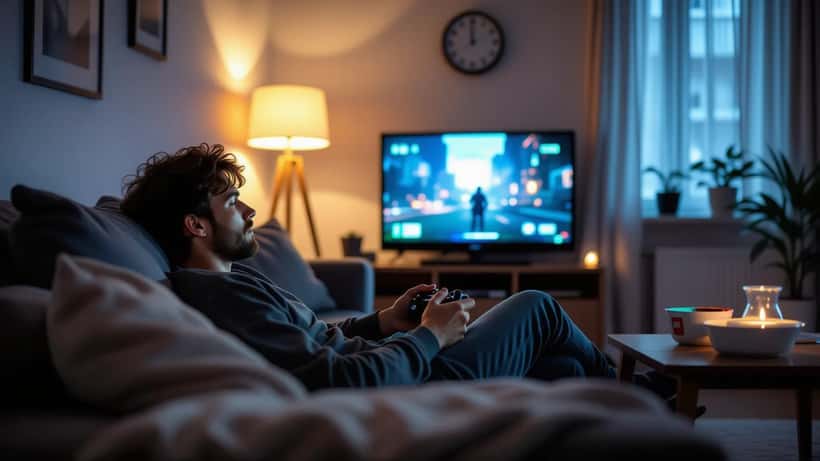
Imagine a 29-year-old warehouse supervisor in Melbourne — call him Daniel — who took two days of annual leave to play Onimusha at launch. He averages around 3.5 hours of gaming on weeknights normally, which sits below the five-hour clinical threshold and causes him no concern. But the launch week pushes him to eight hours daily. He starts going to bed at 3 a.m., arrives at work sleep-deprived, and misses a Saturday barbecue with his partner's family, dismissing the invitation without a conversation.
After the launch week passes, Daniel trims back to his usual habits within a fortnight. That pattern — intense, time-limited spikes around a major release followed by normalisation — is common and is not itself a clinical concern.
But consider the if/then line: if Daniel's post-launch baseline climbs from 3.5 hours to 5.5 hours per night, if he begins cancelling plans routinely rather than occasionally, and if sleep disruption becomes persistent rather than temporary, then the clinical threshold has shifted. The five-hour daily average is not a magic number, but it is the point at which Australian health researchers consistently find impaired daily functioning. At that point, a 15-minute GP consultation — where a validated tool such as the Internet Gaming Disorder Scale can be administered — is the appropriate next step. Early intervention, which can include cognitive behavioural therapy adapted for gaming disorder, achieves significantly better outcomes than waiting until the behaviour is entrenched.
The cost of doing nothing is measurable. A 2026 analysis via Icon Era found that gaming disorder correlates with higher rates of anxiety (up to 44% co-occurrence) and depression (up to 38% co-occurrence) in adults. A GP referral to a psychologist under a Mental Health Treatment Plan costs nothing beyond the initial consultation if the patient is Medicare-eligible — and bulk-billed telehealth options are available through healthdirect.gov.au.
What Healthy Gaming Actually Looks Like in 2026
Australia's Department of Health and Aged Care guidelines don't specify adult gaming limits the way they do for children — adult recreational choices are treated as self-regulated. But health professionals working in this space generally apply the same test to any recreational activity: does it cost you something you didn't choose to give up?
Healthy adult gaming in 2026 looks like this: play is chosen and bounded; it doesn't consistently displace sleep below seven hours; it doesn't generate relationship conflict that goes unaddressed; it doesn't affect professional performance; and the person can pause or stop without significant distress. By those measures, a substantial majority of people who pick up Onimusha: Way of the Sword this month will play it healthily.
For a minority — particularly those already playing at or near the five-hour daily threshold, or those with existing anxiety or mood disorders that make immersive escapism appealing — a high-quality launch creates a genuine risk window.
What to Do Now
If you recognise the escalation pattern described above — in yourself or someone close to you — the action steps are straightforward. Self-assessment tools such as the Internet Gaming Disorder Scale (IGD-20) are freely available online and take under five minutes to complete. A score above the clinical threshold is a prompt, not a diagnosis, but it's a prompt worth acting on.
Your GP is the right first contact. They can rule out other contributing conditions (particularly anxiety and depression, which frequently co-occur), administer a structured assessment, and refer to a psychologist experienced in behavioural patterns if needed.
Australia has a growing network of health professionals who work specifically with gaming and screen behaviour. ExpertZoom connects Australians directly with health consultants — including GPs and psychologists — who can provide a first-opinion assessment via video consultation, without a wait.
The release of Onimusha: Way of the Sword is genuinely exciting news for action game fans. The best version of that excitement is one you're still enjoying three months from now — not one you're trying to claw back from.
This article is informational and does not constitute medical advice. If you are concerned about your gaming habits or mental health, consult a registered health professional.
