 Fred Rivers
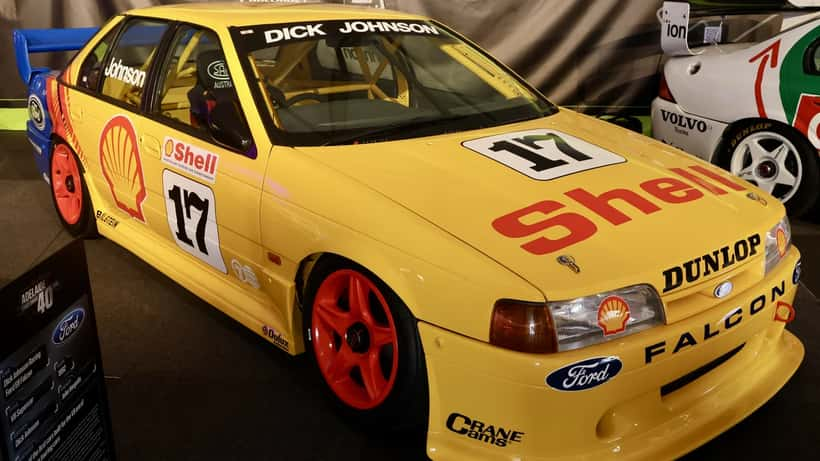
When Brodie Kostecki rolled his Dick Johnson Racing Mustang out of the Stapylton workshop for the 2026 Repco Bathurst 1000, he carried more than a racing legacy — he carried a brand that survived two ownership changes, a global motorsport giant's exit, and the kind of corporate turbulence that destroys lesser names. Dick Johnson Racing is again wholly Australian, wholly independent, and trending across every Supercars forum this week. What the DJR story tells us about intellectual property law is, for anyone who has ever built a business on their own name, far more important than the race result.
The DJR Timeline: A Brand That Refused to Die
Dick Johnson first entered Bathurst competition in 1979. He became the sport's folk hero a year later when a rock thrown onto the circuit by a spectator destroyed his car mid-race; businesses and fans across Australia funded the repairs overnight in one of the most famous acts of grassroots crowdfunding in Australian sport, decades before the term existed.
His team, Dick Johnson Racing, became a force in the V8 Supercar era. In 2014, NASCAR and IndyCar heavyweight Roger Penske acquired a major stake, and the team raced as "DJR Team Penske" through 2020. When Penske withdrew at the end of that year — citing pandemic-era financial pressures — Dick Johnson retained ownership of the name. The DJR branding was reclaimed for the 2021 season. New Australian majority investment followed, and the team fielding Kostecki at Mount Panorama this October is as authentically "Dick Johnson Racing" as it has ever been.
That transition was legally clean in one crucial respect: Dick Johnson had never permanently assigned his name to the Penske partnership. The trade mark stayed with the Australian entity. For tens of thousands of Australian tradespeople, consultants, and small-business owners who license or sell their name to commercial partners, that distinction is worth understanding deeply.
What Australian Law Says When Your Name Is the Brand
Australia's Trade Marks Act 1995 (Cth) governs the registration and protection of names as brands. Section 41 allows a personal name to be registered as a trade mark, provided it is "capable of distinguishing" the registered owner's goods or services from others in the same class. According to IP Australia, registration costs AUD $330 per class and confers a 10-year protection period, renewable indefinitely.
Registration matters more than many founders realise. When Miranda Kerr registered her name as a trade mark in 2012 for cosmetics and clothing, she established clear grounds under s.120 (infringement by use of an identical or deceptively similar mark) against any third party who tried to trade on her identity without authorisation. The registered mark gave her immediate, straightforward legal recourse.
Unregistered protections exist but are harder to enforce. The High Court's 2026 decision in Taylor v Killer Queen LLC [2026] HCA 5 — the long-running dispute known as the "Katy Perry case" — turned partly on the own-name defence under s.122(1)(a) of the Act, which permits a person to use their own name "in good faith" even where it resembles a registered mark. The case took over a decade of litigation across multiple courts before the High Court issued a narrow majority ruling. The lesson is not which side prevailed; it is that even a well-resourced party with a legitimate claim to their own name can spend years in court resolving what a $330 registration fee could have pre-empted.
When Partnerships Go Wrong
The DJR story is a best-case scenario: a founder who retained ownership of the name even while a global partner held a controlling financial stake. Many Australian operators face a harder road.
A common situation solicitors encounter: a sole trader builds a regional business under their own name, enters a partnership or franchise arrangement, and discovers — too late — that the agreement has assigned trade mark rights to the acquiring party. When the partnership sours, the original name-bearer may be unable to operate under their own identity. Worse, they can find themselves associated with products or services they never endorsed, with no quick legal remedy.
Under the Competition and Consumer Act 2010 (Cth) Schedule 2 — the Australian Consumer Law — s.18 prohibits misleading or deceptive conduct. If a company continues using a former partner's name in a way that implies ongoing endorsement, that conduct may be actionable. But proving it requires demonstrating that consumers are actually deceived: a higher bar than a straightforward trade mark infringement claim, and considerably more expensive to litigate.
The Real Scenario: What Happens When the Deal Turns
Consider a situation that IP solicitors in Brisbane and Sydney are fielding with increasing regularity this year.
Steve, 54, is an experienced panel beater from Ipswich who built "Steve Mitchell Auto" into a well-regarded suburban brand over 18 years. In 2021, he sold a 70% stake to a national vehicle services chain for AUD $420,000. The sale agreement included a five-year licence permitting the chain to use the name "Steve Mitchell Auto." By late 2025, the chain had expanded the brand into personal care products — branded detail kits and car-fragrance lines bearing his name and face — without his consent or any renegotiation of the original terms.
The legal outcome diverges sharply depending on one early decision Steve made — or failed to make:
If Steve had registered his name before the sale, covering vehicle-repair services (Class 37) and related goods (Class 3), the chain's unilateral expansion into fragrance products would constitute infringement under s.120. He could apply immediately for an injunction and seek damages or an account of profits. Australian courts have ordered five- and six-figure awards in comparable trade mark infringement cases.
If Steve had not registered, he is left relying on ACL s.18 (misleading conduct) or common-law passing-off. Both require him to demonstrate substantial reputation — which 18 years of trading likely establishes — but the evidentiary burden is heavier, the timeline longer, and legal costs at first instance can exceed AUD $80,000 before any judgment is reached.
The gap in real numbers: AUD $330 × 2 classes = $660 initial registration cost. Against a potential litigation bill of $80,000 or more, that is a 120-to-one return on preventive legal investment — before the distress, reputational damage, and lost trading time are factored in.
For anyone building a business under their own name, the calculus is stark.
Steps to Protect Your Name Before You Sign
The Dick Johnson Racing story has a favourable outcome because the right documentation existed when it mattered. Most founders who consult IP lawyers after a partnership breakdown do not share that advantage.
Register early. Apply to register your name as a trade mark at IP Australia before entering any commercial partnership. For tradespeople and service providers whose personal reputation is the core business asset, registration is the most cost-effective legal protection available.
Define the scope of any licence precisely. A licensing clause that allows a partner to use your name "for the business" can be interpreted to cover far more than a founder intends. Any agreement should specify classes of goods and services, geographic territory, and an explicit termination mechanism tied to the partnership's end date.
Include reversion rights. Just as Dick Johnson retained the DJR mark at the end of the Penske partnership, founders should include clauses ensuring trade mark rights return to the original holder if the arrangement ends — on any terms, not only fault-based termination.
Have an IP solicitor review the agreement before signing. IP clauses in partnership and franchise agreements are routinely drafted to favour the acquiring party. A specialist lawyer reviewing a commercial agreement will identify name-assignment risks in a single hour that a founder may overlook for years.
Australia's trade mark framework provides strong protection — but only for those who engage with it proactively. Kostecki is racing the DJR Mustang at Mount Panorama this October because the legal structure was sound when a global partner walked away. For the rest of us, that structure does not happen by accident.
This article is for informational purposes only and does not constitute legal advice. Readers with specific trade mark or IP concerns should consult a qualified Australian solicitor.
For related reading on protecting the value in motorsport heritage assets, see our guide to Bathurst collectibles and investment risk.
