 Chloe Anderson
Dave Rennie, the New Zealander who once coached the Wallabies, has told his All Blacks not to ease off before the second Bledisloe Cup Test in Sydney on Saturday 17 October 2026. Speaking on Thursday 15 October, he warned that Australia is "a proud side" that will be "hurting after last week", according to Kuwait Times. The All Blacks won 50-19 at Eden Park on 10 October and kept the trophy for a 24th straight time.
"Hurting" is a coach's word for wounded pride. For the thousands of Australians who play club rugby on Saturday afternoons, it can mean something more literal. This article looks at what the Bledisloe build-up says about injuries, and what weekend players should do when a knock does not feel right.
What Rennie actually said, and why it matters
The comments landed in an unusual context. Rennie coached the Wallabies in 34 Tests before being dropped ahead of the 2023 World Cup, and he is now the first person to have coached both sides. Ahead of the Eden Park Test, AAP reported him saying: "It's not about me. I've got no regrets."
Les Kiss's Wallabies arrived in Auckland on a six-game unbeaten run after beating South Africa in Perth. They trailed only 17-14 at half-time before the match got away from them. Rennie's message this week is that a team stung by a heavy defeat tends to respond with more intensity, not less.
Intensity has a physical cost. The AAP preview noted the All Blacks were missing several players through injury, including Richie Mo'unga and Ardie Savea. The Wallabies had lost centre Hunter Paisami to suspension, which pushed Len Ikitau into the 12 jersey. Elite squads absorb these changes with large medical teams. Community players rarely have that support.
The expert angle: elite habits that club players skip
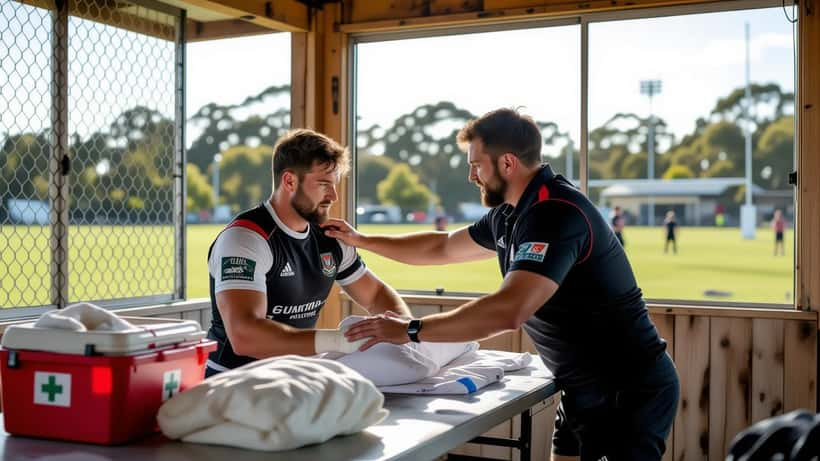
A sports physician looking at a Test match sees a pattern: the best-resourced players in the country still go off with soft-tissue injuries, head knocks and shoulder problems. Amateurs face the same collisions with far less supervision.
Three habits separate professional and community rugby:
- Immediate assessment. Professional teams assess a suspected head knock on the spot and remove the player. Many club players "run it off" and keep playing.
- Structured return. Elite players follow a graded return plan, with each stage cleared before the next. Club players often return the following weekend because they are short of numbers.
- Early imaging and diagnosis. A professional with a sore shoulder gets a scan within days. A weekend player waits until the pain stops them lifting a child.
The Australian Institute of Sport's concussion guidance, published through the federal government's Concussion and Brain Health in Sport resource, is clear that anyone with a suspected concussion should stop playing immediately and not return the same day. Return to sport follows a graded process supervised by a doctor.
A concrete case: the Saturday lock who "felt fine" on Monday
Consider a 34-year-old second-rower in a Sydney Premier Grade or suburban club side. In the 60th minute of a Saturday game he takes a shoulder to the head in a tackle. He stays on for the last 20 minutes with a headache and some blurred vision. By Sunday he has had 12 hours of broken sleep, and on Monday he feels "pretty good" and goes to work.
Here is how the logic plays out from a health perspective.
If his symptoms have fully cleared by Monday, that does not mean the brain has recovered. Symptoms can fade before function returns. Under graded return protocols, he should first have a medical assessment, then complete a staged increase in activity, and community players are commonly advised to wait at least two weeks from injury before contact training. If he plays again next Saturday, that is only 7 days after the knock, which is half the commonly cited minimum.
If he plays and takes a second knock during that window, the risk is higher. The consequences can include prolonged symptoms lasting weeks or months, trouble concentrating at work, and mood changes. If he instead sees a doctor on Monday and sits out the following two weekends, he loses 2 games and protects a career, a family life and his driving licence, because some post-concussion symptoms such as dizziness affect fitness to drive.
The numbers will differ for every player, and a doctor sets the actual timeline. The point of the scenario is that "I feel fine" is the weakest evidence available. A structured assessment is the strongest.
What the Bledisloe week tells parents of junior players
Test matches influence what children do at school grounds the following Saturday. Junior rugby programs in Australia follow modified rules, but parents still ask the same questions: when is a sore neck worth worrying about, and when can a child go back to training?
A few practical rules from sports medicine:
- Stop first, ask later. Any child with a suspected concussion leaves the field and does not return that day.
- Do not rely on the coach's judgement alone. Volunteer coaches are not clinicians.
- See a GP before returning. Children need clearance, and a school return should come before a sport return.
- Watch for delayed signs. Worsening headache, repeated vomiting, confusion or drowsiness need urgent medical attention.
Strains, sprains and the week-after problem
Head injuries get the headlines, but most rugby injuries are muscle and joint problems. Hamstrings, groins, ankles and shoulders account for a large share of missed games. A coach who warns his players against complacency is implicitly warning against the lapses that cause these injuries: late tackles, poor body position and fatigue.
For community players, the week after a hard game is the high-risk window. Muscles are fatigued, sleep is often poor, and many players train hard on Tuesday to make up for lost time. A physiotherapist can usually tell within a few days whether pain is ordinary soreness or something that needs imaging.
Seek assessment promptly if you notice any of the following:
- swelling that has not eased after 48 hours
- a joint that feels unstable or gives way
- pain that wakes you at night
- numbness or tingling down an arm or leg
Why the second Test matters beyond the scoreboard
The All Blacks have held the Bledisloe Cup since 2003 and would extend a run of 12 straight wins over Australia with a victory in Sydney. Fans will watch for tactics and selection. Those who play the game should also watch how teams handle their injured players: who is rested, who is replaced, and how long a returning player is eased back.
Those decisions reflect a medical process. Ordinary players can borrow the same principles, which are to assess early, return gradually, and never treat pain as a character test.
What to do now
If you play rugby or another contact sport and have had a knock in recent weeks, take these steps this week:
- Write down your symptoms, including headaches, sleep changes and any trouble concentrating.
- Book a GP or sports physician appointment before your next game, not after.
- Tell your club's first-aid officer about any head injury so it is recorded.
- Follow a graded return rather than jumping back to full contact.
You can find a sports medicine specialist, physiotherapist or GP who treats contact-sport injuries through the Health category on Expert Zoom. For readers who follow the legal and commercial side of the Wallabies, our earlier pieces cover Les Kiss's Wallabies contract and travel and consumer rights for Wallabies fans.
This article is general information, not medical advice. If you suspect a concussion or serious injury, seek immediate medical attention and consult a registered health professional about your individual situation.
