 Ruby Hall
Collingwood meets Carlton under lights at the MCG on Saturday 18 July 2026 in Round 19, one of the AFL's biggest drawcards, and the six-figure crowd expected at the ground is also one of the richest maths lessons your child will see all year. Behind the tribalism sits a game built almost entirely on numbers — scoring in sixes and ones, win-loss records, and the "percentage" that decides the top eight. For any parent whose kid groans at fractions but memorises player stats, this blockbuster is a rare chance to make the statistics and probability strand of the curriculum feel urgent.
Why this game is a maths problem in disguise
Australian rules football is scored in an unusual way that trips up newcomers and lights up young mathematicians. A goal is worth six points, a behind is worth one, and a scoreline like Collingwood's 13.10 (88) from their Round 6 win over Carlton is really a compact equation: 13 goals times six, plus 10 behinds times one, equals 88. Carlton's 12.11 (83) works the same way — a five-point margin decided by a single kick.
Ask a primary-schooler to reverse-engineer those totals and you are teaching multiplication, addition and place value without a worksheet in sight. Older students can be pushed further: how many different combinations of goals and behinds add up to exactly 88? That single question opens the door to algebra, systematic listing and the idea that one number can have many hidden structures.
Turning the head-to-head record into probability
The pre-game talk this week centres on a lopsided statistic: Collingwood have won 13 of their past 15 meetings with Carlton. That is a gift for teaching probability, the exact skill the Australian Curriculum asks students to build from the middle primary years onward.
Thirteen wins out of 15 is a relative frequency of about 0.87, or 87 per cent. Sit down with your child and convert it three ways — as a fraction (13/15), a decimal and a percentage — and you have covered a whole afternoon of "boring" homework in the space of one footy chat. Then comes the crucial critical-thinking step that separates a data literate teenager from a gambler: past frequency is not a guarantee. Carlton arrive at 8-9 for the season after a seven-match winning streak, while Collingwood sit inside the top four on the back of four straight wins since the bye. A tutor's favourite question — "does an 87 per cent record mean Carlton have almost no chance on Saturday?" — teaches kids to separate long-run trends from a single event. The honest answer is no, and understanding why is genuine statistical maturity.
Percentage: the AFL's own ratio lesson
The AFL ladder hides one of the neatest ratio lessons in Australian sport. When teams are level on wins, their position is decided by "percentage" — points scored for, divided by points scored against, multiplied by 100. A team that has kicked 1,600 points and conceded 1,400 sits on a percentage of roughly 114.
This is exactly the ratio and proportion work that stumps Year 7 and 8 students in the classroom, yet fans calculate it in their heads every weekend. Get your child to work out how many points Carlton would need to overhaul a rival on percentage, and abstract division suddenly has a finals spot riding on it. It is the same skill they will later use for interest rates, unit pricing at the supermarket, and reading a pay slip.
What a maths tutor actually does with a match like this
Turning a football result into a lesson sounds simple, but the value of a good private tutor is in the scaffolding. A generic worksheet asks a child to convert 13/15 to a percentage. A skilled tutor starts from a number the child already cares about, works backwards to the underlying concept, and then bridges to the abstract exam question they will actually be marked on. The engagement does the hard part; the tutor supplies the structure.
That matters because the statistics and probability strand is now assessed heavily through NAPLAN and senior maths, and it is precisely where disengaged students switch off. Kids who "hate maths" often simply have not seen it attached to anything real. A Saturday-night blockbuster watched by more than 80,000 people is about as real as it gets. An experienced tutor can take that spark and turn it into a repeatable study habit — pulling a fresh data set from every round, not just the marquee games.
How to run the lesson at home this weekend
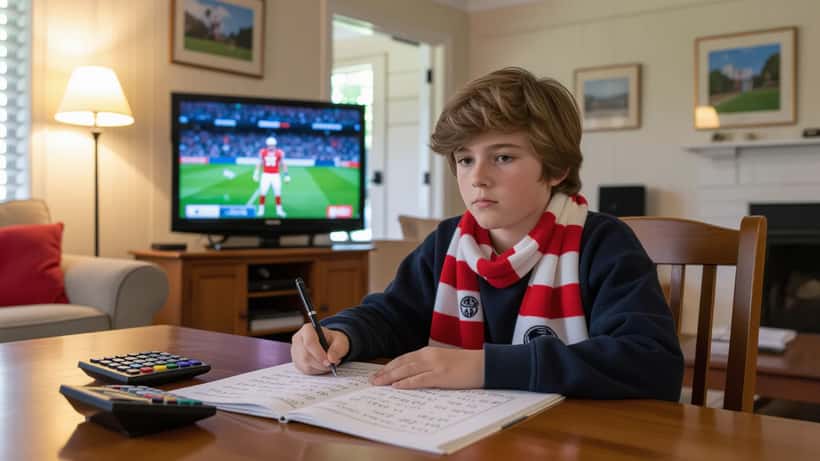
You do not need to be a mathematician to start. Before the first bounce, ask your child to predict the final margin and write it down — that is a hypothesis. During the game, get them to track goals and behinds for one team and keep a running total in the AFL's six-and-one notation. At the final siren, compare the real margin with the prediction and talk about why they differed.
For younger children, keep it to counting and adding. For high-schoolers, layer in the harder ideas: expected scores, the difference between the average margin and any single result, and why bookmakers' odds are not the same as true probability. If your child then wants to go deeper into the numbers behind these fixtures, the same approach works for any big-rivalry round, from a Carlton and Hawthorn clash to a traditional Collingwood and Richmond rivalry match.
If the enthusiasm outlasts the final siren and the school-term maths still feels like a grind, that is the point to bring in a specialist. A qualified maths or homework-help tutor can connect the curriculum to the interests your child already has, so the next set of fractions, ratios and probabilities lands as something worth understanding rather than one more chore. Saturday night's siren is a starting whistle for the lesson, not the end of it.
