 Chloe Harris
Game Freak's Beast of Reincarnation launched globally today, August 4, 2026, placing millions of Australian players in a post-apocalyptic Japan where survival depends entirely on a human-dog partnership. Emma and her dog Koo battle monstrous bosses across a dying world, bound together by instinct and interdependence. As gamers invest hours into that fictional bond, vets across Australia are asking a harder question: if a real emergency — a bushfire, flash flood, or cyclone — struck your suburb this week, would your actual dog be ready?
Beast of Reincarnation and the Dog That Changes Everything
Developed by Game Freak — the studio behind the Pokémon franchise — and published by Fictions, Beast of Reincarnation is one of the most anticipated action RPGs of 2026. Available from today on PlayStation 5, Xbox Series X|S, and Steam (with day-one Xbox Game Pass access), the game scored 35/40 from Famitsu before launch and has drawn comparisons to ICO and Shadow of the Colossus for its emotional depth.
The gameplay structure is deliberate. Emma handles real-time katana combat while players issue strategic commands to Koo through a turn-based interface. The two characters cannot survive independently — success depends on reading Koo's status, managing his abilities, and making decisions that account for both at once. It is, in essence, a crisis management simulation in which the dog is central to every outcome.
That design choice resonates beyond gaming. For Australian veterinarians and animal behaviourists, it captures something clinical observation has documented for decades: in genuine emergencies, the human-dog bond is both a critical asset and, without preparation, a serious liability.
What Veterinary Science Says About Dogs in Real Crises
Dogs are exquisitely attuned to human emotional states. Veterinary behaviourists describe what they call a dyadic stress response — when an owner's heart rate rises, a bonded dog detects the change through a combination of scent, posture, and vocal pitch within minutes. Dogs typically respond by staying in close physical proximity, increasing vocalisation, or attempting to redirect attention. In structured emergency situations, dogs with strong owner bonds perform markedly better when their humans remain calm and issue familiar commands.
Beast of Reincarnation reflects this dynamic. Koo's most powerful abilities become accessible when the player maintains command rhythm rather than defaulting to solo attacks. Improvised play produces worse outcomes than coordinated preparation.
The same is true in the real world — with one crucial difference. The fictional Koo never needs a vaccination certificate, a dose of anxiety medication, or a microchip registration with a current address. Real dogs always do. Australian vets say the planning gap between what pet owners believe they have organised and what they have actually prepared is wider than most families realise.
Concrete Case: One Evacuation, Two Very Different Outcomes
Consider two households in the Hawkesbury Valley, northwest of Sydney, during a January 2026 storm-surge evacuation. Both receive an SES order with four hours' notice. Both own five-year-old labradors. Both evacuate.
Household A has no pet emergency plan. They load their dog and drive to the nearest evacuation centre — which turns them away because it requires proof of a current C5 vaccination. They reach a second centre 40 minutes away and are admitted. After 36 hours, the dog stops eating and shows signs of significant gastric distress. A vet visit costs $185. The dog's microchip registration address is two years out of date: the family moved in 2024 and never updated it. When the dog briefly escaped at a fuel stop, retrieving it would have required a 48-hour process through council records. Total unplanned cost: $185 in veterinary fees, three rejected evacuation centres, six hours of additional driving.
Household B assembled a 72-hour pet emergency kit after a vet consultation six months earlier. In the same scenario: their laminated vaccination certificate admits them to the nearest centre immediately. A calming supplement prescribed in advance — which cost $28 — manages the dog's travel anxiety without a separate vet visit. The microchip address was updated during the same appointment. Total additional cost during the emergency: zero.
The if/then is clear. If your dog's vaccination record is current, their microchip address matches your home, and you have a vet-prepared emergency care note, your access to pet-friendly evacuation infrastructure in New South Wales and Victoria increases substantially — because most registered facilities now require at least two of those three documents before admitting animals.
A 72-hour emergency kit for a 35-kilogram dog costs between $120 and $200 to assemble, according to RSPCA Australia's disaster preparedness guidance. That is a one-time preparation covering years of potential emergencies — versus hundreds of dollars in reactive costs during each event.
What the Kit Actually Contains (According to Vets)
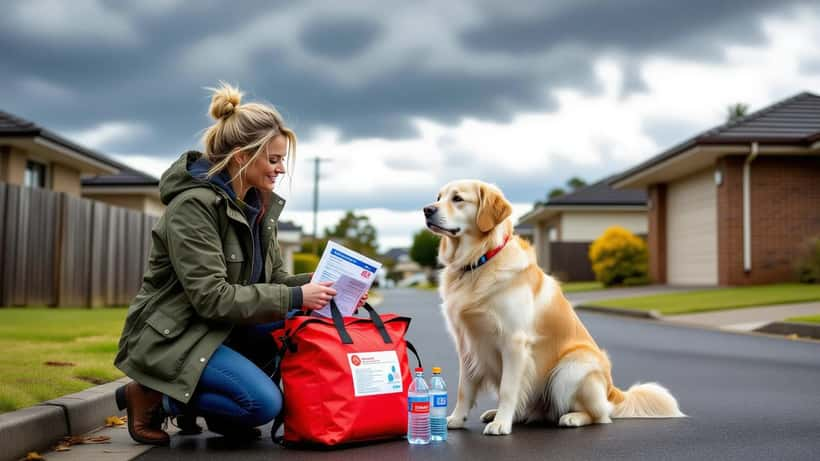
Australian veterinarians organise emergency pet preparedness into four practical categories.
Documentation: A laminated printout of your dog's vaccination history (C5 minimum for kennels and most evacuation centres), confirmation of current microchip registration, a list of medications with dosages and prescribing clinic details, and a photograph of you and your dog together in the same frame. Store the photograph digitally in cloud backup and as a physical print in the kit. It resolves ownership disputes during reunification, which can otherwise take days.
Medical supplies: Three to five days of any regular medication — for chronic conditions, anxiety, or epilepsy — stored sealed and labelled. For dogs with known stress responses to travel or disruption, a vet-prescribed calming supplement can make the difference between a manageable evacuation and a distressing one. A consulting vet can assess your dog's individual needs and issue a recommendation remotely. For pet owners in regional or rural areas with limited clinic access, this is particularly valuable: vet consultations are now available through platforms such as ExpertZoom without requiring an in-person appointment.
Physical supplies: Three litres of water per large dog per day is the RSPCA standard minimum. Add a collapsible bowl, three days of dry food in a sealed waterproof container, a spare lead and collar with an ID tag, a familiar blanket or item carrying the dog's scent (recommended by veterinary behaviourists to reduce displacement anxiety), and a basic dog-specific first aid kit.
Environmental management: In Australian summer conditions, dogs can reach dangerous core temperatures within 20 to 30 minutes inside a parked vehicle — even with windows cracked. Any emergency kit should include a cooling mat, and evacuation routes should factor in shade and water access at each stopping point. For flat-faced (brachycephalic) breeds such as bulldogs, pugs, and French bulldogs, heat tolerance is significantly lower and this planning becomes critical.
According to RSPCA Australia, fewer than one in three Australian pet owners have a documented emergency plan that covers their animals. In a country where bushfire seasons are lengthening and flooding events across the east coast are increasing in frequency, that figure represents a preventable gap. For additional context on how Australian pets respond to sudden stressors, see what vets have previously flagged about noise anxiety in dogs during major crowd events — the physiological response overlaps significantly with emergency displacement stress.
Before the Next Evacuation Order Arrives
Koo is a remarkable fictional companion — always ready, never stressed, never requiring a vaccination update. Real dogs are more complicated, and more rewarding for it.
For pet owners moved by today's launch of Beast of Reincarnation to think about what genuine crisis preparedness looks like for their animal, the first step is a veterinary review. This does not require an in-person appointment. Australian vets available through ExpertZoom can assess your dog's health profile, advise on medication and documentation needs, and help build a personalised emergency plan based on your region's specific risk — whether that is bushfire in Western Sydney, cyclone in tropical Queensland, or flooding across the Murray-Darling basin.
The game launched today. The plan should already exist.
Note: This article provides general guidance only. Medical and veterinary decisions for your specific animal should be made in consultation with a registered veterinarian.
