 Mark Campbell
Electricity powers nearly every aspect of Australian homes and businesses — yet most homeowners don't think about it until something goes wrong. Whether you're building a new home, renovating an old one, or simply trying to understand your energy bill, electricity is a topic that affects your safety, your wallet, and the environment.
TL;DR: Electricity in Australia operates on a 230V/50Hz system, delivered through the National Electricity Market (NEM). Managing your home's electrical system safely requires understanding how power flows, what your meter measures, and when to call a licensed electrician. Solar, battery storage, and smart metering are transforming how Australians consume and pay for electricity in 2026.
How Electricity Works in Australian Homes
Electricity in Australia is delivered as alternating current (AC) at 230 volts and 50 hertz (Hz) — a standard set by the Australian Energy Market Operator (AEMO) and aligned with most of Europe. When power leaves a coal, gas, wind, or solar plant, it travels through the high-voltage transmission network at up to 500,000 volts before being stepped down by transformers to the 230V that enters your switchboard.
Inside your home, the switchboard distributes electricity through individual circuits: lighting, power points, hot water, air conditioning, and kitchen appliances each typically run on separate circuits, protected by circuit breakers or residual current devices (RCDs). RCDs are mandatory in all Australian homes built after 2000 and must protect at least power point and lighting circuits — they trip within 30 milliseconds if a dangerous current leakage is detected, potentially saving lives.
Understanding Your Electricity Meter and Bill
Your electricity meter records kilowatt-hours (kWh) of energy consumed. Traditional accumulation meters are increasingly being replaced by smart meters, which transmit data remotely and enable time-of-use (TOU) pricing. Under TOU tariffs, electricity is cheaper during off-peak hours (typically 10pm–7am on weekdays) and more expensive during peak demand (3pm–9pm on weekdays in most states).
A typical Australian residential electricity bill includes several components:
| Bill Component | What It Covers | Approx. Share of Bill |
|---|---|---|
| Daily supply charge | Fixed cost of connection to the grid | 20–30% |
| Usage charge (peak) | kWh consumed during peak hours | 35–45% |
| Usage charge (off-peak) | kWh consumed during off-peak hours | 15–20% |
| Network charges | Poles and wires maintenance | 25–30% |
| Environmental levies | Renewable energy certificates | 5–10% |
"Many households don't realise that nearly a third of their bill is a fixed daily supply charge — meaning even reducing consumption won't save as much as switching to a lower supply charge rate or a better plan." — Sarah Brennan, Energy Consultant, Energy Consumers Australia [2025]
À retenir: Comparing electricity retailers in your state using the Australian Energy Regulator's (AER) Energy Made Easy tool (energymadeeasy.gov.au) can save the average household $300–$500 per year without changing any habits.
When You Must Call a Licensed Electrician
In Australia, electrical work is strictly regulated. Under the Electricity Safety Act and corresponding state legislation, all electrical work — installing new power points, rewiring circuits, upgrading switchboards, connecting solar panels — must be performed by a licensed electrician. Doing electrical work without a licence is illegal in all states and territories, and can invalidate your home insurance.
What Counts as Electrical Work?
The Work Health and Safety (WHS) Regulations define "electrical work" broadly. Tasks that legally require a licensed electrician include:
- Installing, replacing, or relocating power points, light switches, or ceiling fans
- Upgrading or replacing your switchboard or circuit breakers
- Installing hardwired smoke alarms (battery-powered alarms are a DIY exception)
- Connecting any fixed appliance — ovens, cooktops, air conditioners
- Installing electric vehicle (EV) charging stations
- Any solar panel or battery storage system connections to the grid
What Homeowners Can Do Themselves
You can legally replace a light bulb, reset a tripped circuit breaker, or replace a plug on a power cord in most states. Beyond that, contact a licenced electrician. The Master Electricians Australia (MEA) directory lists licenced contractors by postcode.
Consider this scenario: Marcus, a Brisbane homeowner, attempted to install a new oven himself by extending a power circuit — a task that seems simple. When his insurance assessor visited after a kitchen fire, they found the unlicensed wiring and denied his $80,000 claim. Calling a licensed electrician for the $350 connection would have been the obvious choice in hindsight.
Solar Power and Battery Storage: Transforming Australian Electricity
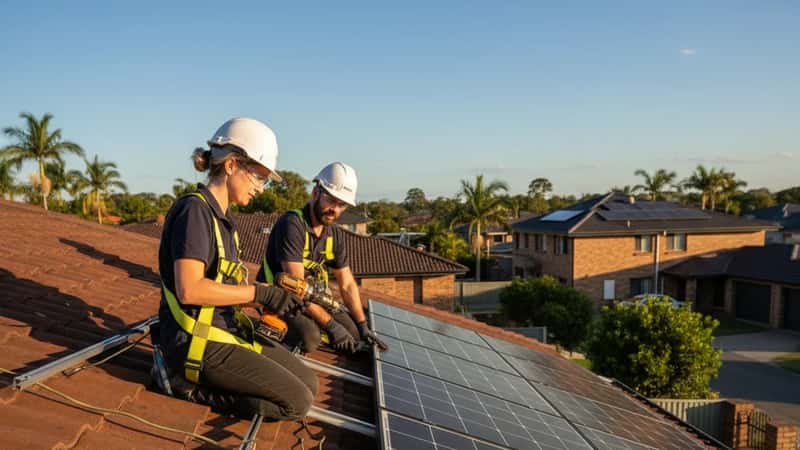
Australia has the world's highest rate of residential solar panel installation, with more than 3.9 million small-scale solar systems installed as of early 2026 [Clean Energy Regulator, 2026]. The combination of high electricity prices, abundant sunlight, and generous government incentives has made rooftop solar an economic necessity rather than a luxury for many households.
How Solar Feed-In Works
When your solar panels generate more electricity than your home uses, the surplus flows back into the grid through a process called net metering. Your retailer pays a feed-in tariff (FiT) for each kWh exported — rates vary from $0.04/kWh to $0.12/kWh depending on your retailer and state. Most households benefit most by self-consuming solar during the day (using dishwashers, washing machines, and pool pumps during sunlight hours) rather than relying on feed-in income.
Battery Storage: Does It Stack Up?
Home battery systems like the Tesla Powerwall and SolaX battery allow you to store excess solar generation for use at night or during peak-tariff periods. A 10kWh battery system typically costs $8,000–$14,000 installed in 2026 [Solar Choice, 2026]. Payback periods are 8–12 years in most Australian states without government rebates, reducing to 5–8 years in Victoria (Solar Homes Program) and South Australia (Home Battery Scheme).
Virtual Power Plants (VPPs)
Virtual Power Plants (VPPs) are networks of home batteries aggregated by retailers like AGL, Origin, or Energy Locals to respond to grid demand. Participating households receive bill credits or payment for allowing the VPP operator to briefly draw from or charge their battery. VPPs are an emerging way to earn additional income from your battery while contributing to grid stability.
Electrical Safety in the Home: Risks You Can Prevent
Electrical hazards cause approximately 15 deaths and 300 serious injuries in Australian homes every year [Energy Safe Victoria, 2024]. Many of these incidents are preventable with simple maintenance and awareness.
Warning Signs That Need Immediate Attention
Contact a licensed electrician if you notice any of these:
- Flickering lights or intermittent power — may indicate loose wiring, overloaded circuits, or a failing switchboard component
- Burning smell near power points or the switchboard — potential arcing fault, a significant fire risk
- Tripping circuit breakers or RCDs — a breaker that trips repeatedly signals an overloaded circuit or a faulty appliance; never simply reset without investigating
- Discoloured or warm power points — heat build-up suggests resistance from poor connections
- Buzzing sounds from the switchboard — often caused by a failing breaker that needs replacement
Appliance Safety and Energy Star Ratings
Every electrical appliance sold in Australia must carry an Energy Star rating label showing its annual energy consumption in kWh. Choosing a 5-star rated refrigerator over a 2-star model can save $120–$180 per year in electricity costs [Australian Government Energy Rating, 2025]. When purchasing second-hand appliances, check for the Regulatory Compliance Mark (RCM) — an octagonal mark confirming the appliance meets Australian safety standards.
How to Choose the Right Electrician for Your Project
Selecting a qualified electrician in Australia requires more than checking availability and price. Each state and territory has its own electrical licencing authority — and each licence type covers different scopes of work.
Verify the Licence
| State/Territory | Licencing Authority | Check Online |
|---|---|---|
| NSW | Fair Trading NSW | onegov.nsw.gov.au |
| VIC | Energy Safe Victoria | esv.vic.gov.au |
| QLD | QBCC | qbcc.qld.gov.au |
| SA | Consumer and Business Services | cbs.sa.gov.au |
| WA | Building and Energy | dmirs.wa.gov.au |
| ACT | Access Canberra | accesscanberra.act.gov.au |
| TAS | Consumer, Building and Occupational Services | cbos.tas.gov.au |
| NT | NT WorkSafe | worksafe.nt.gov.au |
Always request the electrician's licence number before engaging them, and verify it against the relevant authority's online register. A licensed electrician is also required to issue you a Certificate of Electrical Safety (or equivalent) for all prescribed electrical work — keep this document for insurance purposes and any future property sales.
What to Ask Before Hiring
- Are you licensed in this state and is your licence current?
- Do you carry public liability insurance and workers compensation?
- Will you provide a Certificate of Electrical Safety upon completion?
- Do you offer a written quote before starting work?
- Are you familiar with AS/NZS 3000 Wiring Rules (the Australian standard)?
Platforms like Expert Zoom connect homeowners with pre-vetted, licensed electricians in their postcode — making the vetting process faster and reducing the risk of hiring an unlicensed operator.
The Future of Electricity in Australia: What Homeowners Need to Know
The Australian electricity landscape is undergoing its most significant transformation since the grid was built. By 2030, AEMO projects that renewable energy will supply over 60% of electricity in the National Electricity Market (NEM), up from 36% today [AEMO Integrated System Plan, 2024].
Electric Vehicles and Home Charging
With EV sales tripling in Australia between 2023 and 2025 [Electric Vehicle Council, 2025], home charging infrastructure is becoming essential. Most EVs can charge from a standard 15-amp power point at 2.4kW (adding roughly 15km of range per hour), but dedicated EV charging units (called AC wallboxes) operate at 7.2–22kW, charging a typical EV overnight.
Installing a wallbox requires a licensed electrician to assess your switchboard capacity and potentially upgrade circuits. Costs range from $800 to $2,500 installed, depending on the unit and your switchboard's current capacity.
Smart Home Electricity Management
Smart meters, smart power strips, and home energy management systems (HEMS) are enabling Australians to shift consumption automatically to cheaper rate periods. Systems like Amber Electric pair your home with real-time wholesale electricity prices, while smart devices like Reposit Power use AI to optimise battery charging and discharging based on predicted prices.
The most impactful immediate steps for most households: switch to a time-of-use tariff, install solar if you own your home, use a smart meter, and shift large appliance loads (dishwasher, washing machine, EV charging) to off-peak hours.
Frequently Asked Questions About Home Electricity in Australia
Can I legally do my own electrical work in Australia?
Only very minor tasks — such as replacing a light globe or resetting a tripped circuit breaker — are permitted without a licence. All other electrical work, including installing power points, ceiling fans, or any fixed wiring, must be done by a licensed electrician under the Electricity Safety Act in each state and territory.
How much does it cost to rewire a house in Australia?
Rewiring an average 3-bedroom Australian home costs between $8,000 and $20,000 depending on size, access, and the extent of work required. An RCD upgrade alone (mandatory for pre-2000 homes selling or undergoing major renovation in many states) costs $300–$800.
What is the best time to use electricity in Australia?
If you're on a time-of-use tariff, off-peak hours (typically 10pm–7am weekdays, all day weekends) offer the lowest rates — often 15–20 cents/kWh versus 35–50 cents/kWh during peak periods. Running high-consumption appliances during these windows can reduce your bill meaningfully.
How do I find out if an electrician is licensed in Australia?
Visit your state's licencing authority website (e.g., esv.vic.gov.au for Victoria, onegov.nsw.gov.au for NSW) and search the licence register using the electrician's name or licence number. Always verify before work begins.
Is solar power worth it for Australian homeowners in 2026?
For most Australian homeowners in an owner-occupied dwelling, a properly sized solar system (6.6kW typical) generates a return of 15–25% per year on investment, with payback periods of 3–6 years in states with high electricity prices. Battery storage adds cost but improves self-consumption and resilience.
Avertissement / Disclaimer: The information in this article is provided for general informational purposes. Electrical regulations and tariff structures vary by state and territory. Always consult a licensed electrician for work on your property and contact your energy retailer or state regulator for current pricing and compliance requirements.
Electrical Upgrades That Add Value to Your Australian Home
Electrical upgrades are consistently ranked among the highest-return home improvement investments, particularly in the context of tightening building codes and rising energy costs. A switchboard upgrade, for example, not only ensures safety compliance but is often a condition of sale — many conveyancers now request proof that a property's electrical system meets current standards.
Switchboard Upgrades
The Australian Standard AS/NZS 3000 (commonly called the Wiring Rules) sets out minimum requirements for all new electrical installations. Homes built before the 1990s typically have ceramic fuse wire switchboards — these are not compliant with current safety requirements and cannot accommodate modern circuits like solar inverters, EV chargers, or split-system air conditioners without significant risk.
A modern circuit breaker and RCD switchboard installation costs between $1,500 and $4,000, depending on the number of circuits and the complexity of the existing wiring. This upgrade is often mandatory when selling an older property, and insurance companies increasingly require proof of compliance for full coverage.
LED Lighting Retrofits
Transitioning from halogen or incandescent lighting to LED throughout a 4-bedroom Australian home reduces lighting energy consumption by 75–85% [Energy Rating Australia, 2025]. The average cost is $800–$1,800 installed by a licensed electrician (using hardwired LED downlights), with a payback period of 2–4 years at current electricity prices.
Modern LED systems offer dimming capability, smart home integration (via Zigbee or Z-Wave protocols), and lifespans of 25,000–50,000 hours compared to 1,000–2,000 hours for incandescent bulbs.
Three-Phase Power: Do You Need It?
Standard Australian residential connections are single-phase (230V). Three-phase power (400V, three wires) is typically available only in new builds or homes with significant power demands — high-capacity EV chargers (22kW+), large workshop machinery, or commercial-grade air conditioning.
Upgrading to three-phase requires an application to your local distribution network service provider (DNSP) and costs $3,000–$8,000 depending on proximity to existing infrastructure. For most households, single-phase solar with battery storage is a more cost-effective path than a three-phase upgrade.
Managing Electricity Costs: Practical Strategies for Australian Households
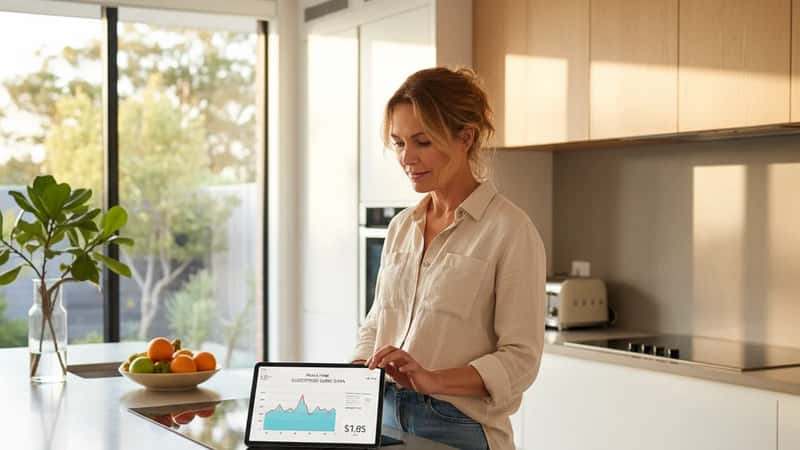
With electricity prices in eastern Australia reaching record levels in 2024–2025 — the average residential rate in NSW hitting 37 cents/kWh, up from 22 cents/kWh in 2021 [AER State of the Energy Market, 2025] — managing consumption has become a significant financial priority for most Australian families.
Appliance-by-Appliance Consumption Guide
Understanding which appliances consume the most electricity helps prioritise savings. A plug-in energy monitor ($25–$60 at hardware stores) can measure any appliance's actual consumption in real time.
| Appliance | Typical Wattage | Annual Cost (37c/kWh) |
|---|---|---|
| Electric hot water system (off-peak) | 3,600W | $600–$900 |
| Air conditioner (ducted, 3BR home) | 2,000–3,500W | $800–$1,200 |
| Pool pump (8 hrs/day) | 750–1,500W | $900–$1,500 |
| Refrigerator (old model) | 150–300W | $200–$400 |
| Refrigerator (5-star LED) | 60–100W | $80–$130 |
| Clothes dryer (electric) | 2,400W | $300–$500 (seasonal) |
| EV charger (home, 7.2kW) | 7,200W | $400–$700 (avg. AU use) |
Hot Water Heating: The Biggest Variable
Hot water accounts for 25–30% of the average Australian home's electricity bill. Heat pump water heaters use 65–75% less electricity than conventional electric resistance elements and qualify for Small-scale Technology Certificates (STCs) under the federal renewable energy scheme — reducing upfront costs by $500–$1,000 [Clean Energy Regulator, 2026]. A heat pump water heater typically costs $2,000–$3,500 installed and pays back within 4–6 years at current electricity prices.
Demand Management: Shifting Load, Not Just Reducing It
Demand response programs — offered by retailers including Amber, Energy Locals, and Origin — pay participating households to reduce consumption during grid stress events (typically hot summer afternoons when air conditioner demand peaks). Households with smart thermostats, pool pump timers, or home batteries can earn $50–$200 in annual credits simply by allowing automated brief reductions during peak events.
Point clé: The most effective single action for most Australians is comparing electricity plans annually on the AER's Energy Made Easy tool. Plan switching saves an average $380 per year without changing any behaviour [AER, 2025].
Navigating State and Federal Electricity Rebates in 2026
Australia's electricity rebate landscape is complex — overlapping federal and state programs mean many eligible households miss out simply because they don't know what's available. Here is a state-by-state snapshot of key programs active in 2026.
Federal Programs
- Small-scale Renewable Energy Scheme (SRES): Reduces the upfront cost of solar panels and solar water heaters through Small-scale Technology Certificates (STCs). A typical 6.6kW system generates around 80 STCs, worth approximately $3,000–$4,000 deducted from the purchase price [Clean Energy Regulator, 2026].
- Home Battery Scheme credits: Available through state programs (below), batteries purchased via approved VPP providers may attract additional federal support through the Capacity Investment Scheme.
State-Specific Programs (2026)
| State | Key Program | Benefit |
|---|---|---|
| VIC | Solar Homes Program | Up to $1,400 rebate on solar; $2,950 battery rebate |
| SA | Home Battery Scheme | $2,000 subsidy + $0 interest loan for batteries |
| QLD | Queensland Battery Booster | $4,000 rebate on approved home batteries |
| NSW | Energy Bill Relief (Low Income) | $380–$500 annual credit for concession holders |
| WA | Household Electricity Credit | $400 credit for all residential customers |
| ACT | Sustainable Household Scheme | 0% interest loans up to $15,000 for EVs, solar, batteries |
Eligibility conditions change regularly — always verify current terms at the relevant state government website before committing to an installation.
Electricity in Australia is both an essential utility and a complex financial asset, especially as solar generation, battery storage, and dynamic pricing converge. The households that navigate it well — understanding their tariff structure, maintaining their electrical system, and taking advantage of rebates — will be significantly better positioned over the decade ahead.