
 Liam Campbell
TL;DR: For the 2026-27 financial year, Australian small businesses with aggregated annual turnover below $10 million can immediately deduct the full cost of any eligible asset costing under $20,000 in the year of purchase — rather than depreciating it over several years. The 2026 Federal Budget made this threshold permanent, ending the annual renewal uncertainty that had frustrated business owners since 2015. Assets must be first used or installed ready for use for a taxable purpose by 30 June 2027, and the deduction is claimed on your annual income tax return.
What the ATO Instant Asset Write-Off Actually Does
The Instant Asset Write-Off (IAWO) allows eligible small businesses to deduct the entire purchase cost of a qualifying asset in the same income year the asset is acquired and put to use — rather than writing it off gradually through a standard depreciation schedule.
Under normal depreciation rules, a $15,000 piece of equipment might be written off over five or more years depending on its effective life as determined by the Australian Taxation Office (ATO). With the IAWO, the same asset generates a $15,000 deduction in year one, reducing taxable income immediately and improving cash flow when it matters most.
The 2026 Federal Budget confirmed the $20,000 threshold is now a permanent feature of Australian tax law, as detailed in the Budget 2026 small business analysis. Previously, the threshold was extended year by year, forcing business owners to time purchases around budget announcements rather than genuine business needs.
The mechanism applies asset by asset. If a tradie purchases a $12,000 generator and a $9,500 drill press in the same financial year, both qualify as separate assets — generating a combined deduction of $21,500, despite neither asset exceeding the $20,000 cap individually.
Key takeaway: The write-off is per asset, not per year. Multiple assets each costing under $20,000 can all be written off in the same financial year, with no cap on the total number of assets.
Who Qualifies in 2026-27? Eligibility Criteria Explained
To claim the IAWO for the 2026-27 income year, your business must satisfy a turnover threshold and an operational requirement.
Meeting the Aggregated Annual Turnover Threshold
Your business qualifies as a Small Business Entity (SBE) under the Income Tax Assessment Act 1997 (ITAA 1997), section 328-125, if its aggregated annual turnover is below $10 million. Aggregated turnover is not simply your own business revenue — it includes the turnover of any entities connected to or affiliated with your business.
This is a commonly misunderstood point. A sole trader whose spouse controls a connected company must count the combined revenues against the $10 million threshold, even if the two businesses operate entirely independently day to day. If you are uncertain whether related entities affect your calculation, a registered tax agent can assess your structure before you lodge.
Which Business Structures Are Eligible
All standard business structures operating in Australia qualify for the IAWO, provided the turnover test is met:
- Sole traders
- Partnerships
- Companies
- Trusts (including discretionary family trusts)
The Active Business Requirement
Your business must be actively carrying on a business in Australia during the relevant income year. Passive investment — such as holding residential rental properties — does not meet this threshold, as the ATO does not classify property investment as carrying on a business for these purposes.
Scenario: Sophie Nguyen runs a small electrical contracting business in suburban Brisbane with annual revenues of $1.4 million. Her husband owns a separate plumbing company with revenues of $3.2 million, and the two businesses are connected entities under tax law. Their combined aggregated turnover of $4.6 million sits well below the $10 million threshold, so Sophie's business qualifies for the instant asset write-off in 2026-27.
Which Assets Are Eligible — and Which Are Not?
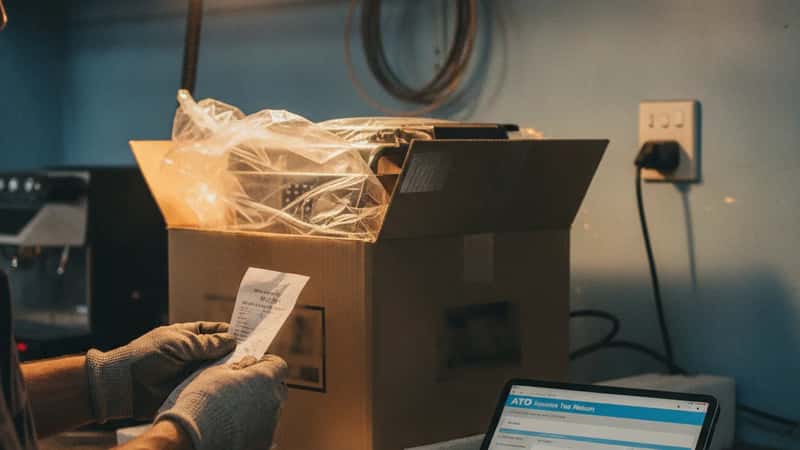
Common Qualifying Assets
The IAWO covers tangible depreciable assets used wholly or partly for a taxable business purpose. Common examples include:
- Plant and machinery (commercial ovens, compressors, lathes)
- Hand tools and power tools
- Vehicles used for business (utes with payload over one tonne, panel vans, trucks, forklifts)
- Computers, laptops, tablets, and business-grade smartphones
- Office furniture, commercial shelving, and fit-out equipment
- Point-of-sale systems, cash registers, and EFTPOS terminals
Both new and second-hand assets qualify. The asset must cost less than $20,000 — calculated as the GST-exclusive amount if your business is registered for the Goods and Services Tax (GST), or the GST-inclusive amount if it is not.
The Passenger Vehicle Car Limit
Passenger cars — as defined by the ATO — are subject to a separate annual car cost limit for depreciation purposes. Even if a passenger vehicle costs under $20,000, only the eligible business-use portion is deductible. For the 2026-27 income year, check the current car cost limit on the ATO's website at ato.gov.au, as this figure is indexed each year. Commercial vehicles such as utes with a payload above one tonne and panel vans without rear seats are generally not subject to this restriction.
What You Cannot Claim
The following expenditure does not qualify for the IAWO:
- Land and buildings
- Capital works (extensions, renovations, structural fit-outs)
- Intangible assets such as trademarks, patents, and goodwill
- Assets used exclusively for private or domestic purposes
- Stock held for resale (trading stock is not a depreciable asset)
Where an asset has a mixed business and private use — for example, a laptop used 60% for business and 40% for personal tasks — the deductible amount is apportioned accordingly. A $14,000 laptop used 60% for business generates an $8,400 deduction, not $14,000.
How to Claim the Deduction: A Step-by-Step Process
Step 1: Confirm Your Business Is Eligible Before Purchasing
Verify that your aggregated annual turnover is below $10 million — including revenues from connected and affiliated entities. If purchasing a passenger vehicle, check the current-year car cost limit via ato.gov.au before assuming the full purchase price is deductible.
Step 2: Purchase the Asset and Put It to Use by 30 June 2027
The asset must be acquired and either first used for a taxable purpose or installed ready for use by 30 June 2027. An item ordered in June 2027 but not delivered or operational until August 2027 falls into the 2027-28 financial year and cannot be claimed in 2026-27. Keep the delivery note or installation record as evidence of the date of first use.
Step 3: Maintain Contemporaneous Records
Under the Taxation Administration Act 1953 (TAA 1953), you must retain records for five years from the date you lodge the relevant income tax return. Your records should include:
- Original purchase invoice or contract of sale
- Proof of payment (bank statement or credit card receipt)
- Evidence of business use (vehicle logbook, installation records, work orders)
- Warranty card, registration documents, or serial number records where applicable
Step 4: Apportion the Deduction If Necessary
If the asset is used partly for private purposes, calculate the business-use percentage and apply it to the total asset cost before claiming the deduction. Document your apportionment methodology — the ATO may ask you to justify it.
Step 5: Lodge Your Tax Return and Claim the Deduction
Declare the asset deduction in the business expense section of your annual income tax return. Most cloud accounting platforms (such as Xero, MYOB, or QuickBooks) handle this classification automatically once you log the purchase under the correct asset category. If preparing your own return via myTax, the deduction appears under the depreciation or business assets section. A registered tax agent can ensure the claim is correctly categorised and that all supporting records are in order.
Three Strategies to Maximise Your Write-Off Before 30 June 2027

Plan Capital Purchases Around the Financial Year Deadline
The 30 June 2027 cutoff is absolute. An asset that is operational before midnight on 30 June qualifies; one that arrives on 1 July does not. For businesses considering capital investment in mid-2027, bringing those purchases forward by a few weeks can deliver a meaningful tax benefit in the current year. The permanent nature of the $20,000 threshold means there is no need to rush purchases to beat a sunset clause — but the financial year boundary remains a genuine planning lever.
Invoice Assets Separately to Stay Under the $20,000 Cap
Where a supplier quotes a bundled price for what are genuinely distinct assets — for example, a commercial espresso machine and a refrigerated display cabinet — ask whether the items can be invoiced separately. Each distinct asset valued under $20,000 qualifies independently. However, artificially splitting a single asset across multiple invoices to stay below the threshold is not permissible. The commercial substance of the transaction must reflect two genuinely separate items.
Combine the Write-Off with Other Small Business Concessions
The IAWO operates alongside other concessions available to Small Business Entities. Sole traders and certain partnerships may also benefit from the Small Business Income Tax Offset (SBITO), which reduces tax payable by up to $1,000 per year [ATO, 2026]. A registered tax agent or accountant can model the combined impact of these concessions before year-end, identifying whether any interactions affect your overall tax position.
Staying on the Right Side of the ATO
The ATO cross-matches business deductions against industry benchmarks and flags returns where asset claims appear disproportionate to reported income. Four compliance issues account for the majority of IAWO disputes:
Private use not apportioned correctly: Claiming 100% of a vehicle or device that is partly used for personal purposes. If the split is not documented in a logbook or usage diary, the ATO will default to a reduced deduction.
Timing errors: Claiming an asset in 2025-26 when it was not delivered or operational until 2026-27 — or, conversely, missing an eligible purchase by lodging late.
GST treatment errors: Businesses registered for GST must claim the IAWO on the GST-exclusive price of the asset. The GST component is recovered separately via your Business Activity Statement (BAS). Claiming the full GST-inclusive price inflates the deduction and can trigger a review.
Ineligible expenditure included: Capital works such as a shopfront renovation or warehouse extension cannot be claimed under the IAWO. These fall under separate capital works provisions with their own depreciation rates.
Understanding what triggers an ATO audit in 2026 helps you maintain clean records from the outset, rather than scrambling to reconstruct documentation after the fact.
Frequently Asked Questions
Is the $20,000 cap per asset or a total annual limit?
The $20,000 cap applies per individual asset, not per year. You can write off multiple assets each costing under $20,000 within the same financial year. There is no annual limit on the number of assets you can claim under the IAWO, provided each one individually costs less than $20,000 and meets all other eligibility criteria.
Can I claim the write-off for second-hand equipment?
Yes. The IAWO applies equally to new and second-hand assets, provided the asset is used for a taxable business purpose and costs less than $20,000. Pre-owned machinery, refurbished equipment, and used commercial vehicles all qualify under the same rules as new assets.
What happens if my asset costs more than $20,000?
An asset costing $20,000 or more cannot be claimed under the IAWO. It instead enters your general small business asset pool, where it depreciates at 15% in the year of acquisition and 30% per year thereafter under the ATO's simplified depreciation rules for Small Business Entities.
Does claiming the write-off affect my GST credits?
No. GST and income tax operate as separate systems. If you are GST-registered, you recover the GST component of the asset purchase through your BAS (a Business Activity Statement). The IAWO income tax deduction is then calculated on the GST-exclusive cost. The two claims are independent of each other.
Disclaimer: The information on this page is general in nature and does not constitute tax, financial, or legal advice. Tax rules and thresholds change frequently. Consult a registered tax agent or accountant for advice tailored to your specific business circumstances and the 2026-27 financial year.