 Isabella Torres
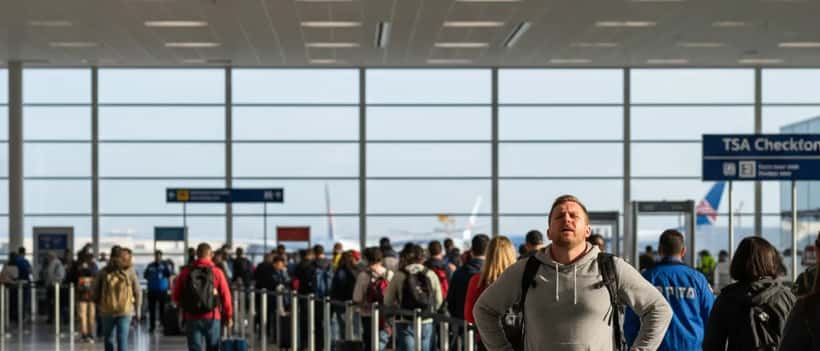
JFK Airport hit a 28.7% TSA officer callout rate on March 19, 2026 — more than 14 times the normal rate — as the ongoing government shutdown enters its sixth week with 50,000 federal security workers going without pay. Wait times at Terminal 8 are exceeding 30 minutes at peak hours, and TSA officials have warned that certain airports could face partial closures if Congress does not act. For American travelers, this raises an urgent question: when airport security chaos derails your trip, what can you actually do?
What's Causing the TSA Crisis Right Now
The shutdown, which began February 14, 2026, has created a cascading staffing emergency at the TSA. Over 300 officers nationwide have quit since it started — choosing to find paid work elsewhere rather than continue as essential workers without a paycheck. At JFK, the callout rate hit 28.7% on March 19, compared to a normal baseline of around 2%.
The numbers tell the story: 2.8 million passengers are expected to travel daily in March-April 2026, a record travel period. Houston Hobby recorded a 33.1% callout rate on the same day; Atlanta, the busiest airport in the world, stood at 31.8%. The gap between expected service capacity and actual staffing availability is, at this point, structurally dangerous.
Congressional leaders are locked in a standoff over how to fund TSA operations separately from other DHS priorities, and no resolution is imminent. For now, travelers bear the cost — in time, missed connections, and in some cases, real financial loss.
The Hard Truth About US Passenger Rights
If you missed your flight because of a 45-minute TSA security line, you might expect the government to owe you something. The reality is more complicated — and more frustrating.
There is no mandatory federal compensation for TSA-caused delays. Unlike the EU's EC 261/2004 regulation, which requires airlines to pay €250-€600 for delays over 3 hours, US law does not guarantee passengers financial compensation when security delays cause missed flights.
Here is what you are entitled to under federal law:
If your flight is canceled or significantly delayed (3+ hours domestic, 6+ hours international):
- You have the right to a full refund to your original payment method — but this is a refund, not compensation for consequential losses.
- You can request a refund even on a non-refundable ticket if the delay is significant.
If you are stuck on the tarmac:
- Water and snacks within 2 hours
- Working bathrooms
- Medical assistance if needed
- The right to deplane after 3 hours (domestic), unless doing so would create a safety or security threat
Denied boarding (involuntary bumping):
- If you are involuntarily bumped from an oversold flight, the airline must compensate you — up to $1,550 for delays of 2-4 hours, and up to $3,100 for delays over 4 hours. This is the one scenario where compensation is guaranteed by law.
What Your Airline May — or May Not — Offer
Beyond what the law requires, each airline has voluntary customer service commitments. The Department of Transportation maintains an Airline Customer Service Dashboard where you can check whether your carrier has committed to meal vouchers, hotel accommodation, and rebooking on partner airlines in cases of significant delays.
Several major carriers have committed to providing meals after 3+ hour delays and hotel accommodation for overnight disruptions — but these are voluntary commitments, not legal requirements. The key word is "significant delay" as defined by each airline, not by the TSA line that made you miss your flight.
Practical steps if a TSA delay costs you a flight:
Document everything. Take timestamped photos of the security line and your boarding pass. Note the exact time you entered the line and the time you reached the gate.
Request a written statement from TSA. TSA officers at the checkpoint can sometimes provide documentation of abnormal wait times. This is not guaranteed, but it's worth asking.
Contact your airline immediately at the gate, not at a service desk — gate agents have more immediate rebooking authority.
File a complaint with the DOT. Go to airconsumer.dot.gov. Complaints on file help build the regulatory record for future rule changes.
Check your credit card benefits. Many travel credit cards include trip delay insurance that covers accommodation, meals, and transportation when a delay exceeds 6-12 hours — regardless of whether it was caused by the airline or by TSA. Read your card's benefit guide carefully.
When a Lawyer Can Help
The legal picture shifts if you can demonstrate that the TSA's failure caused you quantifiable financial loss — a non-refundable hotel booking, a pre-paid tour, a business conference you missed. In those cases, there are two potential avenues.
Small claims court against the airline: If an airline fails to provide the customer service commitments it explicitly promised (as documented on the DOT dashboard), you may have grounds to pursue the cost of those services in small claims court. The filing fee is typically $30-$100 and you do not need an attorney.
Federal tort claim against the government: You can file an administrative claim against the federal government under the Federal Tort Claims Act (FTCA) if you believe TSA negligence directly caused your injury or financial loss. These cases are complex and slow — most attorneys will advise that the cost of litigation outweighs the likely recovery in straightforward delay cases. But for significant losses (think: a $5,000 non-refundable family vacation package), a consultation with an attorney specializing in aviation or consumer law is worthwhile.
⚖️ This article is for informational purposes only and does not constitute legal advice. If you have suffered significant financial loss due to airport security delays, consult a licensed attorney in your jurisdiction.
What Comes Next
TSA officials testified before the Senate Homeland Security Committee on March 20, 2026, warning that the agency was "one bad weekend" away from a crisis that could force closures at smaller hub airports. That testimony has not yet moved Congress.
For travelers with upcoming flights in the next 30 days, the practical advice is simple: arrive earlier than you think you need to. The TSA's published wait times at tsa.gov are updated in near-real time and can help you calibrate. At JFK, plan for at least 90 minutes before your departure during peak hours (6-9 AM and 4-7 PM).
If you've already been financially impacted by the current situation, document it now, while the evidence is fresh.
Sources: CNN (March 21, 2026), CNBC (March 8, 2026), NPR (March 21, 2026), TIME (March 17, 2026), US DOT Fly Rights guidelines.
