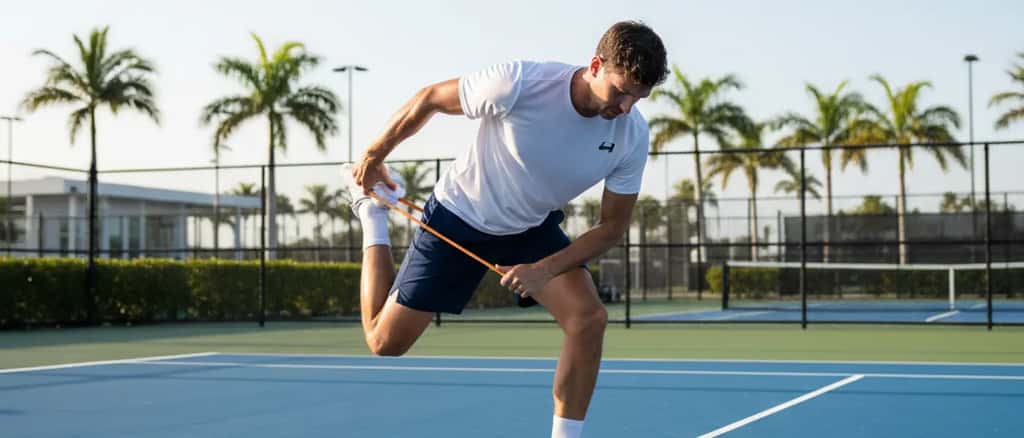
Jannik Sinner, the world number two seed, begins his campaign at the 2026 Miami Open on March 18, seeking to defend the title he first claimed in 2024 at Hard Rock Stadium. As qualifying rounds wrapped up on March 15-16, 2026, sports medicine physicians are watching closely—not just for results, but for what the Italian champion's meticulous physical preparation reveals about injury prevention at the highest level.
Sinner's Physical Edge: What Elite Conditioning Looks Like
Sinner's rise to the top two in the world rankings is inseparable from his approach to physical conditioning. ATP professionals average over 60 hours of training per week during pre-season, and Sinner works with a dedicated physiotherapist team that monitors load, recovery, and movement mechanics year-round. His on-court movement—explosive lateral bursts, rapid deceleration, repeated overhead strikes—places extraordinary demands on specific muscle groups and joints.
What sets elite players apart is not just training volume but the integration of preventive work into the daily routine. Dynamic warm-up protocols lasting 15-20 minutes before every session, targeted strength work for stabiliser muscles, and proprioception training (balance and joint position sense) form the foundation. These aren't optional extras—they're the reason players like Sinner can compete through the gruelling North American hard court swing without breaking down.
The Most Common Tennis Injuries—and Their Warning Signs
Tennis places repetitive stress on the same structures across thousands of hours of play. Understanding the most frequent injuries helps recreational players know when minor discomfort crosses into a medical concern requiring professional evaluation.
Lateral epicondylitis (tennis elbow) affects the outer elbow where forearm muscles attach. Pain worsens when gripping or lifting, and players often notice it most when opening jars or lifting a cup. Early-stage tennis elbow responds well to rest, ice, and targeted strengthening—but ignoring it can lead to tendon micro-tears requiring months of recovery.
Rotator cuff injuries involve the four muscles stabilising the shoulder joint. A serve generates enormous rotational force, and cumulative stress can cause partial tears. Warning signs include weakness when lifting the arm above shoulder height, pain at night when lying on the affected shoulder, or a catching sensation with overhead movement.
Knee ligament strains, particularly to the medial collateral ligament (MCL), often occur during rapid direction changes. The knee feeling unstable, giving way, or swelling after a lateral sprint are signs that warrant prompt medical assessment—not just a support bandage.
Hip flexor injuries manifest as a deep groin pull during acceleration or a loaded lunge. Neglected hip flexor strains frequently become chronic, altering gait mechanics and loading other structures compensatorily.
Lumbar spine problems are almost universal among competitive players. The combination of repeated extension, rotation, and flexion under load—every serve and forehand drive involves this pattern—creates cumulative disc and facet joint stress. Sharp, radiating pain down the leg indicates possible nerve involvement and requires immediate medical attention.
Self-Care vs. Professional Consultation: Knowing the Line
Not every ache following a hard session requires a doctor's visit, but there are clear thresholds that should prompt professional evaluation. The USTA's Sports Science guidelines provide a useful framework: any pain that persists beyond 72 hours of relative rest, any swelling that doesn't resolve with ice and elevation within 48 hours, or any joint that feels unstable or catches during movement warrants clinical assessment.
For recreational players, the mistake is usually the opposite of elite athletes—under-resting rather than managing load carefully. Playing through significant pain alters movement mechanics and transfers stress to secondary structures. A three-day rest that addresses an early-stage problem prevents a three-month absence caused by a structural injury.
Sports medicine physicians—a specialty distinct from general practice—can assess biomechanics, order appropriate imaging, prescribe targeted rehabilitation, and advise on return-to-play timelines. For serious club players, investing in a seasonal sports medicine consultation (not just when injured) provides a baseline assessment and identifies compensatory patterns before they become injuries.
What Weekend Players Can Learn from the Miami Open
The Miami Open's hard courts are notoriously unforgiving—high-speed surfaces with limited shock absorption. Court surface matters for injury risk, and the same principle applies at club level. Playing four hours on hard courts without adequate footwear, surface-appropriate technique, or sufficient conditioning preparation significantly elevates injury risk compared to clay.
Sinner's team will monitor his hitting volume during the tournament, managing cumulative load across rounds. For club players, weekly session frequency and duration matter more than most realise. Sudden spikes in training load—returning after winter with the same volume as peak summer, or jumping from twice-weekly to daily ahead of a club tournament—account for a disproportionate share of recreational player injuries.
The simple principle sports physiotherapists repeat: increase training load by no more than 10 percent per week. The body adapts, but adaptation requires time.
When to See a Sports Medicine Doctor
Consulting a sports medicine specialist is warranted in several situations beyond acute injury. Recurring pain in the same location across multiple sessions suggests an underlying biomechanical issue that rest alone won't resolve. Declining performance without obvious cause—less power, reduced agility—can indicate chronic overloading that hasn't yet manifested as frank pain. Pre-season assessments are valuable for players returning from a significant break or stepping up competition level.
The Miami Open runs through March 29, 2026. Whether Sinner claims a second title or not, his physical preparation exemplifies what evidence-based sports medicine looks like in practice. The gap between elite and recreational approaches isn't primarily about genetics—it's about taking physical preparation seriously before injury forces the issue.
This article is for informational purposes only and does not constitute medical advice. Consult a qualified sports medicine physician for personal health concerns.
