 Amelia Ward
XO Kitty Season 3 Drops on Netflix: The Binge-Watching Habits That Are Quietly Damaging UK Teenagers' Health
All eight episodes of XO Kitty Season 3 landed on Netflix at 3 a.m. on 2 April 2026 — and within hours, the show was trending across the UK. The return of Kitty Covey to the Korean International School of Seoul comes with a pregnancy scare, a guest appearance from Lana Condor, and a 14 million+ fan base ready to consume the entire season in one sitting. But as millions of UK viewers — many of them teenagers — queue up their marathon watch, health professionals are raising an urgent question: what is all this bingeing actually doing to young people's bodies and minds?
The scale of the problem: UK teenagers and screens in 2026
The numbers are striking. According to UK Government guidance updated in March 2026, the Children's Commissioner Dame Rachel de Souza led a panel that found excessive screen time is now one of the primary concerns in children's developmental health.
Among teenagers specifically, a 2025 Sleep Charity survey found that 7 in 10 UK teenagers get less than the recommended 8 hours of sleep per night — with late-night streaming cited as a leading factor. NHS data shows that 18% of children and young people aged 7 to 16 now have a probable mental health disorder, up from 12.1% in 2017. Clinicians report that digital life — including binge-watching — is a contributing factor in two-thirds of anxiety and depression cases they see.
What bingeing actually does to the adolescent brain
XO Kitty is designed to be watched in a single sitting. Eight episodes, cliffhangers between each one, a satisfying romantic arc — Netflix's own engineers optimise for this. The autoplay function alone reduces the decision to stop by an estimated 70%, according to platform behaviour research.
For adults, the physical and mental risks of occasional binge-watching are moderate. For teenagers, whose brains are still developing, the picture is more complex:
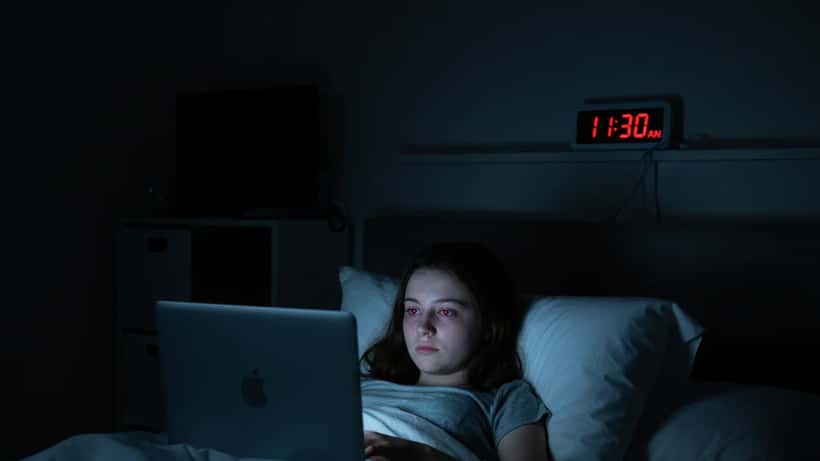
Sleep disruption is the most immediate risk. Blue light emitted by screens suppresses melatonin production — the hormone that triggers sleepiness — for up to 4 hours after exposure. An episode watched at midnight pushes back natural sleep onset to 4 a.m., and the story's emotional content keeps cortisol levels elevated even after the screen goes off.
Emotional dysregulation is a subtler concern. Research published in Psychological Science found that rapidly cycling through high-emotion TV narratives — love, betrayal, resolution, new crisis, repeat — can impair the adolescent prefrontal cortex's ability to regulate emotions in real-life situations. The brain learns to expect rapid resolution of conflict, which real relationships do not provide.
Physical inactivity compounds the issue. Watching 4 or more hours of TV daily is associated with a 50% increased risk of early death according to American Heart Association research. For teenagers whose school days are already sedentary, a 6-hour Saturday binge session replaces time that might otherwise include physical activity.
The safe way to enjoy a binge: a health professional's checklist
None of this means XO Kitty Season 3 is off the table. Most UK health professionals agree that moderate screen time, including occasional binge sessions, is not inherently harmful. The issue is pattern and context. Here is what makes the difference:
- Finish before 9 p.m.: Blue light exposure within 3 hours of bed significantly disrupts sleep architecture. The NHS recommends at least 1 hour of screen-free time before sleep
- Watch with someone: Co-viewing reduces passive consumption and provides natural break points for conversation
- No meals in front of the screen: Distracted eating consistently leads to overconsumption and reduces mindful satiety signals
- One episode at a time on school nights: Reserve multi-episode sessions for weekends with no early morning commitments
- Outdoor time first: Even 30 minutes of daylight exposure before a viewing session offsets some of the melatonin suppression
When binge-watching becomes a warning sign
For some young people, excessive screen consumption is not a habit — it is a symptom. Mental health professionals identify binge-watching as a common avoidance behaviour in adolescents experiencing anxiety, depression, or social difficulties. Signs that warrant a conversation with a GP or mental health professional:
- Your teenager regularly watches until 2 a.m. or later, even on school nights
- Attempts to reduce screen time lead to irritability or distress disproportionate to the situation
- They are withdrawing from social activities or sports in favour of streaming
- Their mood is notably low or anxious after extended viewing sessions, not refreshed
The NHS Long Term Plan has committed to mental health support teams reaching 60% of schools by the end of 2025/26 — an acknowledgement that youth mental health is a systemic concern, not just individual choice.
What parents can do right now
UK health experts suggest these three concrete steps for parents before tonight's XO Kitty session:
1. Set a hard stop time, not an episode limit. "We'll watch until 9 p.m." is easier to implement than "only three episodes" because it removes negotiation.
2. Enable Netflix's Watch Time Reminder. The feature sends a notification after a set viewing duration. For teenagers, 90-minute reminders are clinically recommended by sleep specialists.
3. Know your local resources. If you're concerned about your child's screen habits and their effect on mood, sleep or school performance, a GP can refer to CAMHS (Child and Adolescent Mental Health Services) or recommend a private therapist. Expert consultation does not require crisis-level symptoms — early intervention is consistently more effective than late-stage treatment.
XO Kitty Season 3 is a well-crafted, joyful show. Millions of UK viewers will enjoy it this weekend, and that is entirely reasonable. The question is not whether to watch — it is how to watch in a way that keeps wellbeing intact.
Read also: Children's Screen Time Hits Record Highs in 2026 — What UK Parents Must Know
This article is for informational purposes. If you are concerned about your child's mental health or screen habits, please speak to your GP or visit NHS.uk/mental-health.
