 David Taylor
The UK's record-breaking July 2026 heatwave is ending today — and tomorrow's forecast of storms, low pressure, and a dramatic temperature drop from 35°C to near-seasonal averages has pushed "weather tomorrow" past 100,000 daily searches. If you're still relying on a manual app check each morning to decide whether to open the windows or close the conservatory roof, an IT consultant says you're one step behind.
What July 2026 Has Done to UK Weather Expectations
According to GB News, July 2026 is on track to be one of the hottest Julys ever recorded in the UK. London sustained temperatures of up to 35°C through mid-month, while parts of the south-east recorded consecutive nights above 22°C — the official threshold for a "tropical night." Drought warnings were issued across six counties, and hospital trusts from Surrey to Essex reported spikes in heat-related admissions throughout the fortnight ending 25 July.
Then comes the reversal. Meteorologists confirm that temperatures are set to fall close to long-term seasonal averages around 26-27 July, when the UK turns "low pressure dominated" — shorthand for thunderstorms, heavy rain, and gusty winds arriving in rapid succession. The Met Office publishes live storm warnings for the transition period from 26 July, with alerts covering southern England, the Midlands, and Wales.
That 72-hour reversal is precisely why "weather tomorrow" is surging. People aren't just idly curious. They are making consequential decisions: whether to travel, whether to leave skylights open overnight, whether to move outdoor electronics inside, whether to park the car under the oak tree or in the street. These are the moments when a passive morning app-check and an intelligent home that acts automatically on weather data diverge in ways that genuinely cost — or save — money.
The 24-Hour Swing: What the Numbers Show
The meteorological gap between 25 July and 27 July 2026 is striking even by UK standards:
- Peak daytime temperature, 21 July: 35°C (London)
- Forecast high, 27 July: 19°C — a 16-degree drop inside 72 hours
- Active Met Office weather warnings from 26 July: covering southern England, the Midlands, and parts of Wales
- Storm warning notices already issued by the Met Office covering parts of England, Wales, and the Midlands from 26 July
This degree of weather volatility is not new to British summers — but the intensity of both extremes in 2026 has exposed how poorly most UK homes are set up to respond automatically. A thermostat that only knows it is hot indoors cannot close the roof vent before the wind arrives. A smart speaker that cannot read wind-speed data cannot tell you at 8am that by 2pm your garden workshop will take on water.
Why This Is Increasingly an IT Problem
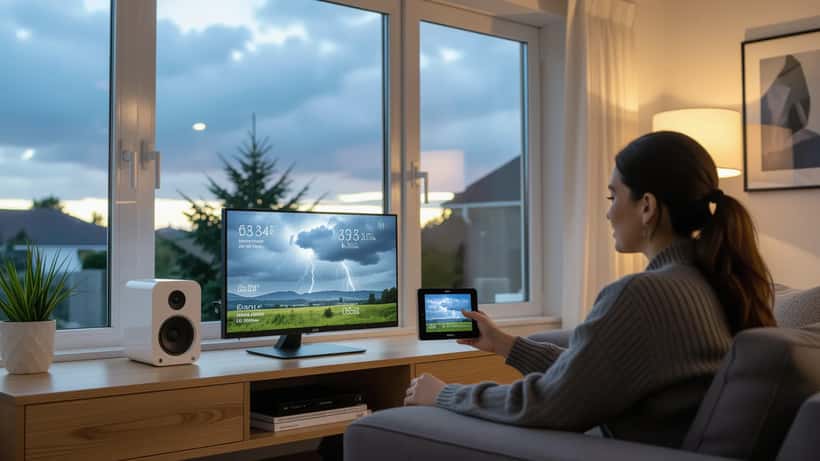
Here is the angle that the "weather tomorrow" search traffic rarely reaches: checking tomorrow's forecast is, in 2026, a problem that UK homeowners can hand entirely to their homes — provided those homes are configured correctly by someone who knows what they're doing.
Personal weather stations with smart home integration — devices from brands including Tempest, Bresser, and Netatmo — connect via Wi-Fi to ecosystems including Amazon Alexa, IFTTT, and Google Assistant. Bresser UK confirms that their stations integrate with Tuya-compatible smart devices to create environments that respond automatically to changing conditions, no manual check required.
An IT consultant setting up a weather-responsive home does not simply install a gadget. They configure conditional automation rules: if outdoor wind speed exceeds 45 mph, cut power to outdoor sockets and send an alert; if indoor temperature passes 28°C and rain probability tomorrow exceeds 80%, schedule the smart blinds to close south-facing windows at 7am; if the forecast shows overnight frost — a concern that returns as early as September in northern England — trigger the smart plug on the conservatory heater at midnight.
The hardware cost is accessible: a quality connected weather station for a UK home runs from £85 to £320, depending on the sensors included (wind, rain, UV index, soil moisture, indoor CO₂). A professional IT consultation to configure integrations and automation rules typically costs £75 to £150 for a single 90-minute session. Total investment under £450. No ongoing subscription required.
Concrete Case: Croydon, 27 July, and £230 in Preventable Damage
Take a specific scenario — a homeowner in Croydon with a south-facing conservatory, a garden workshop housing power tools, and a set of smart plugs already installed but not configured for weather triggers.
Without automation: They check their phone at 7:30am on 26 July, see "partly cloudy, slight chance of showers," and leave for work with the conservatory roof vent open and an outdoor extension lead live in the garden. By 2pm, a fast-moving storm cell — accurately forecast in Met Office data since 8am — pushes through south London. Wind drives rain through the open vent, soaking a rug and damaging a portable speaker left on a garden table. A power surge trips the outdoor socket, killing a connected irrigation controller. Estimated cost: £230 in replacements and a weekend afternoon of repairs.
With a weather-configured smart home: The system's outdoor wind sensor triggers at 38 mph — still 22 minutes before the storm hits. An IFTTT automation closes the conservatory roof vent via its connected motor, sends a push notification reading "Storm arriving 2:15pm — outdoor power switched off," and cuts the live socket circuit. The homeowner, at their desk in Canary Wharf, taps "acknowledged." Nothing is damaged.
The difference between these two outcomes is not the price of the hardware — both households had smart plugs. It is the absence of professional IT configuration in the first. If you own any smart devices — plugs, thermostats, blinds, speakers — and have not set up weather-triggered automation, you are almost certainly underusing what you already own.
You can find further guidance on seasonal home readiness in articles such as this piece on UK spring weather checks and home preparation — the same principles of anticipating weather transitions apply now, in midsummer, as the UK moves from heat to storm.
Three Automations an IT Specialist Would Configure This Week
Given the UK's current pattern — heat followed by rapid storm transitions — here are the three integrations a home IT consultant would prioritise for any smart-home-enabled household before the end of July:
1. Wind-speed trigger → outdoor power cutoff. Set a threshold of 40-50 mph. A single electrical surge during a July thunderstorm can destroy smart appliances worth several hundred pounds. This is the single highest-value automation for summer-to-storm transitions.
2. Heat index → sleep-mode alert. During remaining summer weeks, an automated notification when indoor temperature holds above 26°C after 10pm prompts ventilation decisions before overheating becomes a health issue — especially relevant for households with elderly residents, young children, or anyone on medications affected by heat.
3. Rain probability forecast → smart blind scheduling. If your home has motorised blinds, a morning trigger pulling from your connected weather station or a free forecast API (Open-Meteo provides 1-hour resolution data at no cost) can pre-close south-facing blinds by 9am when afternoon rain probability exceeds 75% — protecting furniture, flooring, and electronics automatically.
None of these require new hardware for a home already running a smart hub. They require configuration — specifically, the kind of logical rule-writing and integration testing that an IT specialist handles in a standard consultation session.
How to Know If Your Setup Is Ready
A basic readiness check takes 15 minutes. Open your smart home app (Alexa, Google Home, SmartThings, or Apple Home) and ask: does any automation trigger based on outdoor temperature, wind speed, or rain probability? If the answer is no, your home is reacting to weather rather than anticipating it.
An IT specialist at Expert Zoom can audit your existing devices, recommend a compatible weather station if needed, and configure weather-responsive automation in a single session — no contract, no ongoing subscription. Given what July 2026 has demonstrated about the speed of UK weather reversals, a 90-minute consultation before the next forecast change is a measurably sensible investment.
"Weather tomorrow" will keep trending. The question is whether tomorrow you are still checking manually — or whether your home already knows.
