 James Harrison
The Met Office issued weather warnings for widespread snow and ice across the UK on 19–21 March 2026, catching many homeowners off guard after a record-warm start to spring. As temperatures drop to 0°C in Scotland and 1–3°C across England and Wales, the risk of frozen pipes, roof damage, and boiler failure is very real — and very expensive if you're not prepared.
What the Met Office Is Forecasting This Week
The Met Office confirmed on 19 March 2026 that a cold snap would bring snow to Scotland, Northern England, and Northern Ireland, with wintry showers possible on higher ground across Wales and the Midlands. Storm Goretti, which swept the Canary Islands earlier this month, contributed to unsettled Atlantic conditions now pushing cold Arctic air southward over Britain.
Temperatures expected:
- Scotland: 0°C overnight, 2–4°C daytime
- Northern England: 1–3°C overnight
- London/South East: 3–5°C, mainly rain
The Met Office weather warning for snow and ice covers roads, pavements, and elevated terrain. But the real danger for households lies beneath the floorboards and in the loft.
The Frozen Pipe Crisis: Numbers You Need to Know
Frozen and burst pipes are the UK's most costly winter home emergency. According to British Gas, the company anticipates over 50,000 emergency callouts for frozen pipes and failed boilers in 2026. Allianz UK paid out £20 million for 345 burst pipe claims between 2023 and 2025, with the average claim running between £7,500 and £9,300. The largest single claim was £566,000 — a four-bedroom home left empty while the owner was abroad.
Pipes begin to freeze when temperatures fall below 12°C in the spaces where they're installed. The most vulnerable locations in a typical UK home:
- Loft and roof space — where supply pipes often run uninsulated
- Under kitchen and bathroom sinks — against exterior walls
- Garages and outbuildings — with poorly heated pipe runs
- Meter boxes — especially on north-facing exterior walls
When water freezes, it expands with enough force to split copper and plastic pipes. The burst usually occurs not at the frozen point but downstream, where the pressure builds — meaning the leak often isn't discovered until the pipe thaws and water floods through the ceiling.
Five Steps to Protect Your Home Right Now
You don't need a builder on site to reduce your risk significantly. These are the measures a qualified plumber or heating engineer would recommend this week:
1. Set your heating to maintain at least 13°C Even if you're away, programme your thermostat to hold a minimum temperature overnight. Moving water is far less likely to freeze than stagnant water in cold pipes. The small cost in heating bills is trivial compared to a burst pipe claim.
2. Lag exposed pipes in unheated spaces Foam pipe lagging is available at hardware shops for approximately £5 per metre. Focus on loft pipes, garage runs, and any external pipe sections. A 15-minute job can prevent thousands of pounds of damage.
3. Know where your stopcock is If a pipe bursts, the first action is to turn off the water supply immediately at the mains stopcock — usually under the kitchen sink or where the supply enters the property. Test it now to make sure it turns. A stopcock that hasn't moved in years can seize.
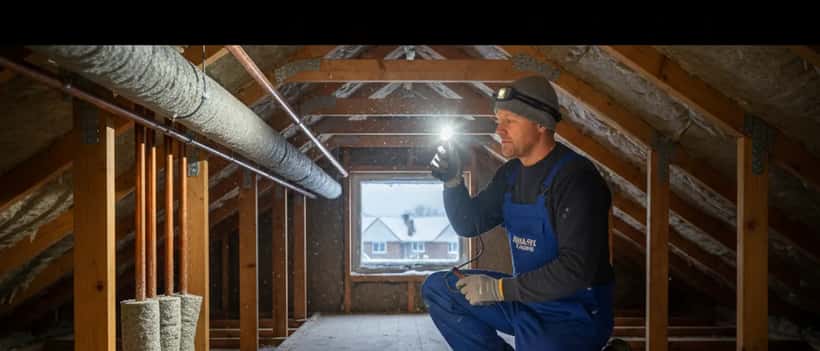
4. Check your loft insulation Poor loft insulation allows cold air to penetrate the roof space where water tanks and supply pipes often sit. If insulation is thin or absent around the tank, add lagging around the tank itself as a priority. Never insulate beneath a cold-water tank — the warmth rising from below helps prevent freezing.
5. Inspect gutters and roof tiles before the freeze Blocked gutters cause water to back up against fascia boards and into the roof structure. A brief visual check or a call to a local roofer or gutter specialist takes little time. Once gutters are full of ice, the problem is already happening.
What to Do If a Pipe Bursts
If you discover a burst pipe:
- Turn off the mains stopcock immediately
- Switch off the boiler and water heater
- Turn on all cold taps to drain the system
- If water is near electrics, turn off the electricity at the consumer unit
- Call an emergency plumber — not every plumber offers 24/7 callouts, so verify before you need one
Document all damage with photographs before any cleanup, and notify your home insurer as soon as possible. Most policies cover burst pipe damage under buildings and contents insurance, but only if you've taken reasonable steps to prevent freezing (i.e., keeping the property adequately heated).
When to Call a Professional
Temporary measures such as a hair dryer on a frozen pipe can work, but they carry risks: if the pipe has already cracked, thawing it will cause an immediate flood. A qualified heating engineer or emergency plumber can:
- Safely locate and thaw frozen sections
- Identify and repair cracks or splits before the water is restored
- Assess whether pipe lagging or re-routing is needed for long-term prevention
- Service your boiler to ensure it performs reliably during the cold spell
Home Improvement tradespeople on Expert Zoom are available for emergency consultations and same-day callouts across the UK.
Is your home ready for this week's freeze? Find a local plumber or heating engineer on Expert Zoom for rapid emergency support and professional advice on winter-proofing your property.
