 Stephen Hall
Britain's autumn TV season exploded back onto screens this month. SNL UK launched its second series on Sky One on 12 September 2026, The Blame debuted on ITV1 on 20 September, and The Great British Bake Off returned to Channel 4 on 22 September — triggering a familiar pattern that home improvement professionals recognise immediately: a spike in TV purchases, followed by a wave of DIY wall-mounting attempts that go quietly, expensively wrong.
The temptation is understandable. A VESA-rated bracket costs between £25 and £80. A YouTube tutorial takes twelve minutes to watch. But between the bracket and the finished install lies a set of structural, electrical, and regulatory questions that trip up even confident DIYers — and the consequences can range from a fallen screen to a voided home insurance policy.
Why September TV Sales Create a Home Improvement Risk
Every autumn, as UK broadcasters unveil their premium schedules, households upgrade their screens. The 65-inch and 75-inch formats have become the default new purchase: large enough for an immersive viewing experience, heavy enough that safe wall mounting stops being optional.
According to cost guides published by MyJobQuote and MyBuilder in 2026, professional TV wall-mount installation costs between £80 and £150 depending on screen size and installation complexity. For many buyers, that figure feels like an unnecessary extra after spending £700 to £2,500 on the TV itself. So they reach for the drill.
The physical bracket is rarely the problem. The problem is the cascade of decisions that follows: which wall is being used, whether cables can be hidden, whether an existing socket is close enough, and what the regulations say about each of those choices.
Where UK Homeowners Get Caught Out
The most common surprise is Part P of the Building Regulations, which governs electrical safety in domestic dwellings in England and Wales. Its scope is broader than most people expect.
If you want a socket installed behind the mounted TV so the power cable does not trail visibly down the wall, and that socket requires a new electrical circuit, the work becomes notifiable under Part P. Notifiable work must be carried out or certified by a registered member of a competent person scheme — NICEIC, ELECSA, or equivalent. You cannot run a new spur from the consumer unit yourself, close the wall, and consider the job done.
The regulatory stakes increased further in 2026. BS 7671, the UK wiring standard underpinning Part P compliance, had its Amendment 4 published on 15 April 2026. The previous version is formally withdrawn on 15 October 2026. Any electrical work certified after that date must comply with the updated standard. An uncertified installation — from a handyman without scheme registration — leaves no paper trail, and that matters significantly when selling a property or making an insurance claim following an electrical fault.
The brighter side: adding a socket on an existing ring main (not a new circuit) is non-notifiable in most domestic locations, meaning a competent homeowner can legally carry it out. But the work still has to meet BS 7671 standards, and most homeowners cannot self-verify compliance without specialist test equipment.
For a clear summary of when building regulations approval is required, the UK Government's official guidance covers domestic electrical work, structural changes, and what qualifies as permitted development.
The Structural Assessment No One Thinks to Make
Beyond the electrics, there is the wall. UK homes contain a mix of solid brick, aircrete block, and lightweight partition walls — sometimes in the same room. The fixings required for each differ substantially, and getting it wrong with a heavy screen is not a small mistake.
A 65-inch OLED TV can weigh between 20 and 28 kilograms. On a plasterboard stud partition, the mount screws must reach timber studs or use specialist cavity wall anchors rated for the load. Plasterboard alone cannot support that weight long-term. The screws may hold initially and fail weeks later without warning.
Solid brick walls require masonry anchors and the correct drill bit and setting. The drill depth, anchor size, and torque each matter. Hitting a buried pipe or cable in either wall type creates a significantly different and costlier problem than the £80–150 installation fee that was avoided.
For any screen above 55 inches, or for any installation in a location with unusual structural characteristics — above a fireplace being the most common — a professional assessment before drilling is a genuinely sound investment rather than an upsell.
A Concrete Case: The 65-Inch Screen Above the Chimney Breast
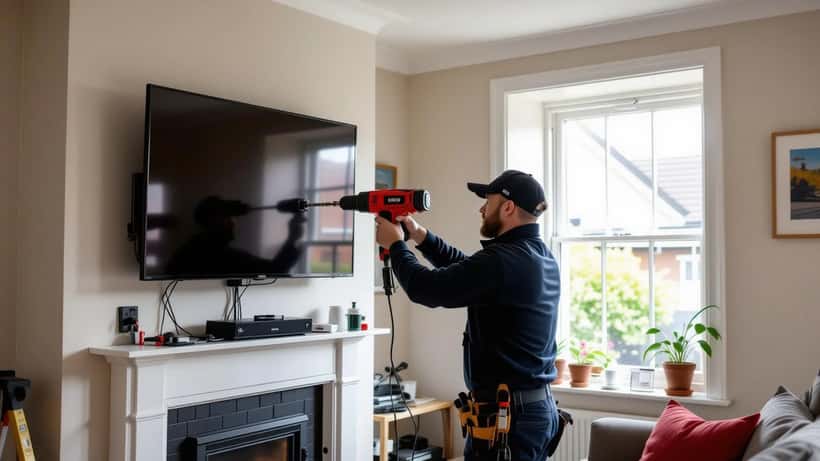
Consider a UK homeowner in a 1970s semi-detached property who purchases a 65-inch OLED TV to enjoy the new autumn schedule. They want it mounted above the chimney breast with no visible cables — which means a hidden socket and a concealed aerial connection through the wall.
This is one of the most requested TV installations in GB, and it involves several compounding factors.
The wall: A chimney breast is typically solid brick, 100mm to 215mm thick depending on the build period. Masonry anchors rather than timber screws are required, needing a hammer drill, the correct SDS bit, and anchor bolts sized to the bracket's load rating. The surface may also be rendered or plastered at varying thicknesses, which affects drill depth calculations.
The socket: If the hidden socket requires a new circuit — which it will if no ring main runs in proximity — the work is notifiable under Part P. Certification from a registered electrician typically costs £80–£150 on top of the installation charge. Without it, the homeowner has an unregistered electrical installation. When they come to sell the property, a surveyor will flag the absence of an electrical installation certificate, typically requiring either retrospective certification (£150–£300) or remedial work.
The heat: An OLED TV's manufacturer-rated maximum ambient operating temperature is typically 40°C. A regularly used fireplace can push ambient temperatures in that zone above threshold. If the TV overheats and fails, and the manufacturer's temperature ratings were exceeded, the warranty claim may be declined.
The asbestos risk: Properties built before 2000 may contain asbestos insulation board in or near chimney breast cavities. Before drilling into a chimney breast in an older property, an asbestos survey — or at minimum a visual assessment by a competent tradesperson — is advisable. Disturbing asbestos without appropriate controls is a health and safety matter that carries legal consequences.
A professional home improvement specialist covering the full chimney breast installation — structural assessment, bracket fitting, certified socket, aerial routing, asbestos check — would charge between £200 and £400 for this scenario. Against the combined risk of a failed warranty claim, an unregistered electrical installation, and potential structural remediation, that cost calculation is straightforward.
When to DIY and When to Call a Professional
Not every TV installation requires a professional, and it is worth being clear about where the line sits.
DIY is reasonable when:
- The wall is solid brick or block and you can identify a clear, cable-free drilling path
- You are mounting a screen under 50 inches and under 18kg
- An existing socket within the TV's cable reach means no new electrical work
- You have a stud finder, the correct drill, and appropriate anchors for the wall type
Call a professional when:
- The screen is 55 inches or larger and weighs over 18kg
- You want hidden cabling and the nearest socket requires a new circuit
- The mount location is above a fireplace or chimney breast
- The wall is a lightweight plasterboard partition and you cannot locate studs confidently
- The property predates 2000 and you are drilling into a wall cavity
If the installation is straightforward, a local handyman with TV mounting experience and a stud finder can often complete the job in under two hours. For the electrical element — particularly any notifiable work — an NICEIC or ELECSA-registered electrician is the correct specialist, and using an unregistered tradesperson removes the one thing that most matters: the certificate.
Expert Zoom connects UK homeowners with verified home improvement professionals, from certified electricians to experienced general tradespeople, who can assess your wall type, advise on the correct installation approach, and provide documentation for any notifiable work. Before Britain's autumn viewing season gets fully underway, it is worth a short consultation to make sure the screen that is going up stays up — and that the paperwork is in order if it ever needs to come down.
Please note: This article covers general guidance on UK building regulations and electrical standards. For specific advice on your property, consult a qualified professional. Building regulations and wiring standards may differ in Scotland and Northern Ireland.
For more on safe home entertainment setups, see our guide to home cinema installation and UK building regulations or the TV setup safety guide for large screen viewing.
