 Sophia Hamilton
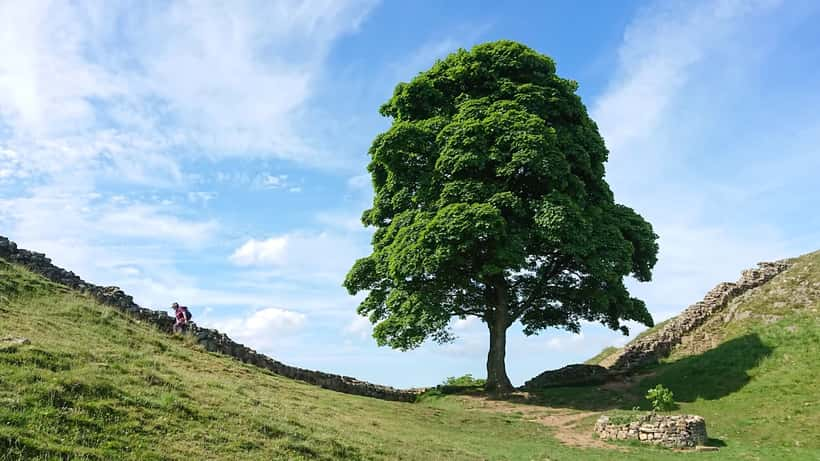
Three years after Daniel Graham and Adam Carruthers took a chainsaw to one of England's most beloved landmarks, new life is stirring at Hadrian's Wall. The National Trust confirmed in September 2026 that the Sycamore Gap stump — fenced off and carefully tended since the night of 27 September 2023 — has produced a dense ring of basal shoots now standing two to three feet tall. It is a fragile but tangible sign of recovery. But the extraordinary legal aftermath that unfolded between the felling and these first green shoots carries lessons that reach far beyond Northumberland — and directly into the gardens and properties of ordinary homeowners across the UK.
The Felling That Shocked a Nation
Just before dawn on 28 September 2023, Graham and Carruthers drove from the Carlisle area to the natural dip in the landscape where a late-19th century sycamore had stood beside Hadrian's Wall — a UNESCO World Heritage Site — for more than 150 years. The tree, known worldwide after featuring in the 1991 film Robin Hood: Prince of Thieves, was independently valued at over £620,000. In a matter of minutes, it was on the ground.
The pair were arrested, charged with criminal damage, and — in a conviction that attracted global attention — found guilty by a jury in May 2025. On 15 July 2025, Newcastle Crown Court sentenced both men to four years and three months in prison each. The Crown Prosecution Service described it as a "moronic mission" causing irreplaceable harm to a natural monument; structural damage to the adjacent Wall was separately estimated at £1,100. The case was prosecuted under the Criminal Damage Act 1971, with specialist arboricultural evidence establishing the tree's monetary value using replacement cost, amenity contribution, and heritage significance.
Now, in the autumn of 2026, the stump — protected by fencing, careful soil management, and reduced visitor disturbance — has thrown out its first visible ring of recovery. Experts remain cautious: the National Trust says the site could take more than 150 years to resemble what was lost. But the biological resilience of the stump has renewed public fascination with exactly what legal protections exist for trees in the UK, and what happens when those protections are ignored.
What UK Tree Law Actually Covers
The Sycamore Gap prosecution relied on the Criminal Damage Act 1971 rather than tree-specific legislation, but the case has reactivated a much wider public interest in the full scope of UK tree law — in particular Tree Preservation Orders (TPOs) and the protections afforded to trees in conservation areas under the Town and Country Planning Act 1990.
A Tree Preservation Order is a legal instrument applied by a local planning authority (LPA) to any tree, group of trees, or woodland whose removal would have a significant impact on the local environment and amenity. Once a TPO is in place, it becomes a criminal offence to cut down, uproot, top, lop, wilfully damage, or wilfully destroy the tree without written consent from the LPA. Penalties on summary conviction carry an unlimited fine, as set out in the government's official guidance on Tree Preservation Orders and conservation area trees. There is no cap — courts take into account the financial benefit the offender might have gained and the value of what was destroyed.
Crucially, the Sycamore Gap tree did not hold a formal TPO at the time it was felled. Its protection came via its location on National Trust land, its proximity to a World Heritage Site, and — in court — via the Criminal Damage Act's broad coverage of property valued over a certain threshold. Legal experts note this reflects an important distinction: TPO protection and criminal damage liability are parallel but separate. A tree can attract serious criminal consequences regardless of whether it appears on a formal TPO register.
The Hidden Legal Exposure for Homeowners and Landowners
The Sycamore Gap case may be extraordinary, but tree law affects ordinary homeowners far more routinely than most people recognise. According to the Woodland Trust, local planning authorities issue thousands of TPO notices each year across England alone, protecting an estimated 1.5 million individual trees. Many of those trees sit in or adjacent to private gardens, on boundary lines, or within development sites — and their owners are not always informed.
The most legally exposed moment for a homeowner is typically during planning or renovation work, or when roots or branches from a neighbour's tree are causing damage to their property. UK law is unambiguous: carrying out any works to a TPO-protected tree — even one growing in your own garden — without prior written consent from the local planning authority constitutes a criminal offence. There is no general defence of self-help, urgency, or nuisance abatement (other than in cases of immediate danger to persons).
Trees in conservation areas attract equivalent protections even without a specific TPO: anyone planning to carry out works to a tree with a trunk diameter exceeding 75mm (measured at 1.5 metres above ground level) in a conservation area must give the LPA six weeks' written notice before starting. Failure to do so carries the same unlimited fine as a TPO breach.
Home insurance compounds the exposure. Most standard policies exclude coverage for costs arising from prosecution or enforcement proceedings where unlicensed work was carried out. If a homeowner instructs a tree surgeon who removes a protected tree without consent, the homeowner — not only the contractor — can face prosecution.
What Happens if Your Neighbour's Tree Comes Down Unlawfully
Consider a homeowner in a conservation area in Hampshire who discovers in early 2026 that the foundations of their 1930s semi-detached are being undermined by roots from a mature boundary oak estimated at 90 years old and protected by a council TPO. Frustrated by the structural cracking — repair quotes coming in at around £12,000 — they arrange for a tree surgeon to carry out targeted root pruning without first applying to the LPA. The work costs £2,200 and appears, initially, to resolve the problem.
Eight months later, the council's arboricultural officer visits following a complaint from a neighbouring resident and identifies the unlicensed root works.
Under the Town and Country Planning Act 1990, the homeowner is now exposed to prosecution for damage to a protected tree. Magistrates sentencing guidelines for TPO offences allow unlimited fines; in cases involving high-amenity trees, courts have imposed penalties exceeding £30,000 — multiples of the commercial value of the actual works carried out. The homeowner's insurer declines to indemnify legal costs because the act was unlicensed and therefore excluded under the policy terms.
The alternative path would have been a free application to the LPA for consent to carry out root pruning — a process that typically takes eight weeks. Councils regularly approve proportionate, evidence-based root works where structural damage is properly documented with a structural engineer's report and an arboricultural impact assessment. In that scenario, the homeowner spends the same £2,200 on the tree surgery. The £12,000 foundation repair remains a civil matter for negotiation with their insurer. There is no prosecution, no fine, no enforcement notice on their property title. The entire difference between the two outcomes is procedural.
When to Seek Legal Advice
The Sycamore Gap case illustrates what happens at the extreme end of unlawful tree damage. The everyday reality in LPA enforcement files is quieter but financially just as damaging for the individuals involved.
A solicitor or planning consultant specialising in property and tree law can advise on:
- Whether a specific tree is covered by a TPO or conservation area notice — and how to check the LPA's public register before commissioning any works
- How to structure an application for consent, including what supporting evidence (arboricultural survey, structural engineer's report, photographic record) will improve the chances of approval
- Liability and cost recovery where a third party — including a contractor or a neighbour — has unlawfully damaged or destroyed trees on your land
- Valuation methodology for insurance or civil claims, using the same approaches that produced the £620,000 figure in the Sycamore Gap prosecution
An initial consultation with a planning solicitor or tree law specialist typically costs between £150 and £350 — a fraction of the fines that routinely follow unauthorised tree works. The Sycamore Gap case attracted a sentence of over four years in prison and international coverage; most TPO prosecutions are handled in magistrates' courts with far less ceremony, but the financial consequences for homeowners caught without consent are consistently severe.
As the shoots around the Sycamore Gap stump push upward through the Northumberland soil — slowly, haltingly, against all odds — they serve as a living reminder of how long irreplaceable things take to grow back. In law, as in arboriculture, prevention costs far less than restoration.
This article provides general information about UK tree law and does not constitute legal advice. Readers with specific concerns about Tree Preservation Orders, conservation area restrictions, or unlicensed tree works should seek advice from a qualified solicitor.
