 Harriet Price
Spider-Man: Brand New Day hits UK cinemas on 31 July 2026, marking Tom Holland's fourth solo outing as the web-slinging hero in a film directed by Destin Daniel Cretton. As the Marvel-Sony blockbuster prepares to break box office records, UK Trading Standards officers are bracing for a familiar side effect: a sharp surge in counterfeit merchandise. Fake T-shirts, unlicensed figurines, and unofficial prints flood high streets and online marketplaces every time a major superhero franchise releases a new film — and the legal consequences for buyers, small traders, and creators are more serious than most people expect.
The question UK fans and small traders are actually asking
Search queries spike with every blockbuster release: "Is it illegal to buy fake Spider-Man merchandise in the UK?", "Can I sell fan-made Spider-Man prints?", "What happens if I accidentally sell counterfeit goods?" These are not niche concerns. The UK's licensed character merchandise market is worth an estimated £4 billion a year, and the grey and black markets around it are substantial.
Understanding where the legal lines sit — and what happens when you cross them — requires knowing an unexpectedly complex body of intellectual property law. The answer is not simply "fakes are illegal." It depends on your role, your intent, and whether you took reasonable steps to check what you were buying or selling.
What UK law actually says — and why the penalties are steeper than most people realise
Under Section 92 of the Trade Marks Act 1994, it is a criminal offence to apply a registered trade mark to goods, sell or offer to sell goods bearing an unauthorised trade mark, or possess such goods with a view to trade. Penalties upon conviction can reach up to 10 years' imprisonment and an unlimited fine.
Enforcement in the UK is multi-agency. Local authority Trading Standards departments handle day-to-day investigations and market raids. They operate alongside the Intellectual Property Office (IPO), the City of London Police IP Crime Unit, and HM Revenue and Customs' Border Force, which intercepts counterfeit goods at ports and parcel depots.
The stakes are large even at the corporate level. Sony Pictures acquired the theatrical film rights to Spider-Man for approximately $10 million (around £7.8 million) in 1999. Under the licensing arrangement struck with Marvel in 2015, Sony retains full film revenue while Marvel holds the merchandising rights and collects royalties from every officially licensed Spider-Man product sold globally. With the Spider-Man film franchise having grossed over $9 billion at the box office, the licensed merchandise stream is enormous — and every counterfeit item sold represents a direct loss to the rights holders who enforce that stream aggressively.
For ordinary buyers, the criminal exposure is more limited. Knowingly purchasing counterfeit goods for personal use is generally not a criminal offence under the Trade Marks Act 1994. However, importing counterfeit goods from overseas — including ordering from cheap international wholesale sites — can trigger Border Force seizure of the parcel.
Disclaimer: This article provides general information about UK intellectual property law and does not constitute legal advice. If you face a Trading Standards inquiry, have received a cease-and-desist letter, or are uncertain about your legal position relating to licensed or unlicensed merchandise, consult a qualified IP solicitor.
A concrete case: the market trader who never asked for paperwork
Imagine a small trader operating a weekend market stall in Manchester who, in early July 2026, discovers an overseas wholesale supplier offering Spider-Man: Brand New Day T-shirts at £2.80 per unit. They place an order for 250 shirts — a total outlay of £700 — planning to sell them at £12 each at the stall on the opening weekend. Gross return: £3,000. Expected profit: £2,300.
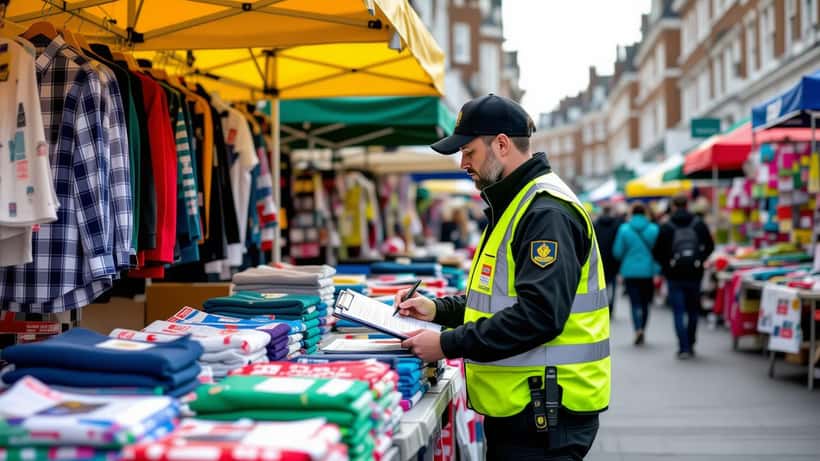
On 2 August 2026, the first Saturday after the film's UK release, Trading Standards runs a routine IP enforcement sweep of the market. An officer examines the shirts. The stitching pattern on the registered Spider-Man logo does not match the authorised version. The T-shirts carry no official Sony Pictures / Marvel licensing strip, which is required on all legitimate licensed merchandise.
The 250 shirts are seized immediately. The trader is interviewed under caution. They have no documentation showing the supplier was an authorised licensee, no email trail in which they requested authenticity certificates, and no record of any due-diligence step.
Section 92(5) of the Trade Marks Act 1994 does provide a statutory defence: if the accused did not know and had no reason to believe the goods were counterfeit, they may avoid conviction. But this defence must be proved by the defendant. Courts expect sellers to have taken active steps to verify authenticity — not merely assumed the supplier was legitimate because the price looked reasonable.
If prosecuted, the trader faces a criminal record, a fine that courts typically start at £1,000 and may exceed £5,000 based on the volume of goods, potential loss of their market licence, and legal costs. Their exposure — from seized stock worth £700 to total costs including legal representation — could reach £12,000 to £15,000 or more.
If instead, before placing that wholesale order, the trader had spent 90 minutes with an IP solicitor to understand what authentication documentation to request and how to verify supplier authorisation status with the IPO, the outcome would likely be entirely different. A professional consultation in this context is not a luxury expense — it is insurance against a disproportionately large risk.
Fan art and the grey area most UK creators misunderstand
The creative explosion that accompanies every blockbuster release brings a separate set of legal questions. UK copyright law protects artistic works, including character designs and illustrations. Creating derivative works based on Spider-Man — prints, custom items, digital art — without a licence from the rights holder is technically an infringement, regardless of whether you label it "fan art" or "inspired by."
In practice, Marvel and Sony direct enforcement resources at commercial-scale operations. Selling three hand-painted Spider-Man portraits at a craft fair attracts different attention than listing 500 screen-printed hoodies on an e-commerce platform. The relevant threshold is commercial intent: if you are selling, you are trading in copyright-protected material without a licence.
The distinction is scale and visibility, not the spirit of the activity. "It was just a hobby" is not a legal defence if a rights holder issues a cease-and-desist notice or a court claim.
What the Sony-Marvel deal teaches about protecting your own creative work
The Sony-Marvel licensing arrangement is one of the most studied IP agreements in entertainment history, and it demonstrates a principle that applies equally to UK independent creators: intellectual property is divisible.
Sony holds theatrical rights. Marvel retains merchandising rights. Marvel can licence Spider-Man's image to a toy manufacturer without any involvement from Sony. Sony can produce and distribute films without sharing box office revenue with Marvel. Each party controls a distinct bundle of rights, negotiated and recorded in a detailed written agreement.
This divisibility applies directly to UK illustrators, musicians, writers, game designers, and photographers. A musician can licence a song for use in a television advertisement while retaining live performance rights. A photographer can licence a single image to a magazine for a specified print run without granting unlimited digital reuse rights. A character designer can grant a regional merchandise licence while retaining animation rights for another deal.
The problem is that many UK creatives — particularly those new to commercial licensing — sign agreements that transfer far more than they intend. Phrases such as "all formats worldwide in perpetuity," "exclusive licence for all current and future media," or "all derivative works" can strip rights you expect to keep. An IP solicitor reviewing a licence agreement before you sign it can identify these clauses, assess whether they are standard for the industry, and negotiate narrower terms where appropriate.
What to do if you are affected
Whether you are a consumer who has purchased merchandise you now suspect may be counterfeit, a small trader sourcing branded goods, or a creator about to sign a licensing agreement, the immediate steps follow a similar logic:
- Retain all documentation — purchase receipts, supplier contact details, any correspondence about product authenticity or authorisation
- Do not destroy goods, delete emails, or return items if Trading Standards has indicated an interest in your stock
- Seek specialist advice before a situation escalates — an IP solicitor can clarify your legal position, advise on any available defences, and communicate on your behalf with enforcement agencies
For guidance on what constitutes a criminal trade mark offence under UK law, Section 92 of the Trade Marks Act 1994 sets out the full statutory framework, including the available statutory defences.
Spider-Man: Brand New Day arrives in UK cinemas on 31 July 2026. The legal questions surrounding its merchandise, licensing, and creative rights are live right now — and a single consultation with an IP expert could mean the difference between a minor compliance issue and a criminal prosecution.
