 Phoebe Wilson
The world's beaches are carrying a new kind of tension in September 2026. As of 16 September, Shark Data Lab has recorded 150 shark attacks globally — 31 of them fatal, a fatality rate of 20.7%. Two incidents in Western Australia within four days have dominated international news: a swimmer was killed off Sorrento Beach in Perth on 18 September, and a surfer was rushed to hospital in a serious but stable condition after an attack at Glenfield Beach on 14 September. While Britain's own coastal waters are among the safest on earth for shark encounters, hundreds of thousands of UK nationals travel every year to Australia, South Africa, Florida, and the Mediterranean — the world's highest-risk zones. Medical experts say that what bystanders do in the first 60 seconds of a shark attack is the single most decisive factor in whether a victim survives.
A Year the Statistics Cannot Ignore
Australia accounts for 63 of the 150 global attacks recorded so far in 2026, according to Shark Data Lab — by far the highest national total, driven by warmer-than-average sea surface temperatures pushing large sharks closer to popular beaches. The Western Australian coast, home to a large expatriate British community and a major destination for UK holidaymakers, has experienced a cluster of incidents this month alone. For British nationals, the distance from familiar NHS care makes the gap between bystander response and hospital arrival especially critical.
The UK has not been entirely insulated: while the last fatal shark incident in British waters occurred more than a century ago, the 40-plus species that inhabit UK and Irish seas — including porbeagles, makos, and blue sharks — do occasionally come close to shore. The first confirmed shark bite in UK waters in modern times occurred in 2017 off Devon. As sea temperatures rise, marine biologists are monitoring whether encounters will become more frequent.
What a Shark Bite Actually Does to the Body
Emergency medicine specialists identify three simultaneous trauma categories in any significant shark bite.
The first and most immediately life-threatening is massive haemorrhage. A large shark can sever major blood vessels in a single bite. The human body holds approximately five litres of blood; losing more than 1.5 litres — 30% — triggers hypovolemic shock, with rapid deterioration in blood pressure, consciousness, and organ function. Without intervention, this progression can become irreversible within minutes.
The second category is crush injury. A great white shark generates bite forces measured at over 1,800 newtons per square centimetre. This compressive force fractures bones, ruptures muscle compartments, and causes tissue ischaemia — the death of tissue deprived of blood supply — in areas that may appear externally intact. Crush injuries to limbs often result in complications discovered days after the initial trauma.
The third is infection. Shark mouths harbour bacteria including Vibrio vulnificus and Aeromonas species, pathogens that thrive in marine environments and can progress to life-threatening soft-tissue infection within hours if untreated. Standard wound bacteria such as Staphylococcus and Streptococcus are also introduced. A wound that looks stable in the emergency room can become critical within 24 hours without targeted antibiotic cover.
The Four Steps Medical Experts Say Save Lives
Across every credible clinical guideline — from the American College of Surgeons' Stop the Bleed campaign to the Royal College of Emergency Medicine — four actions emerge consistently as the bystander response that changes outcomes.
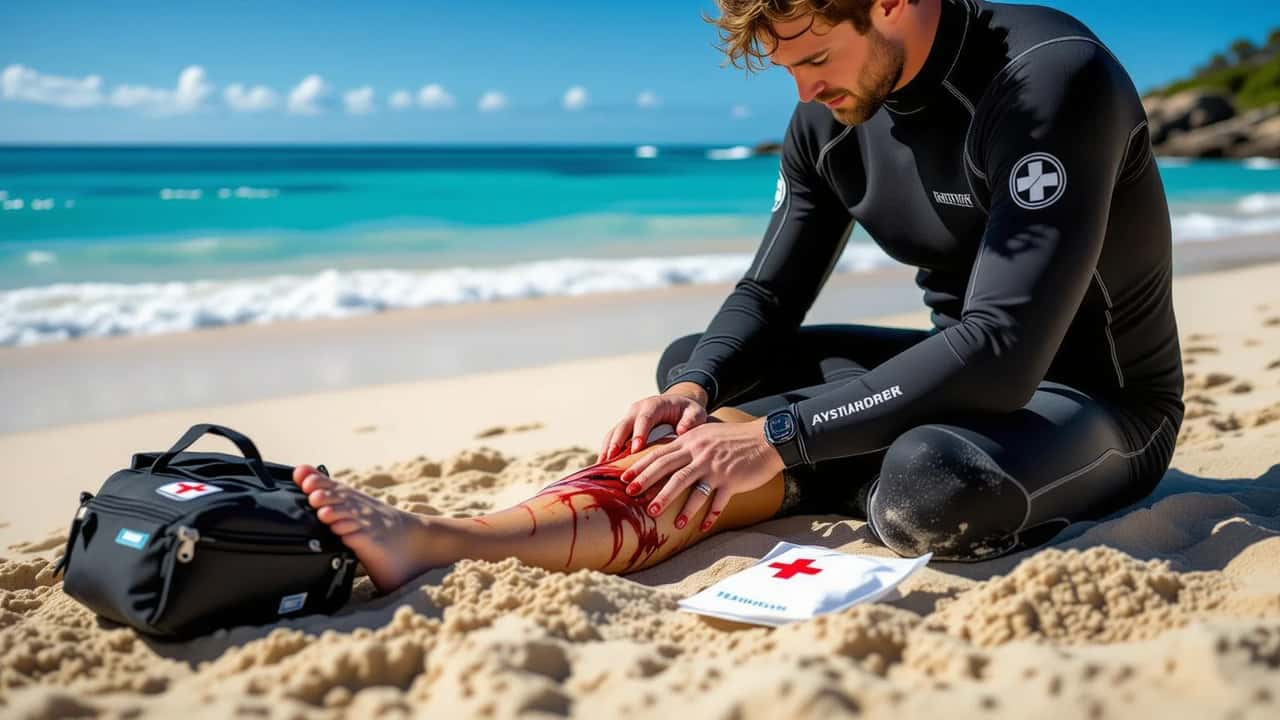
Step one: apply direct pressure immediately. Use whatever is available — a wetsuit, towel, clothing. Firm, uninterrupted pressure on the wound reduces blood loss by constricting damaged vessels. For limb wounds, a tourniquet applied two to three inches above the injury and tightened until bleeding stops is the gold standard if one is available. Note the time it was applied — surgical teams need this information urgently.
Step two: get the person out of the water and horizontal. Movement increases cardiac output and accelerates blood loss. Extraction should be as controlled as possible. Once on shore, keep the person flat. If the wound is to a limb and there is no spinal injury concern, elevate the legs to counteract shock by returning blood to the core.
Step three: manage temperature and consciousness. Cold water and blood loss combine to cause hypothermia rapidly, which worsens coagulation (blood's ability to clot). Cover the person with anything available. Speak to them constantly — maintaining consciousness prolongs the window for effective resuscitation.
Step four: call emergency services and describe the injury precisely. In Australia: 000. In the UK and from most international networks: 999 or 112. Say "severe bleeding, suspected shark bite" rather than just "beach emergency" — this activates a trauma-team dispatch rather than a standard ambulance, and the difference in response capability is significant.
What must be avoided: do not remove embedded objects such as teeth fragments, do not apply a circular bandage that restricts all blood flow without proper tourniquet training, and do not give the injured person anything to eat or drink — surgery will almost certainly be required within hours.
If You Were at Glenfield Beach: A Concrete Case
Consider a 38-year-old British surfer visiting Western Australia in September 2026 — the same coastline where a surfer was hospitalised on 14 September after a shark encounter. He sustains a deep laceration to his left thigh, severing a significant muscle group but narrowly missing the femoral artery.
If a companion applies firm direct pressure within 90 seconds of the bite, and Western Australia's coastal rescue services arrive within 12 minutes (the documented average response time for Perth's northern coastal zones), the prognosis is substantially better than if those first two minutes are spent in shock rather than action.
Here is the if/then logic in concrete numbers: an uncontrolled deep thigh wound loses between 300 and 500 millilitres of blood per minute. Over two minutes without intervention, that is up to one litre of blood — 20% of total volume. With controlled pressure applied from the first 30 seconds, blood loss in those same two minutes is closer to 100–150 millilitres. The difference determines whether a surgical team transfuses 2 units of packed red blood cells or 6.
In hospital, this surfer will require surgical debridement of devitalised tissue, prophylactic antibiotics targeting marine bacteria — typically ciprofloxacin combined with co-amoxiclav, consistent with NHS Emergency Department guidance for marine-acquired wounds — and likely a tetanus booster. Physiotherapy for the muscle injury and plastic surgery assessment for wound closure will follow. Post-traumatic stress disorder, documented in an estimated 30–40% of shark attack survivors according to research published in the Journal of Traumatic Stress, will require psychological input that is often deprioritised in the rush to manage physical recovery.
The bystanders around him are not spectators. Their actions in the first minute are the most effective medical intervention he will receive until the paramedics arrive.
Why Specialist Follow-Up Cannot Be Skipped
Surviving a shark attack is the beginning of a complex medical journey, not the end of one. Emergency departments stabilise. The weeks and months that follow demand coordinated specialist involvement that is easy to underestimate when physical wounds appear to be healing.
Plastic and reconstructive surgeons address long-term wound outcomes — tissue grafting, scar management, and restoration of function in areas of significant tissue loss. Infectious disease specialists monitor for late-presenting marine bacteria, which can emerge as late as five to seven days post-bite and may require intravenous antibiotics. Orthopaedic surgeons evaluate crush-related bone injuries that initial imaging may underestimate. And clinical psychologists address PTSD — a condition frequently underdiagnosed when the focus remains on physical recovery.
For British nationals injured abroad, the Global Health Insurance Card (GHIC) provides baseline coverage across countries with reciprocal agreements. However, reconstructive surgery, specialist rehabilitation, and psychological care after repatriation often fall outside GHIC scope and require private medical insurance or self-funding. Reviewing your travel insurance policy's specific language around "marine incidents" and "emergency evacuation" before departure is not overcautious — it is essential.
What to Do Before Your Next Beach Holiday
The NHS guidance on severe bleeding first aid is a ten-minute read that could save a life. St John Ambulance UK also offers a free one-hour Stop the Bleed course available online and in person across the country.
Before travelling to high-risk coastal destinations, research current conditions through Shark Data Lab's real-time global statistics. Pack a basic trauma kit — a pressure bandage and a commercial tourniquet are available for under £15 combined and take up almost no luggage space.
After any marine incident involving a bite, graze, or significant abrasion from sea life, seek specialist medical review within 24 hours even if the wound appears minor. Marine bacteria do not calibrate their virulence to wound depth.
Disclaimer: This article provides general health information for educational purposes. It is not a substitute for professional medical advice, diagnosis, or treatment. If you or someone near you is experiencing a medical emergency, call 999 or 112 immediately.
format_used: Expert reaction
