 Abigail Clarke
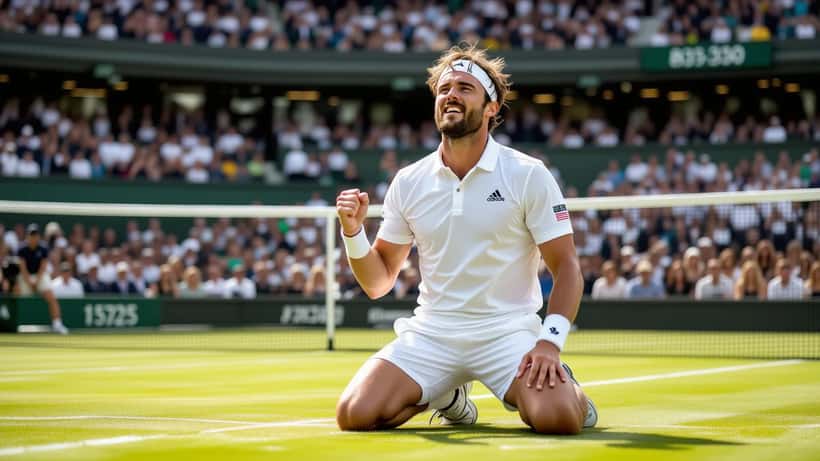
Roman Safiullin collapsed to his knees on Court 2 at Wimbledon on Friday, tears streaming down his face — not in defeat, but in triumph. The Russian qualifier, ranked 132nd in the world, had just dismantled 24th seed Joao Fonseca 6-3, 6-3, 6-3, booking his place in the Wimbledon 2026 last 16. Six months earlier, he had not known whether he would ever play professionally again.
From Injury Doubt to the Wimbledon Last 16
Safiullin cut short his 2025 season after the US Open due to injury, spending months in rehabilitation with an uncertain prognosis. He arrived at Wimbledon 2026 without a single tour-level win this year, battling through qualifying before defeating 12th seed Andrey Rublev in a gruelling five-set epic — 6-4, 6-7, 3-6, 6-3, 7-6 (12) — and then dispatching Fonseca without dropping a set. He faces Novak Djokovic in the fourth round on 5 July 2026.
"Even half a year ago, I didn't know whether I would be able to come back," Safiullin said in his on-court interview, visibly emotional. His words have resonated far beyond the tennis world — because the question he raised is one that every recreational athlete, gym regular, or weekend runner will recognise: how do you know when you are genuinely ready to return from injury?
The Scale of Sports Injuries in the UK
Sports injuries are far more common than many people appreciate. According to the NHS, musculoskeletal conditions — including ligament sprains, tendon injuries, and muscle strains — are among the most frequent reasons adults in England seek healthcare. These injuries affect people across all ages and activity levels, from elite professionals to those who exercise recreationally twice a week.
The consequences of a poorly managed sports injury extend well beyond the immediate setback. Returning to physical activity too soon is one of the leading preventable causes of re-injury, and it frequently extends overall recovery time considerably. What might have been a four-week rehabilitation can become a four-month process if the initial return is misjudged.
5 Signs Your Sports Injury Needs Professional Assessment
Safiullin's recovery was managed by specialist professionals. Many amateur athletes, however, attempt to return to sport after self-treating injuries that turn out to be more serious than they appeared. Here are five signs that professional medical advice is essential before resuming physical activity:
1. Pain that persists beyond 72 hours. Normal post-exercise muscle soreness typically resolves within two to three days. Pain that remains sharp, localised, or worsens after this window — particularly at rest — is a warning sign of potential structural damage requiring clinical assessment.
2. Swelling that recurs after activity. If a joint or soft tissue continues to swell following exercise, even after initial rest and ice, this indicates an ongoing inflammatory response that conservative home management cannot resolve. A clinical examination is needed to rule out internal damage such as cartilage injury or ligament rupture.
3. Loss of range of motion. Reduced joint mobility — particularly if you are unconsciously avoiding certain positions or movements — signals that the body is still protecting an unresolved injury. Attempting to exercise through restricted range increases the risk of harm to surrounding structures and accelerates the development of compensatory habits.
4. Altered movement patterns. Athletes frequently develop unconscious compensations to protect a painful area, changing how they run, jump, or strike to offload the affected region. These compensations generate biomechanical imbalances elsewhere in the body and are a major driver of secondary injuries. A physiotherapist or sports medicine specialist can identify these patterns early, before they create further problems.
5. Psychological reluctance to load the injury. This is perhaps the most overlooked signal of all. If anxiety, hesitation, or preoccupation with re-injury is present when you attempt to return to sport, it represents both a psychological and a biomechanical risk. Research in sports medicine consistently demonstrates that athletes who return before their confidence is fully restored sustain re-injury at a measurably higher rate than those who address the psychological dimension of recovery alongside the physical.
What a Sports Medicine Consultation Involves
A specialist sports medicine consultation is substantially different from a standard GP appointment. Specialists are trained to assess injury mechanisms in detail, conduct biomechanical analysis, order appropriate imaging such as ultrasound or MRI where indicated, and design structured return-to-sport protocols that are specific to both the injury type and the physical demands of the patient's chosen activity.
For a tennis player, this might involve analysis of serving mechanics to reduce rotator cuff load, or a detailed assessment of lateral movement patterns to protect ankle and knee ligaments. For a runner, gait analysis and progressive loading plans are standard components of return-to-sport programmes. For a recreational cyclist or swimmer, the approach differs again. The common principle is objective evidence guiding a monitored, incremental return.
Access to sports medicine expertise in the UK has expanded significantly in recent years. NHS specialist services exist in many areas, and private sports medicine practitioners offer faster access for those who need to return to activity on a specific timeline.
The Psychological Dimension of Sporting Recovery
Safiullin's tears on Court 2 were not simply relief — they were months of fear, uncertainty, and self-doubt being released in a single moment. Sports psychologists who work with injured athletes consistently report that the emotional and psychological consequences of a serious injury are the most underestimated and undertreated aspects of recovery.
Fear of re-injury alters movement patterns, reduces athletic confidence, and objectively increases the risk of further harm. Athletes who address only the physical aspects of rehabilitation — and neglect the psychological — frequently find themselves either returning too cautiously or overcompensating in ways that create new vulnerabilities. Safiullin's own description of his months of doubt illustrates exactly this challenge: the physical readiness and the mental readiness to compete again are not always the same milestone.
A qualified health professional experienced in sports rehabilitation can help establish when both conditions are met. That combination — physical clearance and psychological readiness — is what sustainable return to sport looks like.
Getting the Right Support
Roman Safiullin's Wimbledon 2026 story is one of patience, professional support, and an honest reckoning with the body's limits. Whether you are a professional athlete or someone who exercises for enjoyment, a sports injury that shows any of the five signs above should not be self-managed. Seeking expert guidance is not a sign of weakness — it is the most effective way to ensure your return to activity is safe, lasting, and free from avoidable setbacks.
This article is for informational purposes only and does not constitute medical advice. If you are experiencing a sports injury, consult a qualified healthcare professional before resuming physical activity.
ExpertZoom connects you with qualified health professionals across the UK who can assess your injury, design a structured recovery plan, and support your return to the sport you love.
