 Imogen Bennett
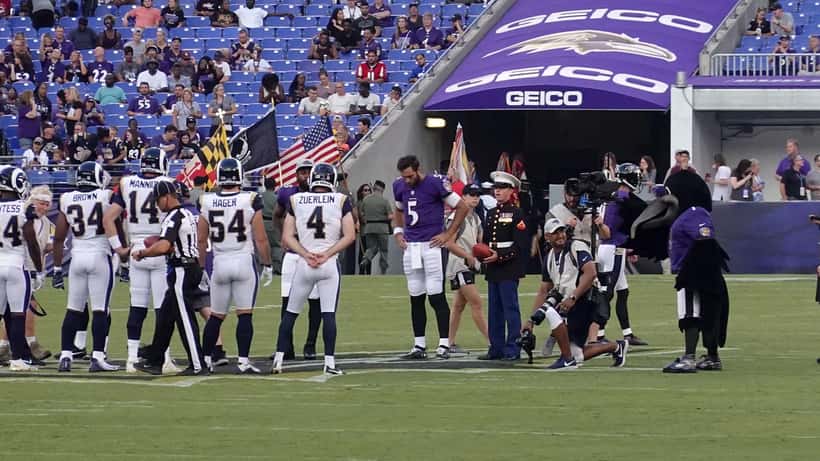
On 10 September 2026, the Los Angeles Rams and San Francisco 49ers made history at the Melbourne Cricket Ground — the first NFL regular-season game ever played on Australian soil. Tens of thousands of fans filled the MCG, and millions more watched on Netflix as Matthew Stafford and the 49ers' defence traded blows in an NFC West rivalry that stretches back decades. But beyond the spectacular athleticism, there is a financial architecture underpinning every single player on that field that most British workers have never encountered — and probably should.
The 2026 NFL season kicks off with a record $301.2 million salary cap, the first time in league history the figure has crossed the $300 million threshold. For UK professionals navigating a landscape of elevated mortgage costs, stretched household budgets, and inadequate statutory safety nets, the contract structures that protect these players offer a revealing mirror.
The Headline Figure: A Record $301M Salary Cap
The 2026 NFL salary cap stands at $301.2 million per team — up $22 million from $279.2 million in 2025. Across the league's 32 franchises, that totals more than $9.6 billion in annual player compensation. The average NFL salary in 2026 sits between $3.1 million and $3.9 million per year, according to salary trackers including Over The Cap and Sport DA.
But averages obscure the real story. The ten highest-paid players in the league are all quarterbacks. Derwin James Jr. of the Los Angeles Chargers, the highest-paid non-quarterback, earns $25.2 million per year. Matthew Stafford, coming off an MVP-calibre 2025 season in which he threw for 4,707 yards and 46 touchdowns, commands a deal that places him in this elite bracket — protected by guaranteed money clauses that ensure he receives a defined sum regardless of what happens to his career.
This cap growth reflects something deeper than American sporting excess. It is the product of a collective bargaining system that has, over decades, created sophisticated income guarantees for professional athletes. The question is whether ordinary UK workers can learn anything practical from that system.
How NFL Guaranteed Contracts Work
Here is what makes NFL deals fundamentally different from virtually every standard employment arrangement in Britain.
When an NFL team signs a player to a multi-year contract, a defined portion of that deal — often 50 to 80 per cent of the total value — is designated as "guaranteed money." According to contract language published by NFL Football Operations, this guaranteed sum must be paid to the player even if they are released, cut from the squad, or suffer a career-ending injury. The cash is protected.
The mechanics work like this: a signing bonus is paid upfront, then spread across the salary cap over up to five years. A $25 million signing bonus on a five-year deal counts only $5 million per year against a team's cap. The player, however, receives the full $25 million in cash — guaranteed, protected, and legally non-refundable under contract law.
This is not simply generous negotiation. It is a structured transfer of financial risk from the player to the organisation — precisely the kind of risk management that wealth advisers help UK professionals replicate through income protection insurance, critical illness cover, and structured savings vehicles.
Rams and 49ers: Contractual Certainty on the World Stage
The Melbourne matchup between the Rams and 49ers is a showcase of players who have negotiated exactly this financial certainty. Both rosters carry multiple players with guaranteed contracts worth tens of millions of dollars. The 49ers have historically been among the NFL's most aggressive signers of guaranteed deals. The Rams, under their front office philosophy, have rewarded core players with long-term security designed to attract and retain talent.
As these players trained, flew to Australia, and took the field in front of a global audience, each had a legal document guaranteeing their financial security — negotiated by specialist agents with deep knowledge of contract law, tax structures, and long-term income planning.
For a detailed look at how sports professionals protect their employment rights through contractual clauses, see this earlier analysis on how free agents structure their exit protections.
The lesson for British workers is not that they need sports agents. It is that the underlying principle — defining and protecting a minimum percentage of income against unforeseen circumstances — is entirely replicable through UK financial planning mechanisms.
The Numbers That Should Concern UK Earners
Consider the case of a 41-year-old senior project manager based in Leeds earning £78,000 per year. He has a £310,000 mortgage, three years remaining on a fixed-rate deal, and two children at secondary school. His employer provides six months of full company sick pay — above the statutory minimum, but not indefinitely.
Under current UK law, statutory sick pay (SSP) for the 2026/27 tax year stands at £123.25 per week — a rate confirmed after the April 2026 reforms made it a day-one entitlement with no earnings floor. That works out to £6,409 per year.
Now apply the if/then logic. If this project manager is diagnosed with a serious condition — a cardiac event, a neurological disorder, or an acute musculoskeletal injury — in month seven of his absence, the financial arithmetic is stark:
- Months 1–6: Full company sick pay at £78,000 per year (£39,000 received in total).
- From month 7 onwards: Statutory sick pay at £123.25 per week — approximately 8.2 per cent of his normal annual income.
- Annual income shortfall from month 7: approximately £71,591 against his expected earnings.
An NFL player in a broadly comparable scenario — a veteran wide receiver earning $3.5 million per year with $9 million guaranteed — would receive the entirety of their guaranteed sum regardless of injury status. The guaranteed money functions precisely as income protection: contractually defined, legally enforced, and not subject to an employer's discretion.
For our Leeds project manager, the absence of an equivalent guarantee is a significant financial vulnerability. A qualifying condition that keeps him out of work for 18 months could, without appropriate planning, result in mortgage arrears, the depletion of his ISA savings, and forced lifestyle changes that affect his family for years.
Income protection insurance — available through UK wealth management advisers — typically covers between 50 and 70 per cent of pre-disability income, paid monthly until a selected retirement age. For a 60 per cent payout on £78,000, that is £46,800 per year in protected income. Current market premiums for a 41-year-old with a six-month deferred period (aligned to his employer's sick pay window) run approximately £80 to £150 per month depending on occupation class and insurer. That is between £960 and £1,800 per year to protect £46,800 per year in income — a ratio that most independent financial advisers consider among the most cost-effective protection products available.
What to Do Before the Week 14 Rematch
The Rams and the 49ers meet again in Week 14. Between now and that second matchup, every player on both rosters will continue to receive income under contractual protection clauses their employers have no power to revoke.
UK professionals earning in the £50,000–£200,000 bracket sit in an awkward financial position: they earn enough to be excluded from means-tested state support, but often lack the accumulated wealth to self-insure against a prolonged income interruption. Statutory sick pay, for all the 2026 reforms that broadened eligibility, remains a floor rather than a safety net.
A wealth management consultation in 2026 should address three specific questions. First, how long does your employer's sick pay provision actually last, and what is your contractual entitlement? Second, what combination of income protection, critical illness cover, and emergency savings would replicate the "guaranteed money" principle for your own household? Third, at your current income level, what is the minimum monthly outgoing needed to protect 60 per cent of your earnings until the age you plan to stop working?
These are precisely the questions that NFL players' advisers answer — systematically, contractually, and with legally binding results — before the season even begins. The Rams vs 49ers Melbourne opener is a reminder that financial protection is not a luxury reserved for elite athletes. It is a structure available to anyone willing to plan for it.
This article is for informational purposes only and does not constitute financial advice. Consult a qualified financial adviser before making decisions about income protection or wealth management products.
format_used: Data deep-dive
