 Alistair Finch
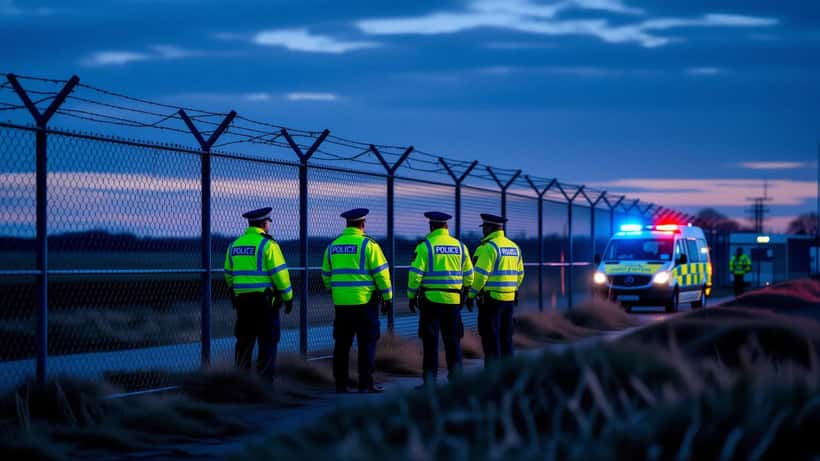
Two Latvian nationals were arrested inside an RAF base in Cambridgeshire this week on suspicion of trespass offences, with counter-terrorism police called in to assist the investigation. The men, found inside the perimeter of the installation, now face a legal situation that surprises many people: trespassing on a protected military site in the UK is not a civil matter — it is a criminal offence that can lead to prosecution, a custodial sentence, and, for foreign nationals, immigration consequences that far outlast any fine.
The Cambridgeshire Arrest: What We Know
The arrests at the Cambridgeshire RAF base bring renewed attention to a security issue that UK parliament was already scrutinising. According to a written ministerial answer published in late 2025, RAF airbases across the country had recorded 22 instances of trespass or intrusion involving evidence of unauthorised forced entry — a figure that prompted urgent questions about perimeter security at installations that house sensitive NATO assets.
RAF Molesworth in Huntingdonshire is among the UK's most strategically significant military installations: it serves as home to the US Joint Intelligence Operations Centre Europe (JIOC-E). When intruders are found inside such a facility, counter-terrorism police are routinely notified as a matter of protocol, even before any terrorism-related charges are formally established. The initial response does not presuppose a terrorism motive — it reflects the standing procedure for protected sites classified under UK national security law.
The involvement of Latvian nationals adds a distinct legal dimension. Both Latvia and the UK are NATO partners, but foreign nationality activates a separate set of legal rights that many detainees — and indeed some custody officers — fail to invoke correctly.
Why Military Trespass Is Different From Walking Across a Field
Most people in England and Wales understand trespass in its civil law sense: you cross someone's land without permission, the landowner can ask you to leave, and if you refuse, they can pursue a civil claim. The sign reading "Trespassers Will Be Prosecuted" is a famous legal myth — ordinary civil trespass cannot be prosecuted, because it is not a crime.
Military land is governed by an entirely different framework. Under the Serious Organised Crime and Police Act 2005, Section 128, the Secretary of State can designate specific sites as protected. Trespassing on a designated site is a criminal offence carrying a sentence of up to 51 weeks' imprisonment and an unlimited fine. A number of Cambridgeshire and East Anglian bases — including RAF Molesworth and RAF Lakenheath — feature on the list of designated sites under orders made pursuant to that Act.
The Ministry of Defence also issues byelaws under the Military Lands Act 1892 that prohibit entry to military land without authorisation. Breaching those byelaws carries a separate penalty of up to a level 2 fine (currently £500). Police can choose to charge under either framework depending on the evidence — or under both simultaneously if the facts support it.
The Counter-Terrorism Clock: A Critical Legal Distinction
The involvement of counter-terrorism police creates significant procedural differences that any detainee and their solicitor must understand immediately.
Under standard Police and Criminal Evidence Act 1984 (PACE) procedures, police may hold a suspect for up to 24 hours without charge. A senior officer can extend this to 36 hours, and a magistrate can authorise detention of up to 96 hours. After that, the suspect must be charged or released.
Under the Terrorism Act 2000, a suspect arrested on suspicion of terrorism offences can be held for an initial 48 hours, extendable to 14 days with judicial authorisation. This extended detention period is rarely applied in full, but even the initial 48-hour window gives investigators significantly more time than a standard PACE arrest.
In the Cambridgeshire case, the two men were arrested on suspicion of trespass offences rather than terrorism offences at the point of arrest. That distinction matters enormously: it determines which detention clock is running, what disclosure rights the defence has, how quickly a duty solicitor must be provided, and — critically for Latvian nationals — when consular authorities must be notified.
Foreign Nationals and the Rights That Are Frequently Overlooked
For any non-UK citizen detained in England and Wales, Article 36 of the Vienna Convention on Consular Relations applies. Police are legally obligated to inform the detainee of their right to have their consulate notified of the arrest, and must actually carry out that notification if the detainee requests it.
In practice, this right is frequently not communicated clearly at the point of arrest — particularly during large-scale operations at military sites where custody procedures can be compressed or rushed. A criminal defence solicitor retained at the earliest opportunity should verify:
- That consular notification has been given, or that any waiver was clearly understood and recorded
- That the right to a free interpreter has been exercised for all caution-stage questioning
- That no substantive statement has been made before independent legal advice was received
Latvia's embassy in London can provide consular assistance and emergency travel documents if needed, but it cannot provide legal representation. The legal outcome depends entirely on the competence of the criminal defence solicitor retained, and on what — if anything — the detainee said before that solicitor arrived.
Concrete Scenario: The £200 Fine vs. the 12-Month Sentence
The following composite scenario illustrates how the same set of facts can lead to radically different legal outcomes depending on the decisions made in the first hour after arrest.
Aleksei, a 34-year-old Latvian national working as a building contractor in Peterborough, is driving near RAF Molesworth late at night when his vehicle navigation fails. He turns onto what appears to be an access track. He gets out of his vehicle to check his location and is detained by Ministry of Defence Police approximately 80 metres inside the outer perimeter zone. No fence has been cut; he entered via an unlocked service gate.
Scenario A — Aleksei says nothing and immediately requests a duty solicitor:
- The 24-hour PACE clock begins
- A duty solicitor arrives within 2 hours
- The solicitor reviews the custody record, CCTV footage from the gate, and entry logs. The gate was unsecured; there is no evidence of recording equipment, and no sensitive building was approached
- The Crown Prosecution Service is advised to charge under MOD byelaws rather than SOCPA 2005
- Aleksei enters an early guilty plea: byelaw breach, fine of £200–£300, no custodial sentence
- Immigration consequence: a byelaw fine does not trigger any automatic flag under UK immigration law
- Solicitor cost: £0 (duty solicitor via legal aid)
Scenario B — Aleksei makes an unsolicited statement before legal advice:
- He explains that he was curious about the airfield after reading about it online
- That account is now on record and can be tested against base access logs and his phone's browsing history
- If CCTV shows he walked towards a satellite communications facility, prosecutors can argue he had intent to inspect a sensitive installation
- Charge escalates to SOCPA 2005 s.128 (trespass on a designated site): maximum 51 weeks' custody
- A sentence of 12 months or more triggers automatic deportation under the UK Borders Act 2007 s.32
- Even a non-custodial conviction under s.128 is a relevant criminal conviction for future UK visa applications and any security clearance he currently holds
- Contested trial legal fees: £8,000–£15,000
The difference between a £250 fine and a 12-month sentence leading to deportation can hinge entirely on the first 30 minutes after arrest.
What to Do If You Are Arrested Near a Military Installation
Whether the arrest involves an accidental incursion or a deliberate protest action, the legal steps are the same:
Say nothing. The police caution explicitly warns that anything said may be used as evidence. There is no legal penalty for exercising silence before a solicitor is present, and considerable risk in not doing so.
Request a duty solicitor immediately. At a military base arrest, ask specifically for a solicitor with experience in counter-terrorism or national security matters. This is available free of charge under the legal aid scheme regardless of income.
Request consular notification. Non-UK nationals should explicitly invoke Article 36 of the Vienna Convention by name and ask that their embassy be contacted before questioning begins.
Do not consent to device searches. Police can apply to a court for a production order to examine phones and laptops. Voluntary consent removes that safeguard and provides immediate access to data that may be used to construct a more serious charge.
This article is for general informational purposes only and does not constitute legal advice. If you are facing criminal charges or have been arrested, you should seek advice from a qualified solicitor immediately.
The legal landscape around military base security in the UK has tightened considerably since 2025 amid heightened NATO tensions. You can also read how UK courts have handled military incidents and civil liability questions for further context on how UK law balances national security with individual rights.
For specialist criminal defence or immigration law advice following an arrest in the UK, Expert Zoom connects you directly with qualified solicitors who handle exactly these situations — without waiting lists and without upfront fees for an initial consultation.
