 Daniel Davies
Queens Park Rangers kicked off the visible part of their 2026-27 pre-season on Thursday 16 July 2026, facing fourth-tier Austrian side SC Wiener Neustadt at the 4,000-capacity Wiener Neustadt Arena, kick-off 16:30 BST. The friendly is one of two fixtures on an eight-night Austrian training camp, and — like most low-key summer warm-ups — it is not on mainstream UK television. For the thousands of Rangers supporters who will not travel to Lower Austria, that means following the game on a laptop, tablet or club audio feed, very often from the garden on a warm July evening.
That simple summer habit — dragging a screen and a few cables outside to watch the football — is where a home-improvement question quietly starts. Every year, garden viewing set-ups multiply through the pre-season and tournament months, and every year avoidable electrical faults follow. If you are planning to watch QPR's Austrian friendlies, or any summer football, outdoors, a few decisions made now are worth more than any transfer rumour.
What is actually happening in Austria
QPR travelled to Austria for an eight-night camp built around two matches: First Vienna FC earlier in the trip, and SC Wiener Neustadt on 16 July. Wiener Neustadt SC play in the Landesliga, the fourth tier of Austrian football, and host their games at the Wiener Neustadt Arena. These are conditioning fixtures rather than showpieces, which is exactly why UK broadcasters rarely carry them and why fans improvise their own viewing.
The manager's priority is minutes and fitness ahead of the Championship season, with the squad due back for fixtures against League One opposition at the end of the month. For supporters, the priority is simpler: how to watch comfortably, and safely, at home.
Why the garden set-up is a real risk
The problem is not the television. It is everything running to it. Indoor extension leads trailed through a back door, non-weatherproof sockets, and daisy-chained adaptors are the three most common shortcuts, and all three are hazardous outdoors. Moisture, foot traffic and summer thunderstorms turn a tidy living-room lead into a genuine shock and fire risk once it crosses the threshold.
UK rules treat outdoor electrical work seriously for this reason. Fixed electrical installations in gardens — a new external socket, garden lighting or a supply to an outbuilding — fall under Part P of the Building Regulations, which covers electrical safety in dwellings and their surrounding land. The government's official guidance, Approved Document P: electrical safety, sets out which jobs are notifiable and why certain work should be certified. Installing a permanent outdoor socket is not a casual DIY afternoon; in most cases it should be carried out or signed off by a registered electrician.
The expert take: what a home-improvement professional would check
Ask a qualified electrician or home-improvement specialist to look at a garden viewing area and the same points come up every time.
First, RCD protection. Any socket that could power equipment outdoors should be protected by a residual current device, which cuts the supply within milliseconds if it detects a fault to earth. A plug-in RCD adaptor is the bare minimum for a temporary set-up; a properly installed outdoor socket with built-in RCD protection is the durable answer.
Second, ingress protection. Weatherproof outdoor sockets carry an IP rating — commonly IP66 for exposed positions — describing how well the enclosure resists dust and water. An indoor socket has no meaningful rating for a July downpour.
Third, cable management. Cables should be rated for outdoor use, kept off wet ground, and never run under rugs or across paths where they can be damaged. For anything semi-permanent, armoured cable buried to the correct depth is the professional standard, not a household lead poked through a window.
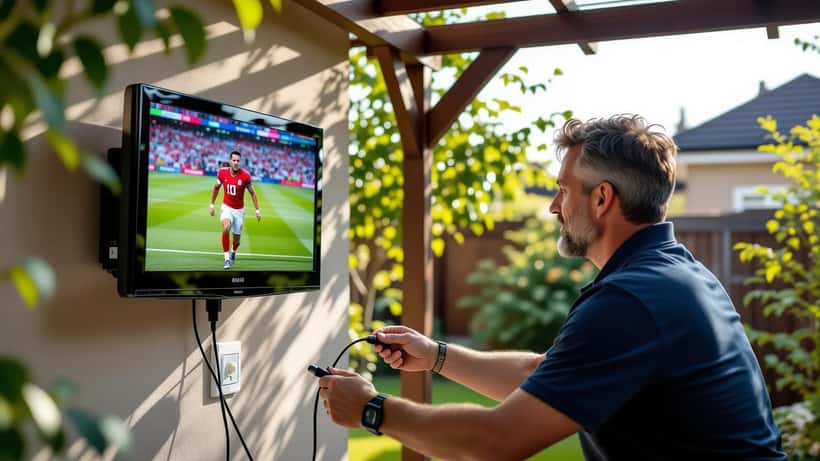
Fourth, the screen itself. Standard indoor televisions are not built for damp, direct sun or overnight dew. Options that a specialist will steer you toward include a purpose-built outdoor television with a sealed, higher-brightness panel, a portable projector brought out only for the match and stored inside, or a covered, ventilated cabinet for a screen mounted under a pergola or canopy.
What to do before the next friendly
You do not need a rewired garden to watch QPR beat, draw with or lose to a Landesliga side. But a few practical steps make the difference between a relaxed evening and a call-out.
For a one-off, keep it temporary and sensible: use an outdoor-rated extension lead with an integral RCD, position the socket end under cover, keep all connections off the grass, and bring everything indoors afterwards. Never join multiple leads together to reach the bottom of the garden.
For a permanent set-up — because you know you will do this every summer — plan the work properly now, before the season's fixtures pile up. Book a registered electrician to install a weatherproof, RCD-protected external socket in the right position, and consider whether garden lighting or a covered viewing corner should be part of the same job. Bundling the work is cheaper than three separate call-outs, and it means the installation is certified rather than improvised.
A registered electrician or a home-improvement contractor can assess your space, advise on IP ratings and cable routes, and complete notifiable work to the required standard. If you are unsure whether a job needs certifying, that judgement alone is worth a professional conversation before anything is switched on.
Pre-season is quiet, results barely matter, and the stakes on the pitch in Wiener Neustadt are low. The stakes in a wet garden with the wrong extension lead are not. Sort the set-up while the football is still just a warm-up, and every match after it — friendly, Championship or cup — is one you can enjoy without a second thought.
