 Amelia Ward
Paris FC host Arsenal at Stade Jean-Bouin tonight, 30 September 2026, in UEFA Women's Champions League matchday 2. Arsenal arrive bruised from a 1-0 WSL defeat to Chelsea; Paris FC are still recovering from a 5-2 opening-day thrashing by Barcelona. But behind the scorelines lies a medical story women's football is only beginning to confront — and one that matters far beyond the professional game.
Women's Football Faces a Serious ACL Crisis
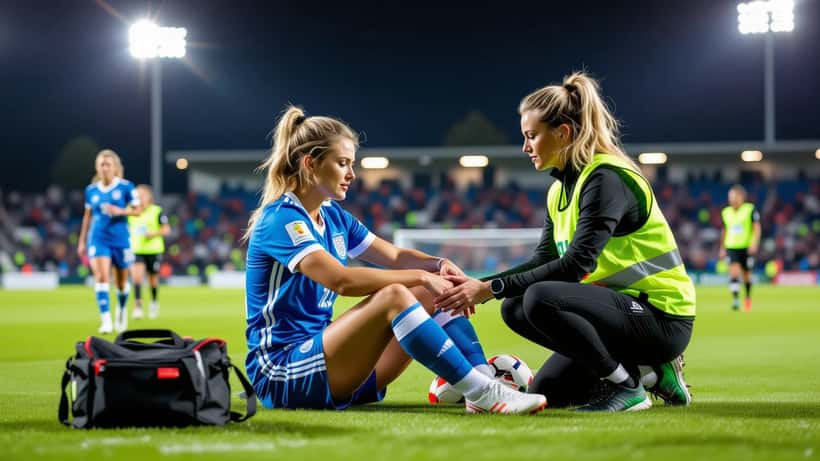
The anterior cruciate ligament (ACL) is the knee's primary stabilising structure, and it is tearing at an alarming rate in women's football. According to the NHS and clinical research reviewed by orthopaedic specialists across the UK, female athletes suffer ACL ruptures at two to eight times the rate of male athletes playing equivalent sports.
The anatomy is central to the explanation. Women typically have a wider pelvis relative to knee alignment — a higher "Q-angle" — which increases the inward force on the knee when landing from a jump or cutting sharply during play. Female athletes also tend to land with less knee flexion, placing greater strain on the ACL rather than distributing load across the surrounding musculature.
Hormonal factors compound the risk in ways the sports medicine community is only now standardising into clinical practice. Research published in the British Journal of Sports Medicine shows that ACL laxity — the degree of stretch in the ligament — increases during the follicular phase of the menstrual cycle, when oestrogen levels are elevated. This means injury risk is not constant throughout the month. Elite clubs like Arsenal now factor menstrual cycle tracking into training load management and warm-up protocols. Most recreational players have no such support.
Paris FC manager Sandrine Roux noted before tonight's match that her squad requires careful load management following last week's exhausting defeat in Barcelona. That comment carries clinical weight: fatigue significantly increases non-contact ACL injury risk because tired muscles provide far less protective support to the knee joint — and tired athletes are more likely to land with the exact mechanics (stiff knee, inward knee collapse) that place the ACL at maximum stress.
The Grassroots Gap Nobody Is Talking About
Since the Lionesses' iconic 2022 European Championship win, grassroots women's football participation in England has grown by over 40%, according to The Football Association. More players means more injuries — but the medical infrastructure that protects elite players has not scaled with participation at recreational level.
Most recreational women footballers in the UK have no access to sports medicine specialists through their clubs. When they sustain a knee injury, they default to the standard GP referral pathway. A standard NHS referral for musculoskeletal assessment currently carries a median waiting time of 10 to 14 weeks in England. Add further time for MRI imaging if required, and a formal diagnosis may not arrive until four to six months after the injury occurred.
During that delay, a partial ACL tear that could have been managed conservatively with early, structured physiotherapy can — through ordinary daily activity with no specialist guidance — progress into a complete rupture requiring surgical reconstruction. The injury that should have cost six months of rehabilitation becomes an 18-month surgical recovery. That is not a hypothetical: it is a trajectory that sports medicine specialists report seeing repeatedly in patients who came through delayed referral pathways.
Watching elite women play a Champions League knockout tie under intense pressure from every direction is inspiring — but it should also prompt recreational players to think critically about how they manage their own bodies.
Concrete Case: The Timeline That Changes Everything
Consider Emma, a 26-year-old recreational footballer in Manchester who plays weekend 11-a-side football. In a match on 21 September 2026, she planted her right foot to pass and felt an immediate pop in her knee. The joint swelled overnight. She booked a GP appointment, received standard RICE (Rest, Ice, Compression, Elevation) advice, and was placed on the referral queue.
Under the NHS pathway at current waiting times, Emma's assessment journey looks like this:
- Physiotherapy initial assessment: approximately week 12 — mid-December 2026
- MRI scan (if the physiotherapist requests one): weeks 16 to 20 after injury
- Orthopaedic or sports medicine review of scan results: weeks 22 to 28
Best case, Emma receives a formal diagnosis by February or March 2027 — five to six months after the original injury.
Under a private specialist pathway accessed through a platform like Expert Zoom:
- Sports medicine consultation: within 3 to 5 working days
- MRI scan ordered at that consultation: completed within 1 to 2 weeks
- Confirmed diagnosis and treatment plan: within 3 weeks of injury
The financial outlay is real: a private orthopaedic consultation runs between £150 and £350; MRI imaging costs £350 to £700 depending on provider and region. But consider the alternative maths. If Emma has a partial ACL tear that is managed conservatively with early-start physiotherapy, those consultation and imaging costs represent the full extent of her financial exposure — and she begins rehabilitation in October 2026 rather than March 2027.
If she waits six months and sustains a complete rupture through under-managed activity, she faces either an 18 to 24-month NHS surgical waiting list or a private ACL reconstruction costing between £7,000 and £12,000. The if/then is blunt: early specialist diagnosis in October gives Emma a structured 6-to-9-month return-to-play programme. Six months of unmanaged partial injury gives her a likely surgical pathway.
Warning Signs That Warrant Expert Evaluation
Not every knee twinge needs a specialist. But these signals do, and women who play contact or cutting sports should know them.
Seek sports medicine review within 48 hours if you experience:
- An audible or felt pop in the knee during sport
- Rapid swelling within two to four hours of a knee incident
- Inability to fully bear weight on the affected leg immediately or by the next morning
- Marked instability — a sense that the knee could give way at any moment
Book a consultation within seven days if you notice:
- Knee swelling that appeared gradually after sport, without a single clear incident
- Pain that worsens when descending stairs, squatting, or rising from sitting
- A sensation that the knee is catching, locking, or failing to extend fully
- Recurring pain in the same location after multiple sessions without injury
Women over 35 are particularly prone to dismissing these symptoms as ordinary age-related wear. In many cases, the underlying cause is diagnosable and treatable — but only if a specialist examines it before compensatory movement patterns allow a secondary injury to develop.
Prevention is also worth raising here. Neuromuscular warm-up programmes — exercises specifically designed to improve landing mechanics, strengthen the glutes and hamstrings, and train dynamic knee alignment — have been shown in clinical trials to reduce ACL injury incidence in female footballers by up to 50%. These programmes take approximately 15 minutes per session and require no specialist equipment. A sports physiotherapist can teach the correct technique in one or two sessions, providing long-term protection for anyone who plays regularly.
This article is for general information only and does not constitute medical advice. If you suspect a knee injury, consult a qualified healthcare professional for diagnosis and treatment.
Beyond Tonight's Result
Arsenal's women are searching for form heading into France. Paris FC, who famously knocked Arsenal out of this same competition in 2023 on penalties after a 3-3 draw, carry both motivation and home advantage tonight at Stade Jean-Bouin. Kick-off is at 5:45pm UK time.
The tactical contest will be compelling. Arsenal have the squad depth to rotate after the Chelsea defeat; Paris FC showed genuine attacking threat even in their 5-2 loss to Barcelona and will be determined to record their first UWCL points of the 2026-27 campaign.
But the real story of women's football in 2026 is the extraordinary scale of participation growth — and the healthcare gap that has grown alongside it. Millions of women are now playing football across the UK without access to the injury prevention and specialist management infrastructure that protects the players they watch on television.
If tonight's match prompts even one viewer who has been putting off a knee concern to book a consultation, that is a meaningful outcome. Find a sports medicine specialist near you on Expert Zoom and book within days, not months.
